The Ground Reality of Credit Card Settlement.
Credit Card Debt Settlement & 50%–80% Bank Waiver Guide
Defaulting on a credit card is not a criminal offense. In India, credit card debt can realistically be waived off by 50% to 80% based on the banks. But it deteriorates your CIBIL score. Here is the ground truth on Top 10 bank waivers, court summons facts, arbitration proceedings, and recovery agent harassment tactics.
Credit card settlement can waive off 50% to 80% of your total balance based on the bank. It severely deteriorates your CIBIL score for 5 to 7 years (marked as “Settled”). The bank can file a case against you and the court can release summons, but if you do not sign or accept the summon, you are fine. Arbitration is a normal proceeding where bank and consumer negotiate and agree on settlement terms through an arbitrator.
Credit Card 50% to 80% Settlement Truth
When you default on credit cards from banks like HDFC Bank, SBI Card, ICICI Bank, or Axis Bank, over 50% to 70% of your ballooned total balance is composed of compound finance charges (36% to 48% APR), penal late fees, and GST.
Credit cards are 100% unsecured. Unlike a home or auto loan, the bank holds zero collateral. They cannot confiscate property, freeze bank accounts without long court orders, or arrest you.
Once an account is classified as a Non-Performing Asset (180+ DPD), RBI provisioning rules force banks to write off the bad asset. Recovering 20% to 50% of the gross balance in cold cash is a massive financial win for the bank compared to 100% write-off.
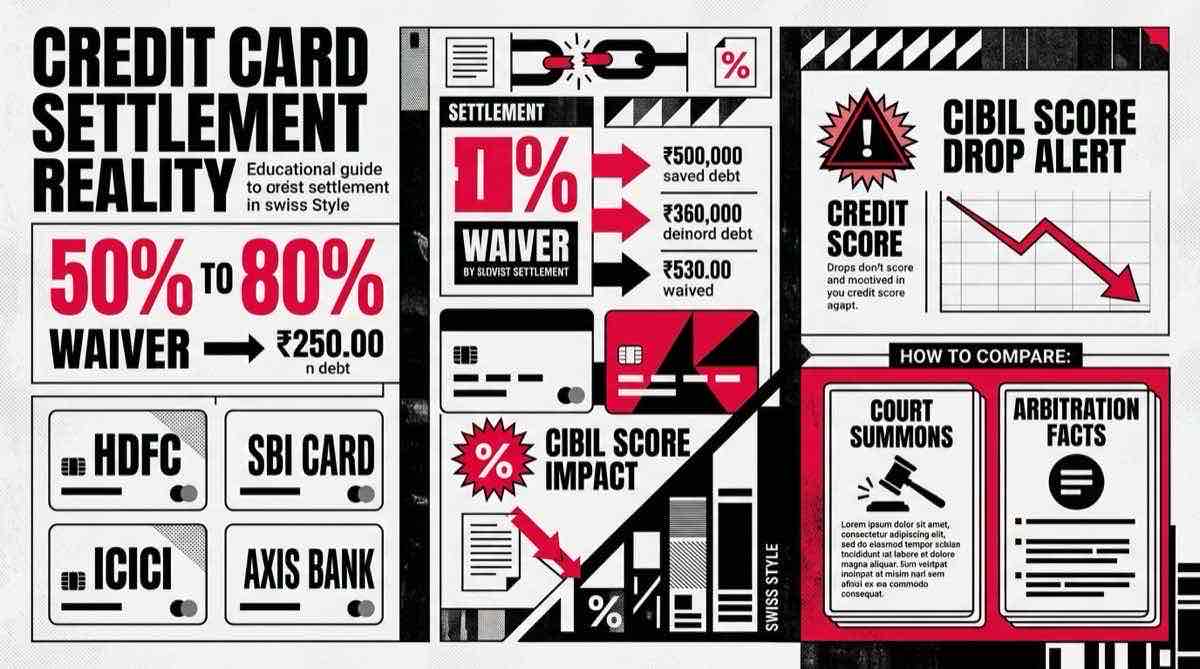
Visual 1.0: Credit card debt settlement dynamics in India, compound interest waivers, CIBIL score drop alert, and arbitration negotiation facts.
The Credit Card Minimum Due Trap vs OTS Settlement
Here is the mathematical proof of why credit card companies encourage Minimum Amount Due (MAD) payments and how a Hardship OTS settlement saves over ₹2 Lakhs on a ₹3 Lakh balance:
Paying Minimum Due (5% MAD)
Monthly Outflow: ~₹15,000 / month (reducing slowly)
Time to Clear ₹3 Lakhs: 22 Years
Total Out-of-Pocket Paid: ₹9,40,000+ (300%+ in 42% APR interest & GST)
CIBIL Result: Score stays 750+, but your wallet is permanently bled dry.
Converting to 3-Year Bank EMI
Monthly Outflow: ~₹14,500 / month fixed
Time to Clear: 36 Months (3 Years)
Total Out-of-Pocket Paid: ₹5,22,000 (Principal + 18% APR EMI interest)
CIBIL Result: Normal closure; requires continuous high income stability.
Hardship OTS (70% Waiver)
Payment Structure: Single lump-sum payment after 180 DPD
Time to Clear: 6 Months total timeline
Total Out-of-Pocket Paid: ₹90,000 Total (Saves ₹2,10,000 in cash)
CIBIL Result: Drops 150 points ('Settled' status), rebuilt over 24 months with an FD card.
Credit Card Settlement Calculator
Select your outstanding card balance and credit card company to estimate your realistic settlement amount and total fee waiver:
Credit Card Settlement Calculator
Calculate your realistic One-Time Settlement (OTS) payable amount based on your credit card issuer and overdue timeline.
Credit Card Default Impact on CIBIL Score
Settling a credit card is a financial compromise that permanently impacts your credit history. Understand the exact trade-offs:
Your credit bureau profile (CIBIL, Experian, CRIF High Mark) will report “SETTLED” or “POST WRITE-OFF SETTLED” instead of “CLOSED”. This alerts all financial institutions that you caused a loss to the bank.
- Your CIBIL score immediately drops by 100 to 200 points.
- Automated credit card underwriting algorithms will instantly reject unsecured card applications for 5 to 7 years.
- The settled issuer (e.g. HDFC or SBI Card) puts you on an internal negative blacklist for future credit cards.
Add-on credit cards given to family members will be permanently canceled. However, because add-on users are not primary debtors, the “Settled” mark only attaches to the primary cardholder's PAN card unless the card was a joint corporate/co-applicant card.
Top 10 Credit Card Issuers Waiver Benchmark
Below is empirical settlement recovery data across the Top 10 Indian Credit Card Issuers in order of popularity:
HDFC Bank Credit Cards
Top Private Issuer (Millennia, Regalia, Infinia)Ground Reality: Minimum 50% waiver is standard once revolving dues hit 180+ DPD (NPA stage). In central recovery pools and Lok Adalat drives, waivers routinely hit 75%–80% for uncollateralized card debt.
SBI Card (State Bank of India)
Top Pure-Play Card Issuer (SimplyCLICK, Elite)Ground Reality: Operates dedicated OTS campaigns and Lok Adalat settlement drives. SBI Card legal team agrees to significant principal + finance charge discounts once written hardship is on record.
ICICI Bank Credit Cards
Top Private Issuer (Amazon Pay, Coral, Rubyx)Ground Reality: High average waiver on unsecured revolving balances. Massive discounts on accumulated 42%+ APR finance charges and late payment penalties when handled via central debt management.
Axis Bank Credit Cards
Top Private Issuer (Neo, Flipkart, Magnus)Ground Reality: Minimum 50% waiver baseline for unserviceable card accounts. Quickest closure at 65%–75% discount when escalated to the Nodal Grievance Officer and Zonal Recovery Managers.
Kotak Mahindra Bank Credit Cards
Private Bank (League, White, 811)Ground Reality: Aggressive initial call frequency, but offers steep settlement reductions (upwards of 60%) once formal legal replies citing financial insolvency are emailed to their dispute desk.
RBL Bank Credit Cards
Co-Branded Specialist (Bajaj Finserv, Shoprite, Edition)Ground Reality: Large co-branded card portfolio with high default volumes. Extremely flexible during quarter-end and financial year-end (March / September) settlement quota drives.
IndusInd Bank Credit Cards
Private Bank (Legend, Platinum, Nexxt)Ground Reality: Delinquent revolving card accounts past 180 DPD see massive penal fee reversals and deep principal compromise settlements through regional settlement clusters.
IDFC FIRST Bank Credit Cards
Private Bank (Millennia, Classic, Wealth)Ground Reality: Follows strict digital communication. Highly receptive to virtual Lok Adalat settlements and structured single-payment OTS agreements upon verified job loss / medical emergency proof.
Standard Chartered Bank
MNC Foreign Bank (Smart, Ultimate, Platinum)Ground Reality: Unsecured credit card dues are swiftly transferred to external empaneled recovery firms. Direct negotiation with their internal central remediation team yields 50%+ waivers.
Bank of Baroda (BOB Card / OneCard)
PSU & Co-branded (Eterna, Premier, OneCard / SBM)Ground Reality: Offers transparent OTS guidelines through annual compromise settlement schemes and Lok Adalat conciliation hearings with full No Dues Certificate generation.
Real Case Study: HDFC 75% Waiver Breakdown
Here is an anonymized real-world case timeline of a tech professional in Bengaluru who settled a ₹4.8 Lakh HDFC Regalia card balance for ₹1.2 Lakh (75% waiver):
Borrower lost job. Card balance of ₹2.8L escalated to ₹3.4L due to 42% APR finance charges and late fees. Automated dialers made 40+ calls daily. Borrower emailed the bank hardship letter demanding written communications.
Card was permanently blocked. Two recovery agents visited his residence unannounced. Borrower refused indoor entry, met them outside, showed the email acknowledgment from the Nodal Officer, and recorded the interaction. Agents backed off.
Account entered the write-off pool with total gross dues of ₹4,82,000. Borrower received a National Lok Adalat conciliation notice. Attended the virtual conciliation bench, presented layoff letter and zero bank balance statements. Bank agreed to a ₹1,20,000 lump-sum OTS (75% total waiver).
Defaulting on an HDFC Millennia, Regalia, or MoneyBack card? Read our comprehensive HDFC Credit Card Settlement & 42% APR Defense Guide → for exact waiver formulas, Banker's Lien protection, and verified PNO escalation contacts.
Defaulting on an SBI SimplyCLICK, Prime, or Elite card? Read our comprehensive SBI Credit Card Settlement & OTS Guide → to separate SBI Cards from SBI Bank, eliminate 45% APR interest, and stop recovery calls.
Defaulting on an Amazon Pay ICICI, Coral, or Rubyx card? Read our comprehensive ICICI Credit Card Settlement & 45% APR Defense Guide → for 100% penal interest waivers, Amazon account protection, and SAMB escalation contacts.
Defaulting on a Flipkart Axis, Ace, Neo, or migrated Citi card? Read our comprehensive Axis Credit Card Settlement & 52% APR Defense Guide → for 100% penal interest waivers, Section 171 salary account protection, and PNO escalation contacts.
Defaulting on a Kotak League, Royale, White, or 811 #DreamDifferent credit card? Read our comprehensive Kotak Credit Card Settlement & 44.4% APR Defense Guide → for 100% late fee waivers, 811 savings account lien unfreezing, and Phoenix ARC assignment rules.
Holding a Bajaj Finserv Insta EMI Card or co-branded RBL SuperCard? Read our comprehensive Bajaj Finance Loan & Card Settlement Guide → to separate Bajaj NBFC dues from RBL Bank credit lines, cancel NACH bounce loops, and avoid unilateral arbitration traps.
Genuine Credit Card Settlement Letter Verification
The single biggest trap in credit card settlements is paying money based on verbal agent promises or WhatsApp messages. If you pay without an official settlement letter from the bank, your money is credited as a normal overdue payment and you still owe the balance!
- ✓1. Unique Internal Reference Number: Must carry a traceable bank settlement reference code (e.g.
CC/OTS/2026/HDFC-88210). - ✓2. Full & Final Waiver Breakdown: Explicitly states that upon payment of ₹X by [Date], the total outstanding of ₹Y is treated as fully settled with zero residual liability.
- ✓3. Direct Card Account Payment Mode: Payment must be routed strictly to your 16-digit credit card number or bank credit card collection escrow via NEFT/RTGS.
- ✓4. Official Bank Email Domain & Letterhead: Delivered as an authorized PDF from an official domain (e.g.
@hdfcbank.com,@sbicard.com,@icicibank.com).
- ✗Verbal or WhatsApp text promise: “Pay ₹30,000 right now on Google Pay and your ₹3,00,000 card bill is cleared.”
- ✗Paying to agent UPI / personal QR: Agents pocketing commission or depositing minimal token amounts.
- ✗The Result: The bank credits the ₹30,000 as partial overdue finance charges; your card remains unpaid with ₹2,70,000+ continuing to accrue interest!
Credit Card Court Summons & Arbitration Facts
Banks and collection agencies routinely use legal jargon to intimidate cardholders into panic payments. Here is the legal ground reality in India:
Court Summons Ground Reality
The bank can file a case against you and the court can release summons for you.
Arbitration: Don't Get Scared
Normal ProceedingAn arbitration can be scheduled-don't get scared of that. Arbitration is a normal proceeding where the bank and the consumer negotiate and agree on settlement terms through an arbitrator.
The arbitrator is not a criminal judge and has zero power to issue arrest warrants or send police to your home. In reality, arbitration hearings and National Lok Adalat sessions are the most effective legal venues to formally negotiate and finalize a 50% to 75% compromise settlement.
Genuine Legal Notice vs Collection Agent Bluff
“LEGAL NOTICE: WARRANT ISSUED. CRIME BRANCH RECOVERY TEAM ARRIVING AT YOUR RESIDENCE IN 1 HOUR.”
Sent on WhatsApp, short countdown, threat of criminal arrest. 100% Fake agent intimidation.“IN ARBITRATION CASE NO: ARB/CC/412/2026. NOTICE OF PRE-HEARING DATED [30 DAYS IN ADVANCE].”
Delivered via Speed Post / Registered Email with official seal, advocate bar registration, and clear hearing dates.Statutory RBI Credit Card Master Directions & Rights
Under Indian law and RBI regulatory frameworks, default on an unsecured credit card is strictly a civil dispute, not a criminal matter. Here are the exact statutory protections:
Under RBI Master Direction RBI/2022-23/92 (Section VI), banks and their recovery agents are strictly prohibited from calling borrowers outside 8:00 AM to 7:00 PM, using abusive language, threatening physical violence, or contacting employers and relatives.
Auto-debit / NACH bounces on credit card minimum payments can trigger Section 25 notices. However, because credit cards lack signed physical cheques (Section 138 NI Act), civil settlement in Lok Adalat dismisses Section 25 proceedings automatically.
Banks occasionally file summary suits for balance recovery. Borrowers have the absolute legal right to apply for “Leave to Defend” by proving unfair 42% APR compounding and uncredited partial payments.
Arbitrators are independent advocates nominated under the card contract. They have zero police powers and zero warrant issuing authority. Their role is strictly to record a mutually agreeable compromise award.
The Supreme Court of India in ICICI Bank vs Prakash Kaur (2007) held that banks cannot use musclemen or abusive tactics to recover loans. Every citizen holds the constitutional right to live peacefully and be subjected only to established legal civil procedures.
Credit Card Recovery Agent Harassment Tactics
Third-party credit card collection agencies deploy aggressive psychological warfare to force panic payments. Know their playbook:
Recovery agents show up at your residence unannounced to create social embarrassment and panic among family members or neighbors.
Automated predictive dialers relentlessly ring your phone 50+ times a day from constantly rotating virtual phone numbers.
Collection harassment spikes dramatically in the final 7 days of every month because recovery agents are desperate to meet their monthly recovery targets and secure commission incentives.
Sometimes an unauthorized minimum due payment (such as ₹500 or ₹1,000) is deposited into your credit card account without your knowledge or consent.
Credit Card Settlement Request Email Generator
Generate and download this formal written notice to send to your credit card company to request an amicable settlement, explain your hardship, and demand an immediate halt to home visits:
Settlement Request Email Generator
Fill your details below to create an official email notice for your credit card company to request OTS and legally halt home visits.
5-Step Credit Card Settlement Protocol & NOC Escalation
Disable all active NACH, e-mandates, and standing instructions from your bank savings account to prevent continuous bounce penalties.
Use our free generator tool above to email your credit card company, asserting your non-wilful defaulter status and requesting an amicable OTS.
Refuse phone negotiations. Keep all correspondence on email to maintain an unassailable legal paper trail.
Never pay based on verbal agent promises. Verify that the settlement letter contains a unique reference ID and full & final waiver clause on bank letterhead.
Pay the agreed lump-sum directly into your credit card account number (NEFT/RTGS) and follow up to secure your final No Dues Certificate (NDC).
The 30-Day NOC Delay Escalation Ladder
Credit card issuers frequently delay generating the No Dues Certificate (NDC). Follow this 3-tier escalation ladder:
cms.rbi.org.in) attaching proof of payment and settlement letter.Credit Card Settlement FAQs
Can I settle my credit card outstanding with a 50% to 80% waiver in India?+
50% to 80% Waiver Reality: Yes, credit card debt routinely settles at 50% to 80% waivers once accounts enter 180+ DPD (NPA/write-off pools). Because revolving credit carries 36% to 48% APR compounding interest, over half of your outstanding balance is accumulated penal fees and finance charges. Banks like HDFC Bank (35.3% avg, up to 80%), Axis Bank (38.3% avg, up to 75%), ICICI (44.4% avg, up to 80%), SBI Card (38.8% avg), Kotak Mahindra Bank (44.4% APR defense, up to 80% waiver), and Bajaj Finance (Insta EMI and SuperCard OTS, up to 65% waiver) prefer recovering discounted principal over zero recovery.
How badly does credit card settlement damage my CIBIL score?+
Severe Credit Score Damage: Settlement results in an immediate 100 to 200 point crash in your CIBIL score. Your credit report will be permanently flagged as “SETTLED” or “POST WRITE-OFF SETTLED” rather than “CLOSED”, halting fresh unsecured credit cards or personal loans for 5 to 7 years. You can rebuild credit only through Fixed Deposit (FD) backed secured cards.
What is the ground reality of court summons for credit card default?+
Court Summons Ground Reality: The bank can file a case against you and the court can release summons for you. But if you just do not sign the summon or accept it when delivered, then you are fine and they cannot easily proceed against you without re-attempting service. Most threatening messages on WhatsApp are fake collection agent notices, not real court summons.
Should I get scared of an Arbitration notice for credit card dues?+
Do Not Fear Arbitration: An arbitration can be scheduled-don't get scared of that. Arbitration is a normal proceeding where the bank and the consumer negotiate and agree on settlement terms through an arbitrator. An arbitrator is a legal referee, not a judge or police officer, and cannot issue arrest warrants. It is one of the safest venues to finalize a 50% to 75% settlement.
Why do recovery agents make sudden uncalled home visits and call 50 times a day?+
Intimidation Tactics: Recovery agents use predictive auto-dialers to flood your phone with 50+ calls a day and conduct uncalled sudden home visits to create psychological panic. Under RBI guidelines, you have the right to request all communications in writing/email and refuse entry into your home, agreeing only to meet outside or at a bank branch.
Why does recovery harassment peak at month-end (25th to 31st)?+
Month-End Target Pressure: Collection agencies and field agents operate on monthly recovery quotas and commission bonuses. Harassment peaks between the 25th and 31st of every month because agents are desperate to meet targets. This also makes month-end your best window to negotiate deep settlement discounts.
Why did a recovery agent make an unauthorized minimum due payment into my card account?+
Agent Target Manipulation: Sometimes an unauthorized minimum due payment (like ₹500 or ₹1,000) is deposited into your credit card account. That is the recovery agent secretly paying out of their own pocket to meet their monthly recovery target. This rolls back your default bucket and delays your eligibility for a 50% to 80% OTS waiver.
Does credit card settlement affect add-on cardholders or family members?+
Primary vs Add-on Liability: The primary cardholder bears 100% legal and CIBIL liability. Add-on cards are closed upon settlement, but primary default does not impact the separate CIBIL score of an add-on family member unless they were a joint co-borrower.
What should I do if the bank delays issuing my credit card No Dues Certificate (NDC)?+
30-Day NDC Escalation: After paying the agreed settlement amount, email your UTR receipt to the Card Operations Manager. If delayed beyond 30 days, escalate to the Principal Nodal Officer (PNO). If unresolved past 45 days, register an official grievance on the RBI CMS portal.
Can the police arrest me for credit card default in India?+
Zero Police Intervention: Defaulting on an unsecured credit card is purely a civil dispute in India, not a criminal offense. Police cannot arrest you, lodge an FIR, or seize your property for credit card debt.