Education Loan Default in India: The Uncensored Reality.
Indian Education Loan Default, SARFAESI & Settlement Guide
Will the bank seize your degree? Can immigration stop you at the airport? Here is the brutal ground truth about SBI and HDFC Credila defaults, SARFAESI house auctions, and Lok Adalat 30%–70% waivers.
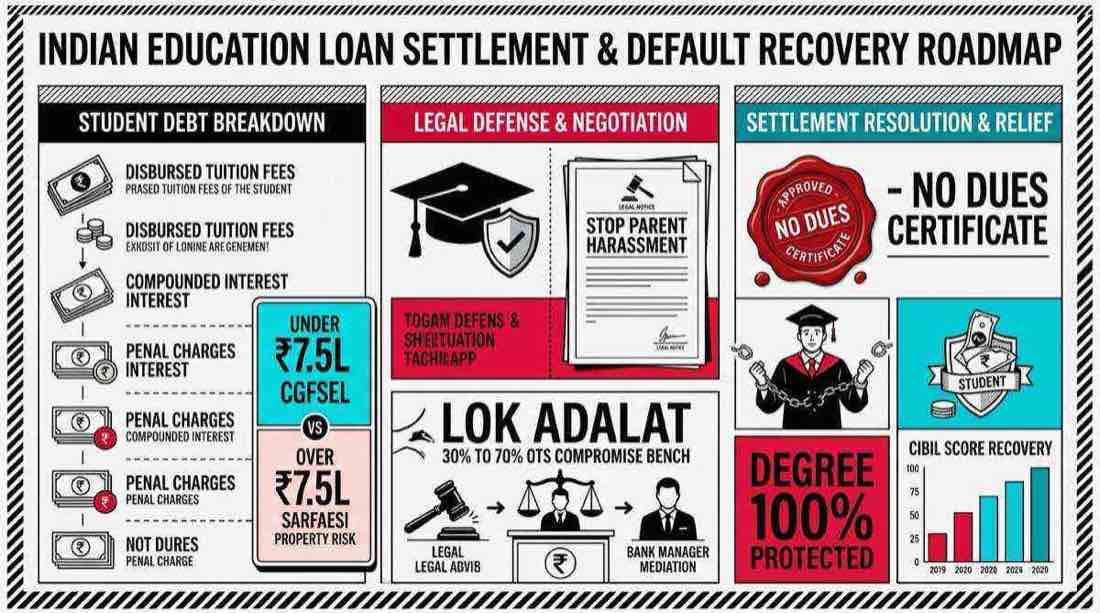
Visual 1.0: 5-step education loan default recovery, CGFSEL vs SARFAESI, and Lok Adalat settlement process.
Banks cannot legally confiscate your university degree, block your passport, or arrest you for defaulting on an education loan in India. However, because parents are mandatory co-borrowers, defaulting immediately destroys their CIBIL score. For loans over ₹7.5 Lakh secured by property, the bank can auction your parents' home under the SARFAESI Act. Unsecured loans (≤ ₹7.5L) can be settled for 30%–70% waivers via National Lok Adalat, leaving a “Settled” mark on CIBIL for 5–7 years.
The Top 5 Recovery Agent Psychological Bluffs
Myth 1: Confiscating or Cancelling Your Degree
The Threat: Recovery agents call claiming they are dispatching a legal team to your university to cancel your degree or legally confiscate your educational transcripts.
Myth 2: Passport Revocation & Travel Ban (LOC)
The Threat: “We will issue a Look Out Circular (LOC), impound your passport, and immigration will arrest you at the airport when you return from abroad.”
Myth 3: Criminal Arrest & Police Interventions
The Threat: Telecallers impersonating police sub-inspectors claiming an FIR has been lodged under Section 420 IPC / Section 318(4) BNS for fraud.
Myth 4: Campus & Workplace Harassment
The Threat: Threatening to call your employer’s HR department or show up at your corporate office to get you fired.
Myth 5: The Secret ₹500 Token Deposit Trap
The Threat: An agent says, “Just pay ₹1,000 to show good faith and we will halt all legal action.”
The Co-Borrower Trap: Your Parents' Liability
In almost all Indian education loans, parents are not just guarantors-they are joint primary co-borrowers with equal legal liability.
Dual CIBIL Score Destruction
When an EMI bounces, the default is reported simultaneously to TransUnion CIBIL, Experian, CRIF High Mark, and Equifax for both the student and the co-borrowing parent. A parent's credit score will collapse from 800+ down to under 550 within 90 days, blocking them from securing emergency medical loans or credit cards in retirement.
Pension & Provident Fund Protection (Section 60 CPC)
Recovery agents frequently threaten to seize a father’s government pension or attach his Provident Fund (PF) balance. Under Section 60(1)(g) and (k) of the Code of Civil Procedure (CPC), 1908, government pensions, provident funds, and basic gratuities are completely immune from attachment by any court decree or bank recovery process.
Stopping Threats Directed at Elderly Parents
If recovery agents visit your parents’ home or send abusive WhatsApp messages, issue a formal Cease & Desist notice immediately using our generator below. You can also file an official complaint against the bank on the RBI CMS Portal under the Integrated Ombudsman Scheme, 2021.
Under vs. Over ₹7.5L: CGFSEL vs. SARFAESI
The legal trajectory of an education loan default in India is strictly determined by whether the loan is below or above the statutory ₹7.5 Lakh collateral threshold.
Unsecured Loans (≤ ₹7.5 Lakh): The CGFSEL Truth
- Collateral-Free: No property, land, or fixed deposits pledged.
- CGFSEL Guarantee: Government provides a 75% credit guarantee to the bank. It protects the bank against bad debts, but the student remains legally liable.
- Bank Leverage: Low. The bank cannot seize any physical property. Their only leverage is CIBIL destruction and telephonic pressure.
- Settlement Feasibility: High. These loans routinely settle for 30%–70% waivers in Lok Adalat.
Secured Loans (> ₹7.5 Lakh): The SARFAESI Section 13 Danger
- Tangible Collateral: Pledged with residential flat, house, land, or FDs.
- SARFAESI Section 13(2): 60-day legal notice issued after 90 days of NPA. Borrowers have the right to file a formal objection under Section 13(3A).
- Section 13(4) Possession: If unresolved, the Chief Metropolitan Magistrate (CMM) or District Magistrate (DM) can order physical possession and property auction.
- Settlement Feasibility: Low. Waivers are limited (10%–25%) because the bank has direct recourse to auction your asset.
High-Ticket Abroad Education Loans (NBFCs & ₹20L+ DRT)
Specialized NBFCs (HDFC Credila, Avanse, Auxilo, InCred) offer ₹20L–₹50L unsecured foreign study loans based on earning parents' high salaries. If you default, they cannot invoke SARFAESI (since there is no property mortgage), but if the outstanding exceeds ₹20 Lakh, they can approach the Debt Recovery Tribunal (DRT) for recovery. However, DRT litigation takes years, forcing NBFCs to negotiate 30%–50% OTS packages once the loan enters aged NPA status.
Education Loan OTS & SARFAESI Risk Calculator
Use our interactive calculator below to calculate your realistic settlement range and assess your parents' asset vulnerability.
Education Loan OTS & Risk Calculator
Estimate realistic One-Time Settlement (OTS) waivers and assess the SARFAESI asset attachment risk for your parents.
₹4,67,500
ZERO (No Collateral to Attach)
Recommended Action: National Lok Adalat Bench
Bank-Wise Settlement Realities in India
How different public sector banks and private NBFCs evaluate education loan compromise settlements.
State Bank of India (SBI Rin Samadhan & Special Benches)
SBI holds the largest portfolio of education loans in India. Under their internal Rin Samadhan policy and special Lok Adalat drives, SBI branch managers have defined discretionary powers to settle unsecured education NPAs by waiving 100% of penal interest and up to 40%–60% of outstanding dues.
HDFC Credila, Avanse & Auxilo (Private NBFC Dynamics)
Private education NBFCs use aggressive automated dialers and field agency visits to contact parents during the initial 90–180 days. They rarely offer in-app settlements. However, once an account crosses 180+ DPD and is categorized as doubtful, their Risk & Collections Desk negotiates 30%–50% OTS to clear the bad book.
Canara Bank, PNB & Public Sector Banks (Compromise Schemes)
Public sector banks operate under strict vigilance norms and cannot grant ad-hoc waivers without documentary proof of distress (e.g. proof of layoff, campus placement failure, medical bills). Once verified, their board-approved compromise settlement policies enable 40%–65% waivers on non-performing assets.
Education Loan Hardship & Notice Generator
Generate an official legal notice to halt third-party harassment against your parents, stop recurring NACH bounce charges, and initiate a formal One-Time Settlement review.
Education Loan Hardship & OTS Request Generator
Draft a formal legal communication to stop recovery agent harassment of parents, halt NACH bounce penalties, and request an amicable One-Time Settlement.
The Lok Adalat Settlement Protocol & NDC
Why National Lok Adalat is the Safest Legal Exit
Organized by the National Legal Services Authority (NALSA), National Lok Adalats are held quarterly across every district court in India. You sit across from the bank’s authorized legal officer and a judicial mediator to arrive at an agreed compromise amount.
- Zero Court Fees: No advocate or legal representation required.
- Civil Decree Finality: Under Section 21 of the Legal Services Authorities Act, 1987, the Lok Adalat award is final and binding with no appeal lying in any court.
- Immediate Harassment Cessation: Once an award is signed, recovery agents are legally barred from contacting you or your parents.
The 5-Step Settlement to No Dues Certificate (NDC) Roadmap
- Secure Official Written Settlement Letter: Never pay a single rupee based on verbal promises. Ensure the letter is on official bank letterhead with an authorized signatory, unique reference ID, explicit waiver amount, and direct bank account payment details.
- Remit Payment via Direct Bank Channel: Pay the agreed OTS amount via RTGS/NEFT directly into your loan account. Save the UTR payment receipt.
- Demand No Dues Certificate (NDC): The bank is legally mandated under RBI directives to issue the NDC / Closure Certificate within 30 days of settlement payment.
- Retrieve Original Property Documents (For Secured Loans): For loans with collateral, collect all original title deeds, encumbrance certificates, and No Objection Certificates (NOC) within 30 days.
- Verify CIBIL Bureau Update: Within 30 to 45 days, check your credit report to ensure the status reflects “SETTLED” and the balance outstanding is updated to ₹0.
The Permanent “Settled” CIBIL Tag & 5-Year Rebuilding
Taking an OTS discount means you did not repay the full contractual obligation. Your CIBIL report (and your co-borrower parent's) will be marked as “SETTLED” or “POST WRITE-OFF SETTLED” rather than “CLOSED”.
Official Government Grievance Escalation
If the lending institution or its third-party recovery agency engages in illegal harassment, use this statutory grievance escalation hierarchy.
Escalation Hierarchy: Branch to RBI CMS Portal
Submit a written complaint to the Branch Manager and Principal Nodal Officer (PNO). If unaddressed after 30 days, lodge a complaint on the RBI Complaint Management System (CMS).
File RBI Ombudsman Complaint ↗Consumer Protection Act (NCDRC) for Severe Harassment
Recovery harassment of elderly parents constitutes “Deficiency of Service” and “Unfair Trade Practice”. You can claim substantial financial compensation via the National Consumer Helpline.
National Consumer Helpline (NCH) ↗Frequently Asked Questions
Can the bank legally confiscate or cancel my degree if I default on an education loan?+
Ground Reality: Absolutely not. Under Indian law and University Grants Commission (UGC) regulations, an educational degree is an academic qualification, not a commercial financial asset. Banks and NBFCs possess zero legal authority to seize, invalidate, or withhold your university degree once it has been conferred.
Will the bank impound my passport or place a travel ban (Look Out Circular) if I default?+
No Travel Ban: Retail education loan default is strictly a civil contract breach under Indian jurisprudence. Lenders cannot confiscate your passport or issue Look Out Circulars (LOC) to stop you at airport immigration. LOCs are strictly reserved for cognizable criminal offenses or economic fugitives, not retail student debt.
Can the bank seize my parents’ house for an education loan default?+
The ₹7.5 Lakh Threshold: For loans under ₹7.5 Lakh (unsecured), there is no collateral, so the bank cannot seize any property. However, for loans exceeding ₹7.5 Lakh secured by residential property, the bank can invoke Section 13(2) of the SARFAESI Act to initiate physical attachment and auction of the mortgaged property after 90 days of NPA classification.
How does an education loan default affect my parents’ CIBIL score?+
Joint CIBIL Destruction: Because parents are mandatory co-borrowers or primary guarantors on Indian education loans, any default is reported identically on both the student’s and parents’ credit bureau profiles. A persistent default will plummet their CIBIL score below 600, freezing their ability to access emergency medical credit or personal loans.
Can recovery agents harass my elderly parents or visit my workplace?+
RBI Guidelines Prohibition: Under RBI Master Directions on Fair Practices Code and Section 351 of the Bharatiya Nyaya Sanhita (BNS, 2024), recovery agents are strictly prohibited from calling outside 8 AM to 7 PM, using abusive intimidation, or harassing family members. Borrowers can file a formal complaint with the RBI Ombudsman.
What is the Credit Guarantee Fund Scheme for Education Loans (CGFSEL)?+
The CGFSEL Scheme: For collateral-free education loans up to ₹7.5 Lakh, the Government of India provides a 75% credit guarantee to the lending bank against default. However, this guarantee covers the bank’s loss; it does NOT forgive the student’s liability or protect their CIBIL score.
Can I settle my education loan through National Lok Adalat?+
The Safest Settlement Venue: Yes. National Lok Adalat is the most effective legal forum to negotiate One-Time Settlements (OTS) with public sector banks (like SBI, Canara, PNB). Lok Adalat awards carry the binding authority of a civil court decree, eliminate future litigation, and secure your No Dues Certificate (NDC).
What happens if I drop out of college before the full loan is disbursed?+
Disbursement Liability: You and your co-borrower are only legally liable to repay the specific tranches disbursed to the college, along with accrued interest. The bank cannot demand repayment for un-disbursed future semester fees.
What is the "Settled" status on CIBIL and how long does it last?+
The Bureau Trade-off: If you take a 30%–70% OTS waiver, the bank marks your CIBIL profile as "SETTLED" rather than "CLOSED". This negative tag persists for 5 to 7 years, preventing approval for fresh unsecured loans until rebuilt with secured credit products.
Can a bank attach my father’s government pension or PF account for loan recovery?+
Statutory Pension Protection: No. Under Section 60 of the Code of Civil Procedure (CPC), government pensions, provident funds (PF), and basic gratuity amounts are completely exempt from judicial attachment or bank seizure.