The Ground Reality of Debt Consolidation in India.
Indian Debt Consolidation & Loan Restructuring Guide
Debt consolidation is marketed by banks as a painless cure for multiple EMIs. The reality? It is a high-stakes financial operation. Done right with a 720+ CIBIL score, it cuts your interest outgo by 60%. Done wrong, it triggers a catastrophic “Double Default” that ruins your finances for a decade.
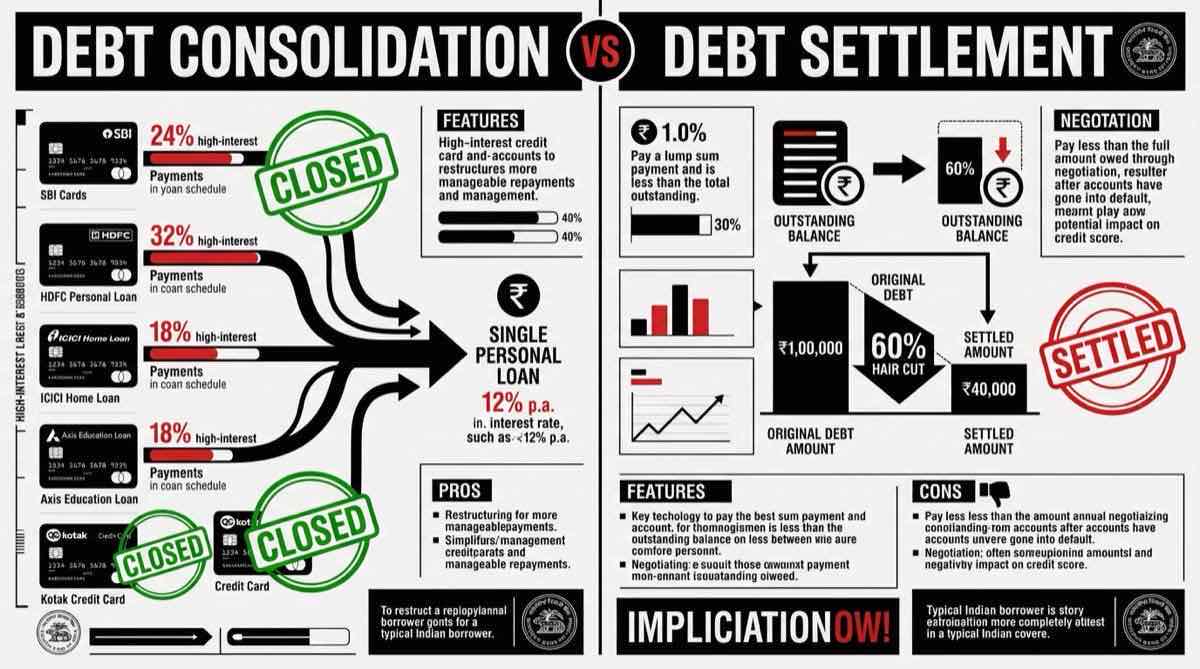
Debt consolidation combines multiple high-interest credit cards (36%–48% APR) and scattered loans into a single 10%–14% personal loan. You repay 100% of your debt, and all accounts are marked “CLOSED” on CIBIL. If you have already defaulted for 90+ days (NPA), consolidation is impossible-your only legal exit is a 50%–80% Compromise Settlement (OTS).
Debt Consolidation Diagnostic: Merge vs Settle Decision Tree
✅ PRIME CANDIDATE: 10%–14% BANK CONSOLIDATION LOAN
You have zero missed EMIs, a healthy CIBIL score (680+), and manageable debt (< 5x salary). You qualify for prime bank consolidation personal loans (SBI Xpress Credit, HDFC, ICICI) at 9.99%–13.5% APR. Pay off your 42% credit cards immediately and surrender the plastic to lock in a pristine "CLOSED" bureau status.
See Top 10 Bank Rates & 5-Step Protocol ↓Debt Consolidation Truth: When to Merge vs Settle
Borrowers frequently confuse debt consolidation with debt settlement. They are opposites. Choosing the wrong path will destroy your finances.
Consolidation Loan (Full Repayment)
Target Profile: CIBIL score of 680–750+, zero missed EMIs, steady salaried income, FOIR below 50%.
Mechanism: You take a single unsecured personal loan at 10%–14% APR (or credit card balance transfer) and clear all credit card balances in full.
CIBIL Result: All original card and loan accounts updated to “CLOSED”. Credit utilization drops to 0%, raising your credit score by 50 to 100 points over 12 months.
Loan Settlement (50%–80% Haircut)
Target Profile: Genuine hardship (job loss, medical crisis), chronic default over 90 days (NPA status), CIBIL already damaged.
Mechanism: You negotiate a one-time compromise payout under RBI June 8, 2023 Framework, paying only 20%–50% of the principal to legally terminate the debt.
CIBIL Result: Accounts permanently tagged as “SETTLED”. CIBIL score drops 75–150 points and unsecured credit is frozen for 5 to 7 years.
Credit Report Impact: Closed vs Settled
| Feature | Debt Consolidation | Loan Settlement (OTS) |
|---|---|---|
| Principal Paid | 100% of Principal + Interest | 20% to 50% (50%–80% Waiver) |
| Bureau Tag | CLOSED (Pristine) | SETTLED / POST-WRITE-OFF |
| CIBIL Score Impact | +50 to +100 Points (12 Mo) | -75 to -150 Points Drop |
| Future Home Loan | Eligible within 6–12 months | Blocked for 5–7 years |
| When Applicable | Before Default (CIBIL > 680) | After NPA / 90+ Days Default |
The Loan Restructuring Myth: Why It Is Dead in 2026
Tens of thousands of distressed borrowers search for “RBI loan restructuring schemes” every month. Here is the unvarnished regulatory reality.
The Demise of RBI COVID Frameworks 1.0 & 2.0
During the COVID-19 pandemic, the Reserve Bank of India introduced Resolution Framework 1.0 (August 2020) and Resolution Framework 2.0 (May 2021) to mandate debt restructuring and EMI moratoria across retail loans.
The Fake “RBI Restructuring” Agency Scam
Unregulated private agencies and telecallers run deceptive social media ads claiming to be “RBI Authorized Restructuring Centers”. They charge upfront fees of ₹15,000 to ₹50,000, issue fake “Debt Waiver Certificates”, and instruct you to stop paying your EMIs.
How Banks Handle Discretionary Restructuring Today
In 2026, restructuring is handled 100% at the internal discretion of individual bank credit committees under board-approved policies. If you have not yet defaulted, your only official route is to contact your branch manager before 60 days of default (SMA-1/2) and apply for internal tenure elongation.
The Double Default Trap: How Consolidation Backfires
Debt consolidation is dangerous because it gives a false illusion of financial recovery while doubling your structural risk.
The High-Interest NBFC Trap (24%–36% APR)
When rejected by public banks, desperate borrowers turn to fintech apps and NBFCs charging 24% to 36% APR plus 3% upfront processing fees. Replacing a 38% credit card with a 30% NBFC personal loan does not fix insolvency-it merely converts revolving card debt into an enforceable EMI mandate backed by Section 25 PSS Act criminal summons.
The Credit Card Re-Accumulation Disaster
Borrowers use consolidation loan funds to pay their credit card balances to zero, feel instant relief, but keep the credit cards active. Within 6 to 12 months, unexpected emergencies cause them to max out the credit cards again-leaving them with both the new consolidation loan EMI and the original credit card debt.
Case Study: Rahul's ₹9 Lakh Double Default
Profile: Gurgaon Senior QA Engineer, Net Salary ₹85,000/month.
The Move: Held ₹4.8 Lakh in credit card debt (HDFC, SBI Card) paying ₹24,000/mo minimum dues. Took a ₹5 Lakh NBFC personal loan at 22% for 3 years (EMI: ₹19,100/mo) to clear the cards.
The Collapse: Failed to surrender the cards. In month 8, medical expenses caused him to run up ₹4.2 Lakh across the cards again. Total monthly debt obligations surged to ₹43,100/mo (51% FOIR).
The Outcome: Simultaneous default on both the NBFC loan and the credit cards. Reached NPA at month 14, forcing a combined ₹4.5 Lakh settlement in Lok Adalat with a ruined 540 CIBIL score.
Debt Consolidation Calculator: EMI & Savings Matrix
Calculate your combined monthly savings, interest reduction, and exact FOIR before applying for a consolidation loan.
✓ Safe (Below 40%): Prime banks will approve with high probability.
Settlement Payout: ₹2,00,000 (Saves ₹3,00,000, but CIBIL marked “SETTLED”).
FOIR & CIBIL Eligibility: Why Banks Reject Loans
Underwriting algorithms reject over 65% of unsecured debt consolidation loan applications in India due to two primary triggers.
The 50% FOIR (Fixed Obligation) Ceiling
Banks calculate your Fixed Obligation to Income Ratio (FOIR) using the formula:
If your total debt outflow exceeds 50% of your take-home pay, top-tier banks (HDFC, SBI, ICICI) reject the application automatically regardless of your CIBIL score.
Hard Inquiries: The 30-Day Inquiry Spike Penalty
Applying to multiple banks (or loan aggregators) simultaneously triggers multiple “Hard Pulls” on your CIBIL report. More than 3 inquiries within 30 days triggers an automated “Credit-Hungry / Distress Flag” that drops your score by 25–40 points and locks automated rejections across all prime lenders.
CIBIL Score Cutoffs by Lender Category
- Public Sector Banks (SBI, BoB): Minimum 720–750+ CIBIL. Strict 40%–45% FOIR cap.
- Top Private Banks (HDFC, ICICI, Axis): Minimum 680–740 CIBIL. Fast pre-approved processing.
- Reputed NBFCs (Tata Capital, IDFC): Minimum 650–680 CIBIL. Rates 11%–18% APR.
- Subprime Fintech Lenders: 600–650 CIBIL. Warning: Punitive rates of 24%–36% APR.
Top 10 Indian Lenders Debt Consolidation Rates
Current indicative interest rates, processing fees, and minimum CIBIL benchmarks for personal loans used for debt consolidation in India (August 2026).
| Lender Name | Indicative APR | Processing Fee | Min CIBIL | Key Advantage |
|---|---|---|---|---|
| State Bank of India | 10.00% – 13.50% | 0.50% – 1.00% | 720+ | SBI Xpress Credit (lowest overall interest burden) |
| HDFC Bank | 9.99% – 14.50% | 1.50% – 2.50% | 700+ | Balance Transfer on EMI (up to 48 months tenure) |
| ICICI Bank | 9.99% – 15.00% | 1.50% – 2.00% | 700+ | Instant 3-second disbursal for pre-approved salary accounts |
| Axis Bank | 9.99% – 15.50% | 1.50% – 2.00% | 690+ | Credit Card Balance Transfer up to ₹3 Lakh |
| Kotak Mahindra Bank | 10.25% – 16.00% | 1.50% – 3.00% | 700+ | Flexible partial prepayment on floating loans |
| Bank of Baroda | 10.15% – 14.00% | 0.50% – 1.00% | 720+ | Lowest processing fee for PSU and defence personnel |
| Tata Capital | 10.99% – 18.00% | 2.00% – 3.00% | 680+ | High loan quantum up to ₹35 Lakh for salaried MSMEs |
| IDFC FIRST Bank | 10.49% – 18.00% | 1.50% – 2.50% | 680+ | Zero foreclosure charges under RBI 2026 Directions |
| Bajaj Finserv | 11.00% – 22.00% | 2.50% – 4.00% | 650+ | Flexi Hybrid Loan (initial interest-only option) |
| Poonawalla Fincorp | 11.50% – 20.00% | 2.00% – 3.00% | 660+ | 100% digital KYC with zero physical branch visits |
Credit Card Balance Transfer vs Personal Loan
If 100% of your debt consists of revolving credit card balances, a Credit Card Balance Transfer (BT on EMI) may be cheaper than a personal loan.
Promotional 0%–12% APR Balance Transfers
Card issuers like SBI Card, HDFC, and Axis allow existing cardholders to transfer balances from competing banks at promotional monthly rates of 0.75% to 1.25% (9%–15% annualized) for 3 to 24 months.
Upfront processing fee is typically 1% to 2% (minimum ₹199–₹250). The new bank pays off your source card directly via NEFT, closing the high-interest revolving cycle immediately.
The Post-Promo 42% Interest Reversion Shock
CRITICAL WARNING: If you do not pay off 100% of the transferred balance within the promotional tenure, any unpaid principal instantly reverts to the card's standard 3.50% monthly finance charge (42%–48% APR) compounding daily from the original transfer date.
5-Step Debt Consolidation & Payoff Protocol
Follow this strict operational sequence to consolidate debts without damaging your CIBIL score or falling into the Double Default trap.
Step 1: Calculate Exact FOIR & Total Payoff
Gather latest monthly statements for all credit cards and loans. Sum the exact payoff figures (principal + pending interest). Calculate your projected FOIR-ensure the new consolidated EMI will not exceed 40% of your take-home salary.
Step 2: Check Pre-Approved Offers Only
Never apply randomly across loan comparison websites. Log into your primary salary bank portal (HDFC, SBI, ICICI) to inspect pre-approved loan offers. Pre-approved loans disburse in under 60 seconds with zero manual documentation and zero credit score inquiry penalties.
Step 3: Direct Third-Party Card Payoffs
Once the loan is disbursed, immediately transfer funds directly to your credit card accounts and loan accounts via IMPS/NEFT. Do not leave the money sitting in your primary savings account where lifestyle spending can siphon it away.
Step 4: Immediate Card Surrender & Account Lock
As soon as balances hit zero, send written cancellation emails from your registered ID to card customer care requesting permanent closure. Cut the physical plastic cards. Keeping cards open is the #1 cause of the catastrophic Double Default.
Step 5: Enforce 30-Day CIBIL “Closed” Tagging
Collect formal No Dues Certificates (NOCs) from every paid lender. Check your CIBIL report on day 35. Verify every paid account is marked “CLOSED” with zero outstanding balance. If any account still shows active, raise an online dispute with the NOC attached at CIBIL.com.
After paying your credit card balance to zero, you must formally close the account to prevent recurring annual fees or re-accumulating debt. Generate an RBI-compliant legal notice below:
Debt Consolidation & Restructuring FAQs
Direct answers to the most common questions regarding loan consolidation, restructuring myths, and CIBIL protection in India.
Debt consolidation involves taking a single new personal loan (at 10%–14% APR) or balance transfer to pay 100% of your debts in full, resulting in a "CLOSED" CIBIL status that preserves your credit score. Loan settlement (OTS) occurs after 90+ days of default (NPA), where you negotiate a 50%–80% waiver on the outstanding balance, resulting in a "SETTLED" CIBIL tag that freezes access to unsecured loans for 5–7 years.
No. All uniform RBI loan restructuring frameworks (Resolution Framework 1.0 & 2.0 introduced during COVID-19) expired permanently on September 30, 2021. In 2026, there are zero active blanket government or RBI restructuring schemes. Any restructuring is handled strictly at the internal discretion of individual bank boards for standard accounts, or under the June 2023 Prudential Compromise Framework for NPA accounts.
The Double Default trap occurs when a borrower takes a high-interest NBFC consolidation loan (24%–36% APR) to clear credit cards, but fails to close those card accounts. Within 6–12 months, the borrower maxes out the credit cards again while still owing the massive consolidation EMI, causing simultaneous default on both the bank cards and the NBFC loan.
Public sector banks (SBI, Bank of Baroda) generally require a CIBIL score of 720–750+. Top private banks (HDFC, ICICI, Axis) approve consolidation personal loans with scores of 680–740. NBFCs may approve down to 620–650, but charge punitive interest rates of 20%–32% APR.
FOIR (Fixed Obligation to Income Ratio) measures the percentage of your gross monthly income committed to debt EMIs. Most Indian banks reject applications if the proposed consolidation EMI pushes your total FOIR above 50%, or if you have more than 3 hard credit inquiries within the preceding 30 days.
Yes. Major issuers (SBI Card, HDFC, ICICI, Axis) allow you to transfer outstanding credit card debt to a new card at promotional rates (0.75%–1.5% per month for 3–24 months) with a 1%–2% processing fee. However, you must pay off the full balance before the promo period ends, or interest reverts to 42%–48% APR.
No. The RBI does not regulate, license, or authorize any third-party debt settlement or loan restructuring companies. The RBI has issued explicit public caution notices warning borrowers against private entities charging upfront fees and issuing fake "debt waiver certificates".
Under the RBI (Pre-payment Charges on Loans) Directions effective January 1, 2026, regulated entities are strictly prohibited from levying foreclosure charges or prepayment penalties on all floating-rate personal loans sanctioned to individual borrowers for non-business purposes.
STUCK IN CHRONIC DEFAULT?
If You Have Already Defaulted 90+ Days, Consolidation Is Not Possible.
Find this content helpful?
If this guide has helped you navigate your settlement journey, consider showing some support to keep this platform running.