The Ground Reality of Car & Vehicle Loan Settlement.
Indian Car Loan Default, Repossession & Settlement Guide
Vehicle loans are secured by hypothecation endorsements on your RC. When EMIs bounce, lenders deploy tow-trucks and repo agents. But the Supreme Court has strictly prohibited forceful seizure. Learn how to defend against roadside goons, preserve your cash equity via Private Treaty Sales, and settle post-auction shortfall deficiency debt at 60%–80% waivers in Lok Adalat.
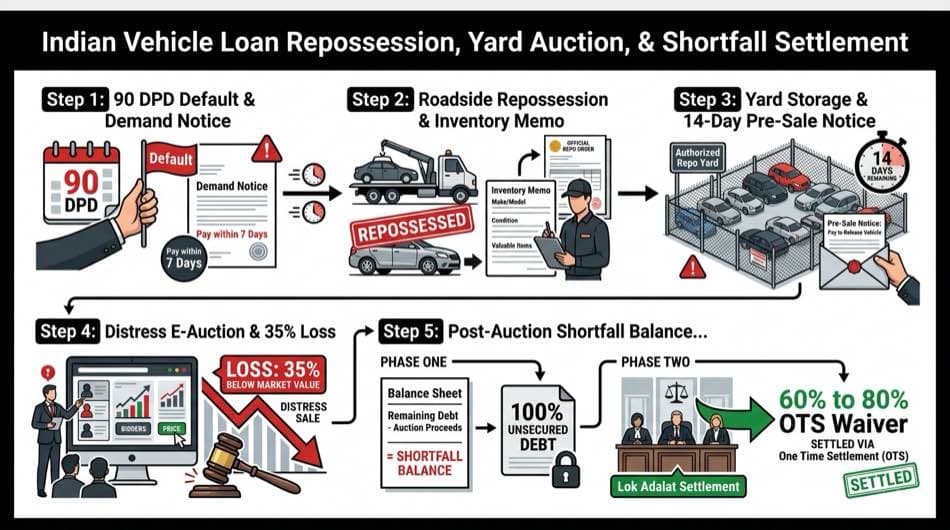
Visual 1.0: Indian vehicle loan recovery lifecycle: 90 DPD NPA, roadside inventory memo, 14-day yard pre-sale notice, distress auction loss, and 60%–80% shortfall OTS waiver.
Vehicle loans are hypothecated debts under Section 51 of the Motor Vehicles Act. Under landmark Supreme Court rulings (*ICICI Bank v. Prakash Kaur* and *Citicorp Maruti Finance*), lenders cannot use musclemen or tow-trucks to forcibly snatch vehicles without due process. If your car is repossessed and auctioned at a distress price, the remaining unpaid balance converts into 100% UNSECURED deficiency debt, which can be settled for 60% to 80% waivers in National Lok Adalat. Alternatively, you can execute a Pre-Repossession Private Treaty Sale to pocket your surplus cash equity and obtain an RTO Form 35 NOC.
Hypothecation vs Ownership: What the Bank Actually Owns
When you buy a car or bike on finance in India, many borrowers mistakenly believe the bank owns the vehicle. This is legally false. Under Section 51 of the Motor Vehicles Act, 1988:
1. You Are the Absolute Registered Owner
RC TitleThe Registration Certificate (RC Smart Card) is issued in your name. You hold full legal title, ownership, and civil custody of the vehicle.
2. The Bank Only Holds a Floating Equitable Lien
HypothecationThe financier only holds a hypothecation endorsement (a charge on the asset) to secure loan repayment. The hypothecation clause grants them a contractual right to recover dues, but does not grant sovereign police power to seize property by force.
Supreme Court Landmark Repossession Rules
The Supreme Court of India has delivered two historic landmark judgments that protect vehicle loan borrowers from recovery aggression:
ICICI Bank Ltd. v. Prakash Kaur & Ors. (2007) 2 SCC 711
The Supreme Court categorically banned banks from hiring “musclemen” and third-party goons to recover vehicle loans. The Court held that India is governed by the rule of law, and lenders must follow statutory legal procedures rather than resorting to strong-arm extra-judicial seizures.
Citicorp Maruti Finance Ltd. v. S. Vijayalaxmi (2012) 1 SCC 1
The Supreme Court reaffirmed that even if the loan agreement contains a repossession clause, the financier cannot take possession of the vehicle without giving prior written notice and affording the borrower a fair opportunity to repay. Forcible repossession was held to be strictly unlawful and actionable under tort and penal laws.
Kotak Mahindra Prime Ltd. Hypothecation & Shortfall Claims
Kotak Mahindra Prime initiates Section 9 arbitration under the Arbitration and Conciliation Act for vehicle shortfall amounts after distressed yard auctions. Borrowers can challenge inflated yard parking charges, stop unauthorized 811 savings account liens, and negotiate 50% to 75% waivers on post-auction residual balances.
The 5-Stage Repossession & Yard Auction Timeline
Stage 01: 90 DPD Default & Formal Demand Notice
Day 90–105Upon 3 consecutive missed EMIs (90 DPD), the loan account turns NPA. The lender issues a formal Demand / Loan Recall Notice giving 7 to 15 days to clear all arrears.
Stage 02: Repossession Order & Inventory Memo
Seizure DayIf dues remain unpaid, authorized agents locate the vehicle. Under RBI guidelines, they must carry an official Bank Authorization Letter, ID cards, and prepare a signed Inventory Memo detailing vehicle condition and returning all personal contents.
Stage 03: Yard Storage & Parking Fee Meter
Day 1 to 30 in YardThe vehicle is moved to a private repo yard. Storage fees of ₹200 to ₹500/day plus towing charges (₹3,000 to ₹6,000) are debited to your loan ledger.
Stage 04: Mandatory 7–14 Day Pre-Sale Notice
Redemption WindowThe bank sends an official Pre-Sale Notice giving a final 7 to 14 days window to redeem the vehicle by paying dues. This is your final chance to negotiate a 100% penal interest waiver OTS or introduce an open-market private buyer.
Stage 05: Distress E-Auction & Shortfall Notice
Auction RealizationThe vehicle is auctioned on portals like IBAPI / AutoJunction at a 30%–40% discount. If the auction proceeds do not cover the loan, the bank sends a Deficiency / Shortfall Notice for the remaining balance.
Roadside Intercept & Tow-Truck Defense Script
If recovery agents stop your car on a public road or attempt to hook your vehicle to a tow-truck without a court warrant, execute this 4-point defense protocol:
Under RBI directives, every recovery agent must carry an official Bank Authorization Letter specifically naming your vehicle, alongside their Debt Recovery Agent (DRA) certification card. If they cannot produce physical ID, they have zero legal standing.
Stay inside the vehicle with doors locked. Snatching keys by force constitutes Robbery / Theft (Section 303 BNS). Dial 112 immediately and inform the police control room that unidentified individuals are obstructing you on the highway.
Quote Section 351 BNS (Criminal Intimidation), Section 329 BNS (Criminal Trespass), and Section 308 BNS (Extortion). Remind them that individual agents face personal non-bailable FIRs for roadside violence.
Inform them clearly: “I am willing to visit the bank branch tomorrow to negotiate with the branch manager. I will not sign any roadside seizure memo under coercion.”
The Shortfall Balance Secret: How Deficiency Debt Converts to 100% Unsecured
Once the Vehicle Is Auctioned, the Bank Has Zero Collateral Leverage
When a ₹6 Lakh car is auctioned for ₹3.5 Lakhs against a ₹5.5 Lakh loan, the bank sends a deficiency demand for ₹2 Lakhs. Because the car is gone, this remaining ₹2 Lakhs is legally classified as 100% UNSECURED DEBT.
Because the bank cannot seize anything else without filing a prolonged 5-year civil summary suit in court, their recovery desk routinely agrees to deep compromise waivers:
A ₹2.5 Lakh shortfall balance routinely settles for ₹50,000 to ₹75,000 as a lump-sum full and final payment before a Lok Adalat bench.
Lenders inflate shortfall demands with ₹30,000–₹50,000 of fabricated yard parking charges. During settlement, central desks waive 100% of these administrative add-ons.
Paying the negotiated shortfall OTS amount legally discharges you from all future civil claims and closes the loan account permanently.
Pre-Repossession Private Sale: Preserve Your Hard-Earned Equity
If your car is worth more than your outstanding loan principal, never let the bank repossess it. In a distress yard auction, the bank sells it for peanuts. Follow this 4-step Private Treaty Sale sequence instead:
Obtain Official Foreclosure Statement
Visit your bank branch and demand an official Loan Foreclosure Statement showing exact principal dues and requesting 100% penal interest waiver.
Find an Open-Market Private Buyer
List the vehicle on direct platforms (Spinny, Cars24, or private buyers) for full fair market value (e.g. ₹6 Lakhs).
Execute Tripartite Direct RTGS Payment
The buyer remits the loan settlement amount (e.g. ₹4.2 Lakhs) directly into the bank loan account via RTGS, and pays the surplus cash equity (₹1.8 Lakhs) directly to you.
Bank Issues Form 35 NOC for RTO Transfer
The bank closes the loan, issues the No Dues Certificate and Form 35 in duplicate. The buyer transfers the RC, and you walk away debt-free with cash in hand.
Top 10 Indian Vehicle Financiers Benchmark
Recovery aggression, pre-repo buyout rules, and post-auction shortfall settlement policies across the top 10 auto lenders in India:
HDFC Bank Auto Loans
Top Private BankICICI Bank Car Loans
Top Private BankState Bank of India (SBI Auto)
Top Public Sector BankKotak Mahindra Prime
Dedicated Auto FinancierMahindra & Mahindra Financial Services
Leading Rural & Commercial NBFCCholamandalam Finance (Chola)
Commercial & Car NBFCShriram Finance Limited
Used Vehicle & CV HeavyweightAxis Bank Vehicle Finance
Private BankSundaram Finance
Legacy Conservative FinancierTata Motors Finance
Dedicated OEM FinancierReal Case Study: ₹9.5 Lakh SUV Default & Shortfall Settlement
The Crisis: A software consultant purchased an SUV with a ₹9.5 Lakh car loan. Due to unexpected medical emergencies, EMIs bounced for 4 months. Recovery agents visited his home and threatened to tow the vehicle from his parking lot.
The Action Taken: The borrower immediately sent a formal legal cease-and-desist letter citing ICICI Bank v. Prakash Kaur and BNS Section 351, which halted the illegal towing attempt.
The Repo & Distress Auction: Eventually, the borrower voluntarily surrendered the vehicle with a signed inventory memo. The bank auctioned the SUV for ₹4.8 Lakhs against a total outstanding claim of ₹7.2 Lakhs, leaving a shortfall deficiency demand of ₹2.4 Lakhs.
The Lok Adalat Compromise: In the subsequent National Lok Adalat, the borrower established genuine medical distress. The bank accepted a one-time lump-sum settlement of ₹65,000 (73% waiver), waived 100% of yard charges, and issued an official No Dues Certificate.
Two-Wheeler vs Commercial Vehicle Defaults
1. Two-Wheeler Loans (Bikes & Scooters)
₹40K–₹1.5LDue to lower asset values, two-wheeler lenders (Bajaj Auto Finance, Hero Fincorp, TVS Credit) rely heavily on telecalling. Post-repo shortfall balances rarely justify civil suits and settle for ₹10,000 to ₹25,000 lump-sum waivers.
2. Commercial Vehicles & Fleets (Trucks & Buses)
₹10L–₹80LCommercial vehicle defaults involve heavy transport operators. NBFCs (Shriram, Chola, Sundaram) prefer restructuring or route-based payment plans because repossessed trucks lose massive commercial value sitting idle in industrial yards.
RTO Form 35 & Hypothecation Removal Masterclass
Settling the loan is only half the battle. You must legally remove the financier's hypothecation from government records:
The 4 Essential Documents for RTO Hypothecation Termination
Apply online on the official Parivahan Sewa portal (parivahan.gov.in) under “Hypothecation Termination” to track RC dispatch.
CIBIL & Credit Bureau Impact
If the vehicle is seized and auctioned with an unresolved shortfall, CIBIL reports “Repossessed / Written Off”. This drops your score by 150+ points and locks you out of mainstream loans.
Negotiating an OTS for the shortfall balance updates the bureau to “Settled / Zero Outstanding Balance”. While it reflects a compromise, it halts negative delinquency compounding.
Take a fixed-deposit secured credit card (IDFC WOW, OneCard, SBM), keep utilization under 20%, and rebuild your CIBIL back to 750+ within 24 to 36 months.
Vehicle Loan Interactive Tools Suite
Vehicle Loan & Shortfall Calculator
Compare distress yard auction loss vs private treaty sale, or calculate 60%–80% Lok Adalat waivers on post-auction deficiency debt.
⚠️ Bank repo yards sell vehicles at low reserve prices. You lose your car, forfeit your accumulated equity, and face a deficiency legal notice.
✅ Find an open-market buyer. Buyer clears the loan directly, bank issues RTO Form 35 NOC, and you walk away with surplus cash equity.
Vehicle Loan Legal Notice Generator
Generate an immediate legal notice for unlawful roadside harassment, pre-repo private sale NOC request, or post-auction shortfall OTS.
To: The Principal Nodal Officer / Head of Collections & Operations, [Bank / NBFC Financier Name]
Subject: CEASE & DESIST: Illegal Vehicle Repossession Threats, Highway Interception & Violation of Supreme Court Mandates - Vehicle: [Vehicle Reg No. e.g. DL 01 AB 1234] | Loan A/C: [Loan Account Number]

Dear Sir / Madam,

I am writing this formal legal representation regarding the above-referenced vehicle loan account ([Loan Account Number]) for vehicle registration number [Vehicle Reg No. e.g. DL 01 AB 1234].

It has come to my notice that your recovery representatives / third-party collection agencies have threatened forcible interception of my vehicle on public roads, unannounced visits, and forceful towing without due process of law.

Please take formal notice of the settled law of the land established by the Supreme Court of India:

1. Prohibition on Forceful Repossession (Prakash Kaur & Citicorp Maruti Precedent):
In ICICI Bank Ltd. v. Prakash Kaur (2007) 2 SCC 711 and Citicorp Maruti Finance Ltd. v. S. Vijayalaxmi (2012) 1 SCC 1, the Hon'ble Supreme Court categorically held that banks and financial institutions CANNOT use musclemen, recovery agents, or forceful means to repossess vehicles. Lenders must strictly adhere to the procedure established by law. Contractual hypothecation clauses do not confer extra-judicial powers to seize property without due process.

2. Penal Liability under Bharatiya Nyaya Sanhita (BNS), 2024:
Any unauthorized interception on public highways, snatching of car keys, physical intimidation, or unauthorized towing constitutes actionable criminal offenses under:
- Section 329 BNS (Criminal Trespass)
- Section 303 BNS (Theft / Dishonest misappropriation of property)
- Section 308 BNS (Extortion)
- Section 351 BNS (Criminal Intimidation)

3. RBI Fair Practices Code Mandate:
Under RBI Master Directions, all recovery communications must be conducted between 8:00 AM and 7:00 PM without verbal harassment, intimidation of family members, or illegal entry.

I am a law-abiding borrower facing genuine temporary financial hardship. I am fully willing to discuss an amicable resolution, restructuring, or compromise settlement through formal written channels.

I formally demand that you immediately direct your recovery agents to CEASE AND DESIST all illegal threats and direct all future communications solely to my registered email ([Your Registered Email]).

Yours sincerely,
[Your Full Name]
Vehicle Reg No: [Vehicle Reg No. e.g. DL 01 AB 1234]
Loan Account: [Loan Account Number]
Email: [Your Registered Email]
Phone: [Your Registered Mobile]
The 5-Step Vehicle Debt Survival Protocol
Issue Anti-Harassment Cease & Desist
Serve a formal notice citing Prakash Kaur and BNS penal codes to stop roadside tow-truck intimidation.
Explore Pre-Repo Private Treaty Sale
If the car has equity, arrange a private buyer who pays the bank loan directly via RTGS to preserve your cash.
Demand Signed Inventory Memo Upon Seizure
If seized, ensure every personal item is documented and retrieved without paying any illegal yard release fees.
Settle Post-Auction Shortfall at 60%–80% Discount
Negotiate the post-auction deficiency balance as 100% unsecured debt before a National Lok Adalat bench.
Execute Form 35 Hypothecation Removal Within 90 Days
Submit bank Form 35 and NOC to the RTO via Parivahan to clear the hypothecation charge on your RC Smart Card.
Vehicle Loan Settlement FAQs
Can recovery agents forcibly snatch my car keys or intercept me on the road in India?+
No. The Supreme Court of India in ICICI Bank v. Prakash Kaur (2007) and Citicorp Maruti Finance v. S. Vijayalaxmi (2012) strictly outlawed the use of musclemen, strong-arm tactics, and forcible roadside vehicle snatching. Stopping your vehicle on a public highway without a magistrate order or police presence constitutes criminal intimidation (Section 351 BNS), criminal trespass (Section 329 BNS), and extortion/theft (Sections 308/303 BNS).
What is a post-auction shortfall balance, and can it be settled?+
When a bank seizes and auctions your vehicle, it routinely sells at a 30% to 40% distress discount. The difference between your total outstanding loan balance and the auction realization is the "shortfall balance" (deficiency debt). Because the collateral vehicle is already sold, this remaining debt converts into 100% UNSECURED debt. Banks have zero asset leverage and routinely settle shortfalls at 60% to 80% waivers in National Lok Adalat.
Can I sell my car privately in the open market before the bank repossesses it?+
Yes. Under Section 51 of the Motor Vehicles Act, 1988, you can execute a Tripartite Private Treaty Sale. You find an open-market buyer willing to pay market value. The buyer remits the agreed loan payoff directly into the bank loan account via RTGS. Upon clearing the principal, the bank issues the No Objection Certificate (NOC) and Form 35 (in duplicate) to cancel the hypothecation, and you pocket the remaining surplus equity.
How long is the bank NOC valid for RTO Form 35 hypothecation removal?+
A bank No Objection Certificate (NOC) for vehicle loan closure is strictly valid for 90 days from the date of issuance. You must submit Form 35 (in duplicate signed and stamped by the financier), the original NOC, and your original Registration Certificate (RC) to the RTO via the Parivahan portal within 90 days to remove the hypothecation endorsement and receive a clean RC Smart Card.
Can the bank or financier remotely immobilize my vehicle using installed GPS trackers?+
While some subprime NBFCs and fintech lenders install GPS trackers with remote ignition cutoff relays, doing so while the vehicle is in motion on a public road violates fundamental public safety and transport regulations. If an unauthorized cutoff causes an accident or stalls you on a highway, the lender faces severe civil liability for endangerment under the Consumer Protection Act and motor safety statutes.
What happens to personal belongings left inside a repossessed car?+
Under RBI Fair Practices Code, recovery agents are legally obligated to prepare a signed, itemized "Inventory Memo" at the exact moment of vehicle possession. Financiers hold a security lien only on the vehicle itself-not on your personal possessions, laptops, documents, or luggage inside the vehicle. You have the absolute legal right to collect all personal belongings from the yard without paying any fee.
Are legal heirs personally liable for a vehicle loan after the borrower passes away?+
No. Legal heirs are not personally liable with their own personal wealth or salary. Under Indian succession laws, liability is strictly limited to the value of the inherited estate. The bank can only repossess and liquidate the hypothecated vehicle itself. If the auction proceeds leave a deficit, the bank cannot demand payment from the personal funds of the surviving family unless they signed as joint co-borrowers or personal guarantors.
What is the difference between "Settled" vs "Repossessed" status on my CIBIL report?+
"Repossessed" indicates the lender forcibly seized the asset and auctioned it, triggering an extreme negative flag that locks you out of secured lending for 5 to 7 years. "Settled" indicates you negotiated a compromise lump-sum payment (e.g. on the shortfall balance) to achieve complete legal closure. While "Settled" also lowers your credit score by 100–150 points, it halts ongoing delinquency reporting and allows credit rebuilding.
How much are repo yard parking charges, and are they negotiable during settlement?+
Authorized private repo yards typically levy storage charges ranging from ₹200 to ₹500 per day plus towing fees (₹2,500 to ₹6,000). During a formal compromise One-Time Settlement (OTS) or Lok Adalat conciliation, banks routinely waive 100% of accumulated yard storage fees and administrative charges as part of the negotiated haircut.
Can the local police arrest me or help recovery agents seize my car for loan default?+
No. Vehicle loan default is purely a civil contractual dispute. Police officers have no legal jurisdiction to seize vehicles, collect EMIs, or act as recovery agents for private banks. If recovery agents arrive accompanied by police without a court warrant, they are misusing local police influence. You have the legal right to demand the formal court order or file an administrative complaint with the Superintendent of Police (SP).