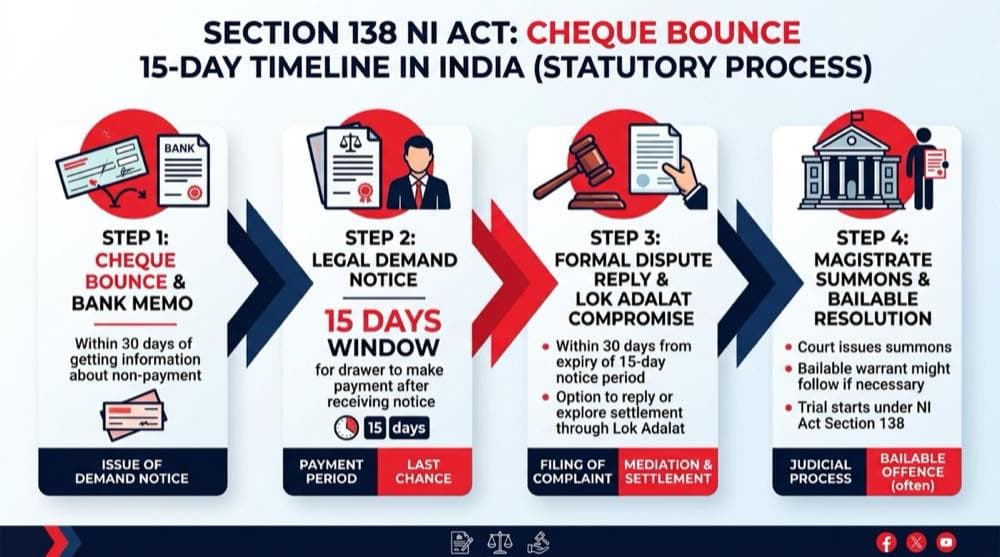
01. The 15-Day Clock: What A Section 138 Notice Actually Means
Receiving a Section 138 notice is an urgent event. It is not an arrest warrant. Section 138 is a rule to enforce payments. A borrower does not become an accused person when the letter arrives. The cause of action arises only after 15 calendar days expire without payment. This clock starts from the exact date of physical delivery.
The date of delivery is the critical starting point. Keep the postal envelope or Speed Post tracking slip. You can also save a delivery screenshot showing the timestamp. Under Indian law, the 15-day payment window begins on the day after physical receipt. It does not start on the date printed at the top of the advocate's letter. For example, suppose the bank sent the letter on May 1st. If you received it on May 8th, your 15-day reply window runs until May 23rd.
Ignoring a Section 138 notice is a serious error. Do not stay silent. The court may presume the claimed debt is undisputed. Sending a factual reply within 15 days puts your defense on the official record. This protects you before the lender files any complaint in court.
02. The Security Cheque Defense & Landmark Supreme Court Precedents
Borrowers often sign blank, undated cheques during loan setup. Banks take these cheques as secondary security. When a borrower suffers job loss or financial distress, banks often fill in the current date. They write an inflated balance and deposit the cheque to cause a bounce.
Under Section 139 of the NI Act, courts presume a cheque was issued for an enforceable debt. However, the Supreme Court has set clear limits on security cheques. In Indus Airways Pvt. Ltd. v. Magnum Aviation (2014), the Supreme Court ruled in favor of drawers. The court held that advance or security cheques cannot be prosecuted if no enforceable debt existed when drawn.
This principle was reaffirmed in Sunil Todi v. State of Gujarat (2021). The Supreme Court clarified that a security cheque must represent an actual debt on the date of presentation. If you paid regular EMIs for two years, your original full-amount security cheque is inaccurate. Depositing it for the full loan sum violates statutory requirements.
03. The Part-Payment Shield: The Dashrathbhai Trikambhai Patel Ruling (2022)
The part-payment rule under Section 56 of the NI Act is a vital defense for borrowers. In Dashrathbhai Trikambhai Patel v. Hitesh Mahendrabhai Patel (2022), the Supreme Court delivered a landmark ruling. The court dismissed a Section 138 prosecution because the lender failed to acknowledge partial loan repayments.
Under Section 56, a lender must endorse all partial payments. These marks must be on the cheque itself. Suppose a borrower took a loan of Rs. 5,00,000 and repaid Rs. 2,00,000 through monthly EMIs. If default occurs later, the bank cannot present the original Rs. 5,00,000 security cheque.
Presenting an unendorsed cheque for the full amount invalidates the claim. The cheque no longer represents the actual legally enforceable debt on that date. The Supreme Court held that dishonour of an unendorsed, inflated cheque is not an offense under Section 138. Raising this defect in your 15-day reply destroys the technical maintainability of the complaint.
04. Civil Default vs Criminal Offense: Why You Will Not Go To Jail Overnight
Recovery telecallers often threaten borrowers with police arrest and instant jail. These threats are legally baseless. Loan default due to genuine financial distress is purely a civil matter. The police have no legal authority to arrest anyone for missing EMI payments.
Section 138 complaints are private criminal cases. A lender must file the case before a magistrate. Police cannot register an FIR or arrest you for a bounced loan cheque. The court follows a strict process. If the lender files a case after the 15-day notice window, the magistrate first reviews the bank's affidavit.
If the court issues process, it sends a summons by post. Section 138 is a bailable offense. A borrower is entitled to get bail upon appearing in court. Furthermore, Section 147 of the NI Act makes cheque bounce cases compoundable. Both parties can settle the matter at any time, leading to a complete case closure.
05. Anatomy of a Defective Section 138 Demand Notice
A Section 138 notice must satisfy strict rules to be valid. Lenders often send rushed demand letters. Auditing the notice for defects gives you strong negotiation leverage.
First, check the 30-day limitation window. Under Section 138(b), the bank must dispatch the notice within 30 days of receiving the bank memo. If the cheque bounced on January 10th and the memo arrived on January 12th, the bank must send the notice by February 11th. Any notice dispatched after 30 days is legally void.
Second, examine the demanded amount. The notice must demand the exact cheque amount. If the advocate bundles overdue interest, penalties, and legal fees into an inflated demand, courts deem the notice defective. Third, check the authorization. The notice must be issued on behalf of the specific entity named on the cheque.
06. Step-by-Step Defense Protocol Upon Receiving A Notice
When a Section 138 notice arrives, take these six immediate steps:
- Preserve Delivery Proof: Photograph the postal envelope showing the barcode and delivery date stamp. Download the tracking record from
indiapost.gov.in. This proves the start of your 15-day clock. - Download Loan Records: Download your loan statements from NetBanking. Calculate the total principal and interest paid since account inception.
- Inspect Cheque Details: Check whether the bounced cheque was an undated security instrument. Note the cheque number and date filled by the bank.
- Draft a Factual Dispute: Use our interactive generator below to draft your administrative dispute letter. Address it to the bank's Principal Nodal Officer and the issuing advocate.
- Send via Registered Post and Email: Dispatch your reply by Speed Post or RPAD. Email a copy directly to the bank's Nodal Officer desk.
- Seek Lok Adalat Settlement: State your willingness to settle the principal balance through an amicable compromise at the National Lok Adalat.