Business Loan Settlement
Reality & MSME Waiver
MSME Business Loan Settlement & 50%–75% Waiver Guide
If your enterprise is facing revenue contraction, unpaid client invoices, or a severe cash flow crunch, you are not alone. Unsecured MSME business loans settle at 50% to 75% waivers once accounts reach write-off pools. Here is the unvarnished truth on CGTMSE claims, Mudra loans, OD/CC limits, DRT thresholds, tax rules, and commercial recovery defense.
By LoanSettlement.online Editorial Team • Reviewed by LoanSettlement.online Editorial Team • Verified for RBI Regulations (September 2026)
Business Loan Settlement Reality
When your business defaults on unsecured installment loans, merchant advances, or working capital limits from institutions like HDFC Bank, ICICI Bank, State Bank of India, Axis Bank, or Bajaj Finance, over 40% to 60% of the overdue balance is inflated penal interest, compounded APR (16% to 24%), and bounce penalties.
Unsecured business loans have no mortgaged commercial property, factory shed, or residential house pledged. The SARFAESI Act does NOT apply. Lenders cannot auction your property without a multi-year civil court decree.
RBI prudential provisioning mandates force banks to write off 100% of unsecured loans past 180 DPD. Recovering 25% to 50% of the loan value in immediate cash is a massive financial win for the bank's recovery balance sheet.
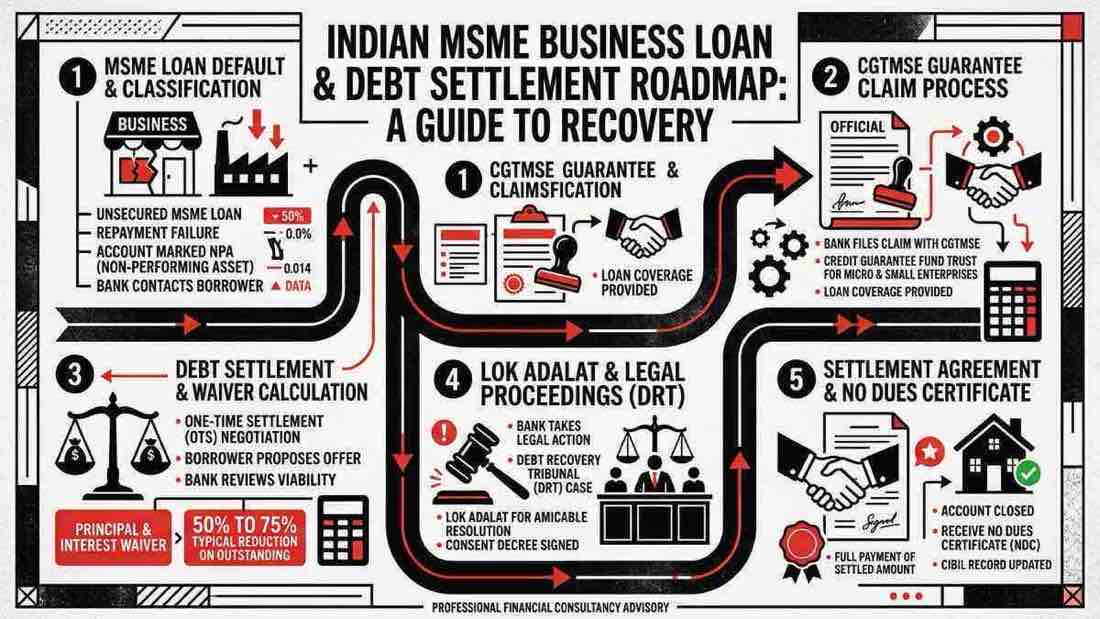
Visual 1.0: Indian MSME business loan default recovery cycle, CGTMSE guarantee interaction, 50%–75% OTS waiver, and No Dues Certificate.
Entity Liability: Sole Proprietor vs Private Limited
Your legal exposure depends heavily on the legal structure of your enterprise:
Under Indian law, a proprietorship has no separate legal existence from its owner. While the lender can technically sue the proprietor personally, attaching personal property requires a lengthy civil court suit and formal decree.
All designated partners remain jointly and severally liable for business loan facilities. Settlement negotiations must encompass all partners to secure a comprehensive joint release.
While a Pvt Ltd company has limited liability, banks almost always mandate a Personal Guarantee (PG) from promoter directors for unsecured loans. If the company defaults, the bank can invoke the guarantee, but cannot touch ancestral or family-owned assets without a formal civil decree.
Interactive Business Loan Settlement Calculator
Select your outstanding business loan balance, lender, entity structure, and delinquency status to estimate your realistic OTS payout and fee waiver:
Business Loan Settlement Calculator
Estimate your realistic One-Time Settlement (OTS) payable amount based on your lender, business structure, and default delinquency stage.
Business Loan Impact on Commercial & Personal CIBIL
Settling an MSME business loan impacts both your company and personal credit histories:
- Commercial CIBIL: Your Company Credit Report (CCR) and CIBIL Rank (scale of 1 to 10) will be severely downgraded.
- Personal CIBIL: The personal credit score of the Proprietor or Guarantor Director drops by 150 to 200 points.
- 5–7 Year Unsecured Loan Freeze: Fresh unsecured business credit lines and credit cards will be blocked.
NO. A loan default or OTS settlement does NOT disqualify your Director Identification Number (DIN) under the Companies Act, 2013. DIN disqualification applies only to statutory non-filings or criminal fraud, NOT to civil loan compromises.
Top 10 Business Loan Lenders Waiver Benchmark
Below is empirical settlement recovery data across the Top 10 Indian Banks & MSME NBFCs:
| # | Lender Name | Product Category | Average Waiver | Realistic OTS Range |
|---|---|---|---|---|
| 01 | HDFC Bank | Business Growth Loans | 42.5% | 50% – 75% Waiver |
| 02 | ICICI Bank | Business Installment Loans (BIL) | 45.0% | 50% – 75% Waiver |
| 03 | State Bank of India (SBI) | SME / Rin Samadhan OTS | 48.0% | 45% – 70% Waiver |
| 04 | Axis Bank | MSME Unsecured Loans | 44.2% | 48% – 72% Waiver |
| 05 | Kotak Mahindra Bank | Business Banking & Commercial | 43.8% | 45% – 70% Waiver |
| 06 | Bajaj Finance | Unsecured MSME Loans | 38.5% | 40% – 65% Waiver |
| 07 | Tata Capital | SME Working Capital | 39.0% | 40% – 65% Waiver |
| 08 | Lendingkart | Digital Fintech MSME | 46.5% | 45% – 70% Waiver |
| 09 | FlexiLoans / NeoGrowth | Merchant POS Advances | 44.0% | 40% – 68% Waiver |
| 10 | Poonawalla Fincorp / IIFL | Business Enterprise Loans | 41.5% | 42% – 68% Waiver |
Tip: Unsecured business loans compound at 16%–22% interest plus penal charges. Formal representation to the Zonal MSME Settlement Desk unlocks 60%+ waivers past 180 DPD.
Tip: Managed by central Debt Service Management (DSM). Submitting audited balance sheets proving operational losses expedites compromise approval.
Tip: Periodically rolls out the official "Rin Samadhan" OTS scheme. National Lok Adalat conciliation benches offer formal compromise awards with clean No Dues Certificates.
Tip: High initial telecalling intensity. Escalating directly to the Principal Nodal Officer (PNO) with GST turnover drop proofs triggers bilateral settlement talks.
Tip: Early Section 25 PSS Act legal notices are common. Engaging the Regional Recovery Manager before legal escalation secures substantial waiver on penal fees.
Tip: High-volume lender with aggressive third-party agencies. Formal written hardship emails bypass agency callers to access genuine OTS pools.
Tip: Structured corporate evaluation. Single-shot upfront bullet payments achieve the highest haircut approvals compared to installment-based settlements.
Tip: 100% digital NBFC. Uses online dispute resolution (ODR). Settlement agreements are executed smoothly via virtual conciliation hearings with quick NDC dispatch.
Tip: Daily/weekly NACH auto-debits inflate bounce levies. Halting mandates forces 180 DPD write-off where 50%+ waivers are routinely agreed.
Tip: Receptive to hardship claims supported by GST cancellation or business premises surrender proofs. Always verify official corporate sanction on letterhead.
- Why Average Waivers Range from 40% to 50%: Unsecured business loans carry higher interest rates (16%–24% p.a.) and steep bounce penal levies, meaning over half the outstanding dues represent non-principal interest.
- Up to 75% in Special Pools: Once an account crosses 180+ DPD and is scheduled for National Lok Adalat or technical write-off, regional zonal committees are authorized to approve up to 75% haircuts.
- No Fixed Mandate: Per RBI June 2023 directives, all settlements must adhere to the lender's Board-Approved OTS policy. Verbal promises from collection telecallers hold zero legal standing.
Real Case Study: Delhi MSME ₹28 Lakh Loan Settled at 68% Haircut
Here is the step-by-step breakdown of a real-world MSME unsecured loan settlement finalized for an auto-components wholesale proprietorship based in Kashmere Gate, Delhi:
The Background: The borrower took an unsecured MSME term loan of ₹22 Lakhs to finance inventory. Following the insolvency of their primary OEM buyer, business cash flow collapsed, leading to default.
The Strategy: The owner immediately halted recurring NACH mandates, diverted telecallers to registered email, and submitted a formal hardship representation citing audited balance sheets showing operating losses.
The Resolution: At 210 DPD (in the written-off NPA pool), the case was referred to National Lok Adalat (Patiala House Courts Bench). A formal compromise award of ₹9,10,000 was recorded as a binding consent decree. The bank issued a full No Dues Certificate within 25 days.
CGTMSE & Mudra Loan (PMMY) Settlement Reality
Government-backed collateral-free schemes under **CGTMSE** and **PMMY (Pradhan Mantri Mudra Yojana)** carry specific default rules:
Under CGTMSE, the Credit Guarantee Trust reimburses the lending bank 75% to 85% of the defaulted amount.
Mudra loans (Shishu up to ₹50,000, Kishore ₹50,000 to ₹5 Lakhs, Tarun ₹5 Lakhs to ₹10 Lakhs) are covered by CGFMU. They are strictly unsecured.
Overdraft (OD) & Cash Credit (CC) Limit Settlement Mechanics
Many MSMEs default on daily-compounding revolving facilities rather than fixed term loans:
When an OD/CC account is expired or unpaid, banks levy monthly penal interest (2%–4% extra) and non-renewal penalties. In an OTS negotiation, 100% of accumulated penal interest is reversed before calculating the principal settlement sum.
For clean business overdrafts, there is no physical asset to seize. If stock or book debts were hypothecated, but stock has degraded or receivables are bad debts, the bank recognizes zero realisable value and accepts a 50% to 65% lump-sum OTS.
Taxation on Business Loan Waivers (Section 28(iv) & 41(1))
Unlike individual consumer loans, business debt waivers have specific income tax implications under Indian tax laws:
If the settled loan was utilized to purchase plant, machinery, or capital assets, the waiver is treated as a capital receipt and is NOT taxable as business income under Section 41(1). However, the actual cost of the asset must be reduced under Section 43(6) for future depreciation calculations.
If the waived amount corresponds to interest or operational expenses that were previously claimed as tax deductions in preceding financial years, that specific remission is deemed taxable business income under Section 41(1) of the Income Tax Act.
Genuine Business Loan Settlement Letter Verification Checklist
Never make payments based on telecaller promises or WhatsApp text messages. Verify these 4 mandatory items:
- ✓1. Unique Internal Reference Number: Must carry a traceable bank settlement code (e.g.
MSME/OTS/2026/HDFC-99120). - ✓2. Full & Final Liability Discharge: Explicit clause stating that upon receipt of ₹X by [Date], all claims against the business enterprise and guarantors stand permanently extinguished.
- ✓3. Direct Loan Account Payment: Payment must be routed strictly to your designated Business Loan Account number (RTGS/NEFT), never to personal QR codes.
- ✓4. Official Bank Domain & Stamp: Delivered as an authorized PDF from the bank's corporate email domain (e.g.
@hdfcbank.com,@sbi.co.in).
Collection agents frequently send fake WhatsApp letters offering “70% discount if you pay ₹50,000 today via Google Pay”. That money is deposited as a regular overdue penalty; your loan remains active with ₹10 Lakhs+ continuing to accrue compound charges.
DRT (₹20 Lakh Threshold), Section 138 & Arbitration Facts
Banks frequently use legal notices to induce panic. Here is the objective statutory reality:
Under the Recovery of Debts and Bankruptcy Act, banks can approach DRT only if the outstanding default is ₹20 Lakhs or more. For loans below ₹20 Lakhs, DRT has zero jurisdiction.
Bounced security cheques (Section 138) and electronic mandate failures (Section 25 PSS Act) are routinely filed. However, these are quasi-criminal compoundable matters. Once an OTS settlement is reached in Lok Adalat, all proceedings are permanently withdrawn.
National Lok Adalat benches offer a formal, judge-supervised venue to lock in a 50% to 75% compromise award. Lok Adalat awards have the status of a civil court decree and CANNOT be appealed by the bank.
RBI June 2023 Compromise Framework & Rights
On June 8, 2023, the Reserve Bank of India issued its landmark circular on Compromise Settlements and Technical Write-offs (RBI/2023-24/40):
All commercial banks and NBFCs must maintain transparent, non-arbitrary criteria for approving compromise settlements for non-wilful defaulters.
Borrowers who execute compromise settlements must undergo a minimum cooling period of 12 months before seeking fresh credit exposure from regulated lenders.
Business Premises Harassment & Supplier Intimidation Tactics
Third-party collection agencies deploy dirty psychological warfare against business owners. Know how to shut them down:
Agents show up during peak customer hours to create public embarrassment.
Agents threaten to inform your suppliers that your business is broke.
Agents claim they will freeze your other bank accounts or cancel your GSTIN.
Business Loan Settlement Request Email Generator
Generate and download this formal written notice to send to your bank or NBFC to request an amicable OTS under the RBI June 2023 framework and demand an immediate halt to commercial harassment:
MSME Business Loan Settlement Letter Generator
Generate an unassailable legal hardship email to demand an amicable One-Time Settlement (OTS), halt unannounced shop/office visits, and stop continuous NACH bounce penalties.
To: The Nodal Officer / MSME Credit & Settlement Committee, [Bank / NBFC Name]
Subject: Formal Request for Amicable One-Time Settlement (OTS) under RBI June 2023 Framework - Business Loan A/C: [Business Loan / OD Account Number] ([Business / Enterprise Name])

Dear Sir / Madam,

I am writing this formal representation on behalf of [Business / Enterprise Name] regarding our unsecured business loan / working capital credit facility (Account Number: [Business Loan / OD Account Number]).

Due to unforeseen commercial distress, specifically Severe Market Downturn & Revenue Loss, our enterprise has suffered severe business revenue contraction, resulting in acute working capital exhaustion. Despite our best efforts, our operating cash flows are currently insufficient to service the regular monthly installments.

We wish to place on record that our enterprise and its promoters are law-abiding businesspersons and NOT wilful defaulters under the RBI Master Circular. We hold bona fide intent to settle our obligations. However, full debt servicing under the original amortization schedule is commercially impossible. We are actively arranging emergency capital from personal savings and family to fund a realistic, lump-sum One-Time Settlement (OTS).

Under the Reserve Bank of India's "Framework for Compromise Settlements and Technical Write-offs" (RBI/2023-24/40 DOR.STR.REC.20/21.04.048/2023-24 dated June 8, 2023), we formally request:

1. Amicable One-Time Settlement (OTS):
Please place our loan account before your Board-Approved Settlement Committee for a compromise settlement with the maximum permissible waiver on accrued penal interest, compound charges, and overdue fees, in view of our documented commercial hardship.

2. Immediate Suspension of NACH / Auto-Debit Presentations:
Kindly suspend presenting electronic mandates, NACH, or cheque clearing instructions against our current account. Because the account holds insufficient balance, continuous automated presentations merely accrue avoidable bank bounce charges and penal levies without recovering any dues.

3. Commercial Premises & Reputational Protection:
We request that your recovery agents and field executives refrain from unannounced visits to our factory, office, retail shop, or commercial premises, and strictly refrain from contacting our clients, vendors, or suppliers. Such actions cause irreparable damage to our business goodwill and hinder our revival efforts. All communications must strictly be maintained in writing on our registered email address ([Your Registered Business Email]).

4. Formal Consolidation of Prior Notices:
Please treat this communication as our formal consolidated reply to all past demand notices, legal letters, and telecalling alerts.

Upon receipt of an official Settlement Proposal on your bank's letterhead bearing an authorized reference number, we will make earnest arrangements to remit the agreed OTS amount via RTGS/NEFT directly into the loan account.

Yours sincerely,

[Proprietor / Managing Partner / Director Name]
Authorized Signatory for: [Business / Enterprise Name]
Entity Structure: Sole Proprietorship
Loan Account: [Business Loan / OD Account Number]
Registered Email: [Your Registered Business Email]
Registered Phone: [Your Registered Contact Number]
5-Step MSME Loan Settlement Protocol & NDC Escalation
Stop automated e-mandates and recurring ECS instructions to prevent continuous bounce penalties.
Use our free generator tool to formally submit your commercial distress representation citing the RBI June 2023 Framework.
Never negotiate over the phone. Direct all correspondence to registered email to maintain unassailable documentation.
Ensure the letter contains an internal reference ID, full liability release clause, and official bank seal.
Remit funds via RTGS directly into the loan account and enforce the 30-Day NOC Escalation Ladder.
Business Loan Settlement FAQs
Can I settle an unsecured business loan for a 50% to 75% waiver in India?+
Yes. Unsecured business loans from banks like HDFC, ICICI, Axis, SBI, and NBFCs routinely settle at 50% to 75% waivers once accounts enter 180+ DPD (written-off pools). Because commercial loans carry 16% to 24% annual interest plus heavy penal bounce charges, over half of the ballooned overdue balance represents non-principal interest. Once classified as NPA, lenders prefer recovering a discounted lump sum over lengthy civil recovery suits.
Can the bank seize my personal home or car for an unsecured business loan default?+
No. For pure unsecured business loans without asset mortgage, the bank has zero direct right to seize or auction your personal residence, vehicle, or ancestral property. In a Sole Proprietorship, the owner has unlimited liability, but attaching personal assets requires a formal civil court decree-a process that takes years. For Private Limited companies, personal assets are protected unless the Director signed a personal guarantee, and even then, execution requires formal court adjudication.
If my business loan was covered under the CGTMSE or Mudra scheme, can I still settle with the bank?+
Yes. While the Credit Guarantee Fund Trust for Micro and Small Enterprises (CGTMSE) or CGFMU reimburses the lending bank a partial claim payout (typically 75% to 85% of default), the borrower is still legally liable for the residual debt. Banks are actively empowered by the RBI to execute One-Time Settlements (OTS) on CGTMSE and Mudra accounts at 40% to 65% discounts to close the NPA file and remit recovery dividends back to the Trust.
What legal action can the bank take if my business loan default is above ₹20 Lakhs? (DRT Reality)+
For debts of ₹20 Lakhs and above, banks can approach the Debt Recovery Tribunal (DRT) by filing an Original Application (OA). However, DRT is a specialized civil recovery court, not a criminal court. It cannot issue arrest warrants or send police to your home or office for simple default. Furthermore, DRT proceedings frequently refer cases to Lok Adalat or court-annexed mediation benches where borrowers negotiate 50% to 70% OTS compromise decrees.
Can recovery agents visit my office, shop, or contact my clients and suppliers?+
No. Contacting your clients, vendors, suppliers, or employees to reveal your debt and destroy your business reputation is strictly illegal under the RBI Master Directions on Recovery Conduct. You are not obligated to let recovery agents enter your shop, office, or factory. Demand that all collection communications be routed in writing to your registered business email.
Find this content helpful?
If this guide has helped you navigate your settlement journey, consider showing some support to keep this platform running.