THE GROUND REALITY OF GOLD LOAN DEFAULT & AUCTION.
Gold Loan Default, Auction & Settlement Guide India
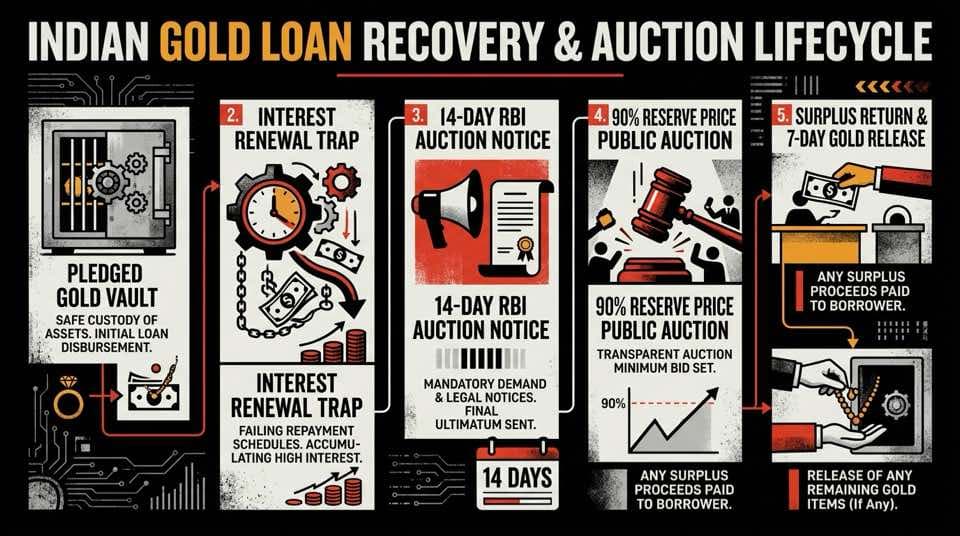
Visual 1.0: Indian gold loan lifecycle: Initial pledge, 24% interest renewal trap, mandatory 14-day RBI notice, 90% reserve auction, surplus refund, and 7-day release mandate.
A gold loan in India is a secured pledge under Section 176 of the Indian Contract Act (not SARFAESI). If you default, lenders cannot seize other assets without court orders, but they can auction your pledged gold. Under RBI Master Directions, lenders must provide at least 14 days written notice, set a reserve price at 90% of market value, and refund any auction surplus to you. If you redeem in full, lenders must return your physical gold within 7 working days or pay ₹5,000/day statutory compensation.
01. What Is a Gold Loan, Really? (Pledge vs Mortgage)
When you take a home loan, you create a mortgage under SARFAESI. When you take a personal loan, it is 100% unsecured. But a gold loan is a bailment of movable goods (Pledge) governed strictly by Section 176 of the Indian Contract Act, 1872.
The Ground Reality Difference:
- No DRT or Magistrate Court Needed: The bank already holds your gold in their vault. They do not need court warrants or police to take possession.
- No SARFAESI Power on Other Assets: Lenders cannot use the gold loan default to seal your house, freeze salary accounts, or repossess your car.
- The Single Threat: Their only immediate power is auctioning the specific pledged gold packet to recover their principal, interest, and charges.
NBFC branches sell gold loans as “instant 15-minute emergency cash” without ever explaining how compound interest and monthly renewal rollovers transform a temporary ₹2 Lakh loan into an inescapable multi-year financial leak.
02. The Renewal & Interest-Only Trap (The #1 Money Drain)
Across Reddit (r/CreditCardsIndia) and Quora, the single most reported regret from gold loan borrowers is the “Continuous Renewal Trap.”
The ₹3 Lakh Muthoot Renewal Story (2 Years Later)
A borrower pledged 65 grams of family gold for ₹3,00,000 at 24% p.a. Every 6 months, the branch called urging: “Sir, just pay ₹36,000 interest and we will renew your gold loan for another 6 months.”
Why lenders love renewals: NBFCs earn high yields on gold loans without taking credit risk because gold prices historically rise. When you renew, the branch collects fresh processing fees and keeps you paying 24%–30% APR forever.
03. The Multi-Lender Stacking Danger (RBI 1.9% Alert)
According to recent Reserve Bank of India retail credit risk reports, borrowers holding 5 or more active gold loans across different lenders exhibit a 1.9% delinquency rate - nearly double the industry average.
How Stacking Triggers Simultaneous Auctions:
When cash flow breaks, stacked borrowers scramble to pay interest to one lender by borrowing on gold from another. When gold prices fluctuate or monthly cash dries up, multiple NBFCs issue 14-day auction notices simultaneously, forcing borrowers to forfeit family heirlooms at distress prices.
04. The 5-Stage Auction Timeline (From Default to Hammer)
Unlike the lengthy 6-stage SARFAESI timeline for houses (which takes 6–18 months), a gold loan auction moves swiftly:
Maturity / Interest Overdue Reminder
Automated SMS, WhatsApp alerts, and telecalling from branch staff urging payment of overdue interest or renewal.
Pre-Auction Warning Letter
Formal registered demand notice stating that failure to clear dues will result in the account being marked for collateral liquidation.
Statutory Written Auction Notice
Under RBI Directives, lenders must give at least 14 days prior notice before auctioning. Must specify packet number, gold weight, and exact dues.
Public Newspaper Advertisement
Public notice in local and national newspapers announcing the date, time, and venue/portal of the public gold auction.
Public Auction & Account Reconciliation
Gold is auctioned to certified jewellers/bidders. Any surplus must be refunded; any shortfall converts to unsecured deficiency debt.
05. The 90% Reserve Price Rule (Why Your Gold Can't Be Sold for Peanuts)
Historically, borrowers complained that rogue branches conducted “sweetheart auctions” to friendly jewellers at 50%–60% of market value, wiping out borrower equity.
The RBI 2025/2026 Reserve Price Mandate:
Under the unified RBI Gold Loan Directions, the auction reserve floor is strictly locked to 90% of the preceding 30-day average closing price of 22-carat gold (published by the India Bullion and Jewellers Association - IBJA). Lenders cannot legally accept bids below this reserve price.
06. The Surplus Secret & Cross-Lien Trap (Money Owed to You)
Because gold prices appreciate over time, when an auction happens, the realized auction value often exceeds the loan principal and interest.
Example of an Auction Surplus:
⚠️ The Banker's General Lien (Section 171) Trap:
If you have an overdue credit card or personal loan with the same bank (e.g. HDFC Bank, SBI, Axis Bank, Kotak Mahindra Bank, or ICICI Bank), the bank may silently adjust your gold loan auction surplus against your credit card debt without your consent.
Defense: Serve our Anti-Cross-Lien Objection Notice before the auction date to record your formal dispute and prepare an RBI Ombudsman filing.
07. What Happens If There Is a Shortfall (Post-Auction Debt)
If severe interest accumulation caused total dues to exceed the auction realization, the remaining unpaid balance is called a “Shortfall Balance”.
The Ground Reality of Shortfall Debt:
- It Converts to 100% Unsecured Debt: Because the gold collateral is already sold, the bank has zero remaining asset leverage.
- No More Auction Threats: The lender can only file a civil recovery suit (which takes 5–8 years) or issue demand notices.
- 50%–70% OTS in Lok Adalat: Because recovery costs are high, banks routinely accept 50% to 70% waivers on shortfall balances in National Lok Adalat.
08. The 7-Day Gold Release Rule & ₹5,000/Day Penalty
A major grievance on Quora is branch staff delaying gold return after full payment with excuses like “the key holder is on leave” or “ornaments are in regional vault.”
RBI Mandatory Release Directive & Penalty Clause
Under RBI Directives, lenders must hand over physical gold ornaments on the date of settlement or within a strict maximum of 7 working days.
09. Top 10 Gold Loan Lenders Benchmark Matrix (2026)
Empirical interest rates, auction trigger timelines, renewal tactics, and surplus recovery profiles across India's leading gold lenders.
Muthoot Finance
Manappuram Finance
IIFL Finance
State Bank of India (SBI)
HDFC Bank
Federal Bank
Canara Bank
Indian Bank
Kotak Mahindra Bank
CSB Bank (Catholic Syrian)
10. Gold Loan Auction vs Redemption Calculator
Gold Loan Auction & Renewal Calculator
Compute RBI 90% reserve auction surplus vs full redemption equity, or uncover the hidden multi-year interest bleed of NBFC renewal rollovers.
RBI 90% Reserve Realization
True open-market gold value: ₹3,60,000. Mandatory RBI auction reserve haircut is 10%.
Your Retained Gold Equity
Pay only base principal ₹2,50,000 under OTS waiver. You recover 100% of your physical gold ornaments.
11. The Balance Transfer Escape (NBFC 24% → Bank 8.65%)
If your gold is trapped in a 24%–30% NBFC loan and you cannot afford full redemption, a Gold Loan Takeover (Balance Transfer) is the smartest financial rescue move.
4 Steps to Execute a Gold Loan Takeover:
- Get Foreclosure Quote: Request an official written payoff statement from your current NBFC branch detailing principal and interest.
- Apply at a PSU Bank: Visit SBI, Canara Bank, or Indian Bank with your pledge slip. They offer gold loans at 8.65%–9.5% p.a.
- Bank Direct Payoff: The new bank officer accompanies you or issues a direct banker's cheque / RTGS to pay off the old NBFC.
- Gold Re-Pledged at Low Rate: The gold is retrieved from the NBFC vault and immediately re-pledged with the PSU bank, cutting your annual interest by 60%+.
12. Free Legal Notice Generator (3-in-1 Suite)
Gold Loan Legal Notice & Dispute Tool
Draft legally enforceable redemption requests, auction surplus recovery notices, or ready-to-file RBI Ombudsman complaints in 60 seconds.
Send via Registered AD Post and from your registered email directly to the lender's Principal Nodal Officer.
13. Gold Loan Default & CIBIL: The Full Truth
A common myth among Indian borrowers is: “Since the bank already holds my gold, default won't affect my CIBIL score.” This is 100% false.
How Gold Loan Defaults Are Reported to Bureau:
- Monthly 30/60/90 DPD Updates: Every missed interest date is reported to CIBIL, Experian, Equifax, and CRIF High Mark.
- 90 DPD NPA Flag: At 90 days of non-payment, your bureau score drops by 60 to 120 points.
- ‘Settled’ Tag After Auction: If your loan is closed via auction or compromise waiver, the account is marked ‘Settled’, which severely blocks future home or personal loan approvals for 7 years.
14. Frequently Asked Questions
Can a bank or NBFC auction my gold without sending a formal notice in India?▼
No. Under the Reserve Bank of India (RBI) Lending Against Gold Collateral Directions and Section 176 of the Indian Contract Act, 1872, lenders are legally mandated to serve a minimum 14-day prior written notice via registered post or verifiable electronic communication before initiating any public auction. In landmark judgments including Kotak Mahindra Bank v. Sarmila Sharma (2026) and Mamina Mallick v. Bank (2025), consumer courts and High Courts have repeatedly set aside auctions and awarded full market-value compensation when lenders failed to serve proper notice.
What happens to the extra money if my gold sells for more than what I owe?▼
If your pledged gold fetches an auction price higher than your outstanding principal, legitimate contractual interest, and reasonable advertisement costs, the lender is legally required under Section 176 to refund the net surplus to your bank account within 7 to 15 working days. Beware that some banks attempt an illegal "cross-lien" (Section 171) to divert this surplus toward unpaid credit card or personal loan dues; you can formally block this by filing an objection notice and escalating to the RBI Ombudsman.
What is the "Gold Loan Renewal Trap" and how does it drain borrower money?▼
NBFC branches routinely push borrowers into 3-month or 6-month interest-only renewals instead of encouraging principal reduction. Under this trap, a borrower with a ₹3 Lakh loan at 24% p.a. pays over ₹72,000 in interest each year, but after 2 or 3 years of renewals, still owes the exact original ₹3 Lakh principal. The borrower ends up paying more than the original loan value in interest alone.
What is the RBI 7-day gold release rule and penalty compensation?▼
Under RBI Master Directions effective 2025/2026, once a borrower pays the full settlement amount or loan payoff, the bank or NBFC is legally mandated to release and hand over the physical gold jewellery within seven (7) working days. If the lender delays returning the gold due to internal vault issues or administrative negligence, the lender must pay the borrower statutory compensation of ₹5,000 per day for every day of delay.
Can I redeem my gold on the day of the auction or just before it sells?▼
Yes. Under Section 176 of the Indian Contract Act, 1872, the borrower’s Right of Redemption remains legally intact until the actual hammer falls and the sale is finalized. If you arrange the funds and demand redemption before the auction concludes, the branch manager cannot refuse your payment.
Does defaulting on a gold loan damage my CIBIL score?▼
Yes. All RBI-regulated banks and NBFCs (including Muthoot, Manappuram, IIFL, SBI, and HDFC) report gold loan repayment performance to all four credit bureaus monthly. At 90 days past due (DPD), the account is flagged as a Non-Performing Asset (NPA). If closed via a compromise discount on interest, it is tagged as "Settled", which stays on your bureau record for 7 years.
How does a Gold Loan Balance Transfer (Takeover) save money?▼
A balance transfer involves moving your loan from a high-interest NBFC (charging 24%–30% p.a.) to a public sector bank like SBI, Canara, or Indian Bank (charging 8.65%–9.5% p.a.). The new bank inspects the pledge receipt, remits the payoff directly to the old lender, retrieves the gold collateral, and re-pledges it at less than half the interest cost, saving ₹40,000 to ₹60,000 per year on a ₹3 Lakh loan.
What should I do if the auction proceeds are less than my loan balance (Shortfall)?▼
If a distress auction realization fails to cover your debt, the remaining balance becomes an unsecured deficiency debt ("Shortfall Balance"). The lender cannot seize other assets without filing a civil recovery suit. You can negotiate a 50% to 70% One-Time Settlement (OTS) on this residual unsecured shortfall balance in National Lok Adalat.
Official Statutory Grievance Portals:
Find this content helpful?
If this guide has helped you navigate your settlement journey, consider showing some support to keep this platform running.