The Ground Reality of Home Loan Settlement & SARFAESI.
Indian Home Loan Default, SARFAESI & Settlement Guide
Defaulting on a home loan triggers the heavy machinery of the SARFAESI Act, 2002. Because the bank holds original Title Deeds under an Equitable Mortgage, they will not give massive 70% principal cuts like credit cards. But you can stop distress e-auctions, secure 100% penal interest waivers, protect your home equity via Private Treaty Sales, and obtain stays in the Debt Recovery Tribunal (DRT).
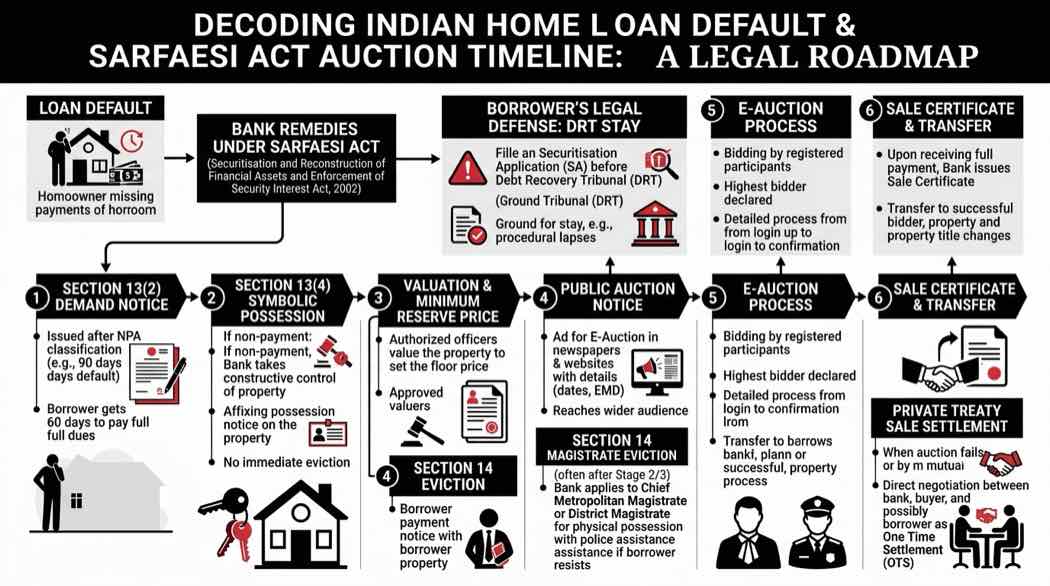
Visual 1.0: Indian home loan recovery lifecycle under SARFAESI Act 2002, Section 13(2) notice, DRT stay applications, 100% penal interest waiver OTS, and Private Treaty Sale exits.
Home loans are secured debts. Banks issue a 60-day notice under Section 13(2) of the SARFAESI Act upon 90 DPD default, followed by Section 13(4) symbolic possession and Section 14 magistrate eviction. While standard principal haircuts are rare on high-value properties, banks routinely approve One-Time Settlements (OTS) waiving 100% of compound penal interest, grant 25%–50% haircuts on stalled/distressed properties with zero auction bidders, and permit Private Treaty Sales under Section 13(8) so you pocket your surplus equity instead of suffering a 30% distress auction loss.
The Ground Reality: Secured Debt vs Unsecured Settlement
The biggest mistake distressed borrowers make is treating a home loan like a credit card. When you take a housing loan from State Bank of India, HDFC Bank (post-HDFC Ltd merger), Axis Bank, Kotak Mahindra Bank, Bajaj Housing Finance (BHFL), LIC Housing Finance, or ICICI Bank, the bank creates an Equitable Mortgage via Memorandum of Deposit of Title Deeds (MODTD). They hold your original Sale Deed, Mother Deed, and sanction plans.
100% Penal Interest Waiver
Over 30% to 50% of the inflated bank demand after 1–2 years of default consists of compound penal interest (18%–24% APR), bounce fees, and legal inspection charges. In a standard OTS, banks routinely waive 100% of these penal fines if you pay the base principal in a single lump sum.
Negative Equity & Stalled Projects (25%–50% Haircut)
If the property is part of a stalled builder project (e.g. Noida/NCR ghost towers), has title defects, or repeated public e-auctions have failed under SARFAESI Rule 9(5) due to lack of buyers, banks face total capital write-off and approve 25% to 50% principal haircuts.
The 6-Stage SARFAESI Auction Timeline
The Securitisation and Reconstruction of Financial Assets and Enforcement of Security Interest Act (SARFAESI Act), 2002 allows banks to seize and sell mortgaged properties without going through lengthy civil court trials. Here is the exact statutory timeline:
Stage 01: 1–89 DPD (Special Mention Accounts)
Pre-NPABorrower misses 1 to 3 EMIs (SMA-0: 1–30 days, SMA-1: 31–60 days, SMA-2: 61–90 days). Automated reminder SMS, phone calls, and 2% per month compound penal charges begin accruing.
Stage 02: 90 DPD (NPA Classification)
NPA TriggerAccount is classified as NPA under RBI prudential norms. The regular branch manager loses settlement authority; the file is transferred to the Stressed Assets Recovery Branch (SARB).
Stage 03: Section 13(2) Demand Notice (60-Day Window)
60 DaysThe bank serves a formal demand notice demanding full payment of all dues within 60 days. Crucial Right: The borrower has the statutory right to file written objections under Section 13(3A), which the bank is legally obligated to answer within 15 days.
Stage 04: Section 13(4) Symbolic Possession
ConstructiveIf the 60-day notice is ignored, the bank takes “symbolic possession”, pastes a possession notice on the building gate in front of 2 witnesses (Panchnama), and publishes it in 2 leading newspapers (1 English, 1 Vernacular).
Stage 05: Section 14 Magistrate Eviction
Lockout OrderTo take actual physical possession, the bank applies to the District Magistrate (DM) or Chief Metropolitan Magistrate (CMM). The Magistrate appoints an Advocate Commissioner with police assistance to execute physical lockout and inventory sealing.
Stage 06: Rule 8 & 9 Public E-Auction (30-Day Notice)
Public SaleThe bank values the property via approved valuers, sets a reserve price, issues a 30-day public auction notice, and conducts an online bidding auction on portals like IBAPI (ibapi.in).
Private Treaty Sale (The Smart Exit vs Distress Auction Loss)
When a bank auctions your property, they set a low reserve price to ensure quick sale. A home worth ₹80 Lakhs is routinely auctioned off for ₹55 Lakhs. The bank clears their loan and legal costs, and you lose ₹25 Lakhs of your hard-earned equity.
How a Private Treaty Tripartite Sale Works (Section 13(8))
Under Section 13(8) of the SARFAESI Act, you retain the legal Right of Redemption before auction completion. Follow this 4-step sequence:
Home Loan OTS vs Auction Loss Calculator
Calculate your exact penal interest savings, distress auction losses, and net surplus cash under a Private Treaty Sale:
Home Loan OTS vs Distress Auction Calculator
Compare your real financial outcome under a Bank E-Auction vs a 100% Penal Waiver Private Sale.
⚠️ Warning: The auction fails to clear the full loan! The bank will legally pursue you for the remaining shortfall balance.
✓ Finding your own buyer with a bank Tripartite NOC saves you ₹22.00 Lakhs more than a distress bank auction.
Debt Recovery Tribunal (DRT) Defense & Stay Petitions
Civil courts are barred from interfering in SARFAESI matters (Section 34). Your sole judicial remedy is filing a Securitisation Application (SA) before the Debt Recovery Tribunal (DRT) under Section 17 within 45 days of any Section 13(4) or Section 14 action.
Severe Undervaluation by Bank Valuer
Banks often use conservative distress valuations that ignore circle rates and market appreciation to conduct fast sales. Filing an independent Government Approved Valuer report in DRT proving gross undervaluation is prime ground for an immediate auction stay.
Non-Disposal of Section 13(3A) Objections
If you submitted a written representation to the 13(2) notice and the bank took possession under 13(4) without sending a reasoned reply within 15 days, the Supreme Court (*Mardia Chemicals vs Union of India*) holds that the entire recovery process is vitiated and legally invalid.
The 25%–50% Pre-Deposit Caution in DRAT Appeals
While filing an SA in the DRT does not require a pre-deposit, appealing a DRT order before the Debt Recovery Appellate Tribunal (DRAT) under Section 18 requires a mandatory pre-deposit of 25% to 50% of the debt. Focus your legal firepower on winning at the DRT stage.
Top 10 Home Loan Lenders SARFAESI & OTS Benchmarks
Empirical recovery speeds, penal interest waiver policies, and auction aggressiveness across the Top 10 Indian Home Loan Lenders:
State Bank of India (SBI)
HDFC Bank
LIC Housing Finance (LIC HFL)
ICICI Home Finance
PNB Housing Finance
Axis Bank
Bank of Baroda (BoB)
Kotak Mahindra Bank
Tata Capital Housing
Bajaj Housing Finance
Real Case Study: Noida Stalled Project ₹65L Home Loan OTS
An anonymized case study of a software engineer in Noida who faced default on a ₹65 Lakh home loan after the builder delayed possession for 5 years:
Paying EMI & Rent Simultaneously
Borrower had an outstanding principal of ₹52 Lakhs. Due to tech layoffs, he could no longer service the ₹56,000 monthly EMI while paying ₹28,000 house rent. Loan defaulted in 2024.
SARFAESI Notice & Compound Penalty Escalation
The bank classified the loan as NPA, issued a Section 13(2) notice demanding ₹68 Lakhs (including ₹16 Lakhs in compound penal interest and legal fees), and attempted an e-auction.
DRT Stay & 100% Penal Waiver OTS
The borrower filed an SA in DRT proving the builder failed to deliver completion certificates, making the property illiquid. With zero auction bidders, the bank approved an OTS of ₹48 Lakhs (100% penal interest waived + ₹4 Lakh principal concession), settled via a Tripartite sale to a cash investor.
Co-Borrower & Personal Guarantor Legal Liability
Most Indian home loans require spouses, parents, or siblings as co-applicants. Understand the legal distinction:
Joint Co-Applicant (Spouse / Co-Owner)
Co-applicants share 100% primary liability. The Section 13(2) notice is addressed to both parties. Their individual CIBIL scores drop by 150+ points simultaneously and both PAN cards are flagged as “Settled” upon compromise.
Third-Party Personal Guarantor
Under Section 128 of the Indian Contract Act, 1872, the guarantor's liability is co-extensive with the borrower. The bank can proceed against the guarantor's personal assets only after exhausting the primary mortgage or in the DRT recovery certificate stage.
RBI Mandate: Original Title Deeds Release Within 30 Days
RBI Circular RBI/2023-24/60 (Dec 2023)
Mandatory LawHome Loan Default Impact on CIBIL Score
Understand how credit bureaus (CIBIL, Experian, CRIF) report secured debt resolution:
'Settled' vs 'Closed' vs 'Auction Realized'
• Closed (Private Treaty Sale): If you sell via Private Treaty and clear 100% of the principal, the account is marked “CLOSED” with zero adverse settlement flag.
• Settled (OTS with Haircut): If the bank waives principal capital, it is marked “SETTLED”, causing a 100–150 point CIBIL drop for 5 to 7 years.
• Auction Realized: Flagged as “Written Off - Realization from Security Interest”, indicating involuntary foreclosure.
Recovery Agent Home Visits & Eviction Defense
Third-party field agents routinely intimidate families by threatening immediate lockout. Know the law:
Zero Agent Eviction Power
Recovery agents have zero legal right to force entry or touch household items. Eviction is ONLY legal through a formal Section 14 order signed by the District Magistrate executed with local police.
Private Sale NOC & Hardship Request Letter Generator Tool
Generate a legally binding notice under Section 13(3A) or Section 13(8) of the SARFAESI Act, 2002 to request an amicable Private Treaty Sale or 100% penal interest waiver:
Home Loan Private Sale NOC & SARFAESI Letter Tool
Draft a statutory representation under Section 13(3A) or Private Treaty request under Section 13(8).
Date: August 2026

To,
The Authorized Officer / Chief Manager / Nodal Officer,
State Bank of India,
Asset Recovery Management Branch / Home Loan Cell.

SUBJECT: FORMAL REQUEST FOR PERMISSION FOR PRIVATE TREATY SALE UNDER SECTION 13(8) OF THE SARFAESI ACT, 2002 – HOME LOAN A/C NO: [Loan Account Number]

Respected Sir/Madam,

I, [Your Full Name], am the primary borrower for the Home Loan facility availed under Account No. [Loan Account Number] against the equitable mortgage of the residential property situated at:
[Complete Mortgaged Property Address]

1. REASON FOR DEFAULT & HARDSHIP:
Due to unforeseen and involuntary loss of employment / income contraction, which temporarily disrupted regular monthly EMI cash flows despite my bona fide intention to clear all legitimate dues., the loan account unfortunately entered default. I categorically state that I am a NON-WILFUL defaulter with a clean prior repayment track record.

2. AVOIDANCE OF DISTRESS AUCTION LOSS:
I am fully aware of the bank's statutory powers under the SARFAESI Act, 2002. However, it is an established commercial reality that distress public e-auctions result in severe undervaluation (25%–35% discount), heavy legal/publication expenditure for the bank, and risk of prolonged litigation in the Debt Recovery Tribunal (DRT).

3. PROPOSED PRIVATE TREATY RESOLUTION (SECTION 13(8)):
To ensure the bank recovers its legitimate dues immediately in cold cash without administrative delay, I have identified a ready, verified open-market buyer willing to purchase the mortgaged property for a total consideration of ₹65,00,000.

4. REPAYMENT & DOCUMENT RELEASE MODALITY:
a) The prospective purchaser will remit the agreed settlement/loan clearance consideration DIRECTLY into the bank's designated loan escrow account via RTGS/NEFT.
b) The bank shall execute a Tripartite Agreement / issue an unconditional No Objection Certificate (NOC) for the sale.
c) Upon receipt of funds, the bank shall release all original Title Deeds (Sale Deed, Mother Deed, Encumbrance Certificate) and remove the CERSAI charge within 30 days as mandated by RBI Circular RBI/2023-24/60.

I request an in-person meeting within 7 business days to finalize the Tripartite draft.

Yours sincerely,

[Your Full Name]
Contact: [Your Mobile Number]
Email: [Your Email Address]
5-Step Home Loan Survival & Settlement Protocol
File Section 13(3A) Representation Within 60 Days
Never ignore a Section 13(2) notice. Dispatch a formal written objection demanding ledger bifurcation of penal interest.
Propose Private Treaty Sale Under Section 13(8)
Find an open-market buyer willing to pay fair market price directly into the bank loan account via RTGS.
File Securitisation Application (SA) in DRT
If the bank rushes to auction, file an SA under Section 17 in DRT within 45 days challenging improper valuation.
Lock in Written OTS Sanction Letter
Ensure the letter contains an official reference number, 100% penal waiver clause, and full liability discharge on bank letterhead.
Pay Direct & Enforce 30-Day Title Deeds Return
Remit settlement funds via RTGS, collect the No Dues Certificate, and enforce the 30-day title deeds release under RBI rules.
Home Loan Settlement FAQs
Can a home loan be settled with a 50% to 75% haircut like unsecured credit cards in India?+
No. Unlike unsecured credit cards or personal loans, a home loan is 100% secured by an Equitable Mortgage (MODTD) on your property. Because the bank can legally seize and auction the property under the SARFAESI Act, 2002 to recover its dues, they will not give massive principal haircuts on high-value properties. However, banks routinely approve One-Time Settlements (OTS) waiving 100% of accumulated compound penal interest and late fees, and may offer 20% to 40% principal haircuts on stalled builder projects, disputed titles, or properties where repeated auctions have failed under Rule 9(5).
What is the 6-stage SARFAESI Act timeline before a bank can auction my house?+
The SARFAESI process follows a strict 6-stage legal sequence: Stage 1 (1–89 DPD): Early default with overdue notices. Stage 2 (90 DPD): Account classified as a Non-Performing Asset (NPA). Stage 3 (Section 13(2)): Formal 60-day demand notice issued. Stage 4 (Section 13(4)): Symbolic possession taken with Panchnama and newspaper notices. Stage 5 (Section 14): District Magistrate (DM/CMM) physical eviction order with police assistance. Stage 6 (Rule 8 & 9): Public e-auction with 30-day notice setting reserve price.
How does a Private Treaty Sale (Tripartite Agreement) save money compared to a bank distress e-auction?+
In a public bank e-auction, properties are sold under distress conditions at 25% to 35% below fair market value, and the bank deducts heavy legal and publication fees. In a Private Treaty Sale under Section 13(8), you find your own open-market buyer who pays full market price directly to the bank via RTGS. The bank waives 100% of penal charges, clears your loan, returns your original Title Deeds within 30 days, and you pocket the remaining surplus cash.
Can the Debt Recovery Tribunal (DRT) grant a stay on a bank property auction?+
Yes. Under Section 17 of the SARFAESI Act, 2002, borrowers can file a Securitisation Application (SA) within 45 days of any Section 13(4) or Section 14 action. Common grounds for interim stays include undervaluation of the property by the bank's valuer, failure to respond to borrower's Section 13(3A) objections within 15 days, defects in auction notices, or procedural violations in possession notices.
What are the RBI rules on returning original property Title Deeds after loan settlement?+
Under RBI Circular RBI/2023-24/60 (effective December 1, 2023), all banks, NBFCs, and housing finance companies are legally mandated to release all original property documents (Sale Deed, Mother Deed, Khata/Patta) and remove the CERSAI charge within 30 days of full loan repayment or OTS settlement. If the lender delays beyond 30 days, they must pay the borrower statutory compensation of ₹5,000 per day of delay.
Can recovery agents physically throw my family and belongings out of our house without a court order?+
Absolutely not. Third-party recovery agents have zero legal authority to enter your home, change locks, or evict residents. Physical possession can only be executed by an Advocate Commissioner appointed by the District Magistrate (DM) or Chief Metropolitan Magistrate (CMM) under a formal Section 14 SARFAESI order accompanied by official police personnel.
How does a home loan default affect co-borrowers and personal guarantors?+
Co-borrowers (such as spouses) and personal guarantors share joint and several liability under Indian contract law. When a home loan defaults, the Section 13(2) notice is issued to all co-signers, and a 'Settled' or 'Written Off' tag is reported to CIBIL against the PAN cards of all co-applicants simultaneously, freezing their access to fresh credit.
Is agricultural land protected from SARFAESI bank auctions in India?+
Yes. Under Section 31(i) of the SARFAESI Act, 2002, the provisions of the SARFAESI Act do NOT apply to any security interest created in agricultural land. Banks cannot issue Section 13(2) or auction agricultural land without filing a regular civil suit in a civil court, which takes years.
What happens if the bank auction proceeds are less than my total home loan outstanding balance?+
If the auction sale proceeds fail to cover your outstanding debt (a 'Shortfall Balance'), the bank does not automatically forgive the difference. The bank will issue a demand notice for the remaining unsecured balance and may file a recovery application before the DRT or Lok Adalat. You can then negotiate an OTS for the residual shortfall at a 60% to 80% waiver.
What is Section 13(3A) and how does it protect borrowers after receiving a 60-day demand notice?+
Section 13(3A) gives the borrower the legal right to submit a formal written representation and objection to the Section 13(2) demand notice within the 60-day period. The bank is legally required to examine the objections, and if rejected, communicate the reasoned decision in writing within 15 days. If the bank fails to reply within 15 days, any subsequent possession or auction can be quashed by the DRT.