WARNING: THIS IS NOT LEGAL ADVICE. THIS IS SURVIVAL GUIDANCE BASED ON STATUTORY INDIAN LAW AND BORROWER EXPERIENCE.
UPDATED: SEPTEMBER 2026

CIBIL Settled to Closed Status: NDC Procurement and Dispute Rules

Convert Settled Remark to Closed and Erase 7-Year Block

When you settle a loan through a One-Time Settlement (OTS), your lender reports the account to credit bureaus as Settled rather than Closed. This single remark cuts your credit score and flags your profile to institutional underwriting algorithms for up to seven years. You can legally convert a Settled status into a clean Closed record by repaying the waived balance, securing an official No Dues Certificate, and enforcing your dispute rights under the Credit Information Companies Act.

Quick Answer: Can You Remove Settled Status?

Under RBI rules and the Credit Information Companies (Regulation) Act, 2005, a Settled remark indicates that the bank accepted a partial payment and absorbed a loss. To convert this status to Closed, you must pay back the exact waived haircut amount directly into your original loan account. Once paid, the bank must issue a formal No Dues Certificate (NDC) and transmit the updated Closed status to all four credit bureaus (CIBIL, Experian, Equifax, and CRIF High Mark) within 30 calendar days under RBI Circular RBI/2023-24/72, or pay you ₹100 per day in compensation.

Ground Reality NoteBook Rules vs Reality
The Harsh Reality: Why System Slowness Demands Direct Self-Protection

All these RBI rules, regulatory guidelines, and police FIR provisions exist officially in the books. However, the ground reality is that the Indian judicial and police system moves very slowly. In most everyday cases, lodging a formal complaint or filing an FIR will not give you immediate relief from aggressive collection calls.

The honest fact is: until all of your outstanding loans are either officially settled (via One-Time Settlement) or fully closed, the probability of getting complete peace of mind from recovery agencies is very low.

Pro Survival Tips for Immediate Peace:

1. Change Your Mobile Number: Switch to a fresh SIM card for daily use, sharing it strictly with close family. Keep your old loan-registered SIM on silent in a spare phone to check SMS once weekly for official bank notices. This instantly cuts off the non-stop daily barrage of abusive phone calls.

2. Shift Your Residential Address: If recovery agents or local collection musclemen know your rented flat and keep showing up to humiliate you before neighbors, relocate to a different address if possible to protect your family from doorstep embarrassment.

3. Delete the Loan App & Revoke All Permissions: Immediately uninstall the lending app from your smartphone. Before deleting, open phone settings, revoke all permissions (contacts, storage, camera, location), and clear app data so trackers cannot continue harvesting your real-time data or accessing your contact list.

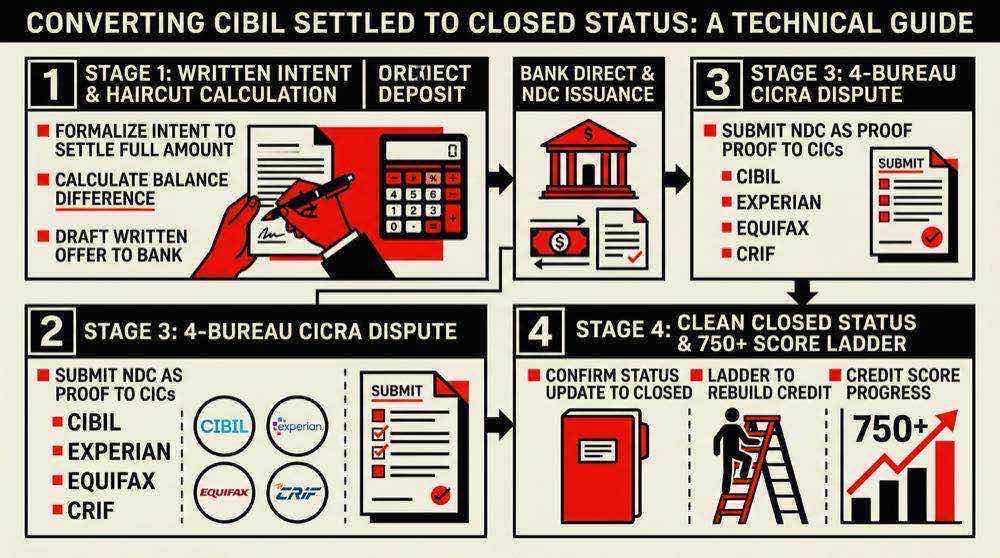
Step-by-step roadmap to convert CIBIL settled status to closed status using NDC

Visual Blueprint: 4-stage statutory protocol for repaying haircut dues, obtaining bank NDC, and resolving bureau disputes.

01. Settled vs Closed: The 7-Year Credit Penalty

Under the Credit Information Companies (Regulation) Act, 2005 (CICRA), credit institutions report the operational standing of every loan facility every 30 to 45 days. Understanding the distinction between Closed, Settled, and Written-Off is critical for your financial recovery.

The Madras High Court clarified that Section 21 of CICRA 2005 provides the primary statutory remedy for updating inaccurate bureau records. You must first exhaust this 30-day statutory update process before seeking arbitration under Section 18.

Status: ClosedClean Status

The borrower paid 100% of the principal, contractual interest, and authorized fees. The loan agreement terminated with zero loss to the lending institution. Bureau impact is positive, and future loan approvals remain unhindered.

Status: Settled7-Year Flag

The borrower experienced financial distress and paid only a compromised lump-sum amount. The lender agreed to stop recovery and waived the remainder as a credit loss. Bureau impact is negative; the remark stays on your bureau profile for up to 7 years, triggering automated rejections on home and auto loan applications.

Status: Written-OffSevere Default

The borrower stopped paying entirely, and the lender classified the outstanding amount as a 100% bad debt after 180 days of non-payment. This is the most damaging tag possible, halting all credit approvals across all registered lenders in India.

The Practical Borrower Takeaway:

A settlement stops legal action and recovery harassment immediately. However, underwriting engines treat a Settled tag as an indicator of past default. If you need a large secured loan in the future, converting this entry into Closed is essential.

02. The Haircut Balance: What You Must Repay

The term haircut refers to the exact portion of your loan balance that the bank agreed to waive during your One-Time Settlement. For example, if your total unpaid dues were ₹5,00,000 and the bank sanctioned an OTS settlement of ₹2,00,000, the haircut amount is exactly ₹3,00,000.

Under Section 63 of the Indian Contract Act, 1872, the bank accepted partial payment to discharge the original contract. To convert your CIBIL record from Settled to Closed, you are not applying for a new loan. Instead, you are voluntarily offering to pay back the waived haircut balance to restore your creditworthiness.

The Full Principal vs Inflated Penalties Rule:

Before paying any additional money, write to the bank Nodal Officer requesting an official calculation of the net principal haircut. Never pay unverified late payment penalties, penal interest, or collection agency commission fees added after the settlement date. You only need to pay the actual waived principal and contractual interest agreed in the original loan ledger.

03. 4-Stage Protocol to Procure Your Bank NDC

Follow this 4-stage operational process to repay the haircut balance and secure your unalterable No Dues Certificate:

STAGE 01Submit Written Intent to Home Branch & Nodal Officer

Draft a formal request letter titled 'Offer to Pay Outstanding Waived Dues for Status Conversion to Closed'. Mention your original loan account number, the date of the OTS sanction letter, and the amount paid earlier. State clearly that this final payment is made strictly on the condition that the bank issues an NDC and reports the account as Closed to all credit bureaus.

STAGE 02Obtain Written Acceptance and Calculation Sheet

Do not deposit money until the bank branch manager or retail asset head issues a written confirmation acknowledging your proposal. This letter must state the exact balance payable and explicitly confirm that upon receipt, the bank will mark the loan account as fully closed with zero dues.

STAGE 03Execute Direct Payment into Your Loan Account

Deposit the approved funds directly into your original loan account via NEFT, RTGS, or a crossed account payee demand draft. Never hand over cash or transfer money to a recovery agent personal UPI handle. Always retain the bank deposit slip and digital transaction reference number (UTR).

STAGE 04Demand the Original No Dues Certificate (NDC)

Under RBI Fair Practices Code, lenders must issue an official No Dues Certificate within 30 days of full account clearance. The NDC must explicitly state that the loan has been closed in full and no further financial obligation remains.

04. The 30-Day CICRA Clock & ₹100/Day Penalty

Once you receive your NDC, the lending institution is legally obligated under Section 21 of CICRA 2005 to transmit the updated Closed status to all credit information companies in its next monthly reporting cycle.

To eliminate chronic delays, the Reserve Bank of India issued Circular RBI/2023-24/72 (effective April 26, 2024), establishing a strict customer compensation framework:

Stage A: 21 DaysCredit Institution

The bank has at most 21 calendar days to verify records, rectify data, and forward the updated status to the credit bureau.

Stage B: 9 DaysCredit Bureau (CIC)

The credit bureau has 9 calendar days to update its live database and issue a corrected credit report to the borrower.

Statutory Compensation Mandate:If either entity delays resolution beyond the combined 30-day window, the defaulting entity must pay you ₹100 per calendar day of delay, credited directly to your bank account within 5 working days of dispute resolution.

05. Disputing Across All 4 Indian Credit Bureaus

India has four RBI-licensed credit information companies: TransUnion CIBIL, Experian India, Equifax India, and CRIF High Mark. Lenders check different bureaus depending on their internal underwriting tie-ups. You must verify and dispute your status across all four platforms simultaneously.

1. TransUnion CIBIL

Log in at mycibil.cibil.com. Open the Dispute Center, select the loan account, choose 'Status Mismatch', upload your NDC in PDF format, and obtain your 9-digit Dispute Control Number (DCN).

2. Experian India

Visit consumer.experian.in. Submit an online dispute form referencing your 10-digit Report Number (ERN) and Unique Transaction ID (UTI). Attach your NDC and haircut payment proof.

3. Equifax India

Access equifax.co.in. File an individual dispute against the specific loan account number. Submit verified KYC documents and the bank closure letter.

4. CRIF High Mark

Visit cir.crifhighmark.com. Access the Dispute Origination System (DOS), select the disputed tradeline, and upload your bank NDC for institutional verification.

Dispute Proof Rule:

Always preserve your dispute ticket numbers. If 30 calendar days pass without status rectification, these ticket timestamps serve as ironclad proof to claim your ₹100 per day compensation via the RBI Ombudsman.

06. Credit Repair Scams: Exposing the 48-Hour Hack

The internet is flooded with fraudulent credit repair agencies, Instagram advertisements, and WhatsApp brokers claiming they can 'delete settled remark from CIBIL in 48 hours' or 'hack credit scores to 750+ for a fee of ₹15,000'. These claims are 100% scams.

Credit bureaus are automated data repositories governed by the Reserve Bank of India. No third-party agent, advocate, or private agency has back-door access to edit bureau databases. The only entity authorized by law to change an account status from Settled to Closed is the reporting bank itself.

Red Flags of Credit Repair Fraud:
  • Demanding upfront non-refundable fees while promising guaranteed score increases.
  • Claiming to possess internal connections inside TransUnion CIBIL or the RBI.
  • Advising you to obtain a fresh PAN card to wipe out past loan default history (this constitutes criminal fraud under Indian tax law).
  • Asking for your net banking credentials, OTPs, or debit card PINs under the pretext of bureau verification.

07. The 3-Step Ladder to Rebuild Your CIBIL Score

Converting Settled to Closed cleans the narrative flag on your report, but your numerical credit score requires disciplined rehabilitation. Follow this 3-step credit ladder to rebuild your score above 750 within 12 to 18 months:

Step 1: Open a Fixed Deposit Backed Secured Credit Card

Since banks will not approve unsecured credit immediately, deposit ₹20,000 to ₹50,000 in a fixed deposit with lenders like Kotak Mahindra Bank, IDFC First Bank, or SBI. Obtain a secured credit card issued against 80% to 90% of the FD value. These cards report directly to all four bureaus as regular active credit lines.

Step 2: Maintain a Credit Utilization Ratio Below 30%

Never spend more than 30% of your available credit card limit in any single billing cycle. For a card with a ₹40,000 limit, keep your total monthly spending under ₹12,000. Pay the full bill amount before the due date, never relying on the Minimum Amount Due.

Step 3: Build 12 Consecutive Months of Flawless Payment History

Payment history accounts for approximately 35% of your total credit score calculation. Maintaining zero late payments across 12 consecutive months demonstrates renewed credit discipline to automated banking algorithms.

08. Stopping Zombie Debt Collectors Post-Settlement

A recurring problem in Indian banking is zombie debt: aggressive recovery agencies attempting to collect money on accounts that were settled months or years earlier. This occurs when banks sell uncollected written-off ledgers in bulk to third-party asset reconstruction companies (ARCs) or collection agencies without properly updating their settlement databases.

If a recovery telecaller contacts you demanding money for an already settled loan, do not panic and never pay them directly. Follow these statutory defense measures:

Statutory Defense Checklist:
  • State immediately: 'This account was officially settled under OTS with the bank. I hold an official No Dues Certificate.'
  • Demand the caller full name, agency registration number, and official employee ID.
  • Email a scanned copy of your OTS sanction letter and bank payment receipts to the bank Principal Nodal Officer, demanding that they recall the rogue agency immediately.
  • If recovery agents visit your residence or threaten your family, dial 112 for criminal trespass and register a complaint under Section 351 of the Bharatiya Nyaya Sanhita (BNS) for criminal intimidation.

09. Statutory Grievance Portals & RBI Contacts

If your lending bank refuses to issue an NDC after receiving full payment, or if the credit bureau fails to update your status from Settled to Closed within 30 days, escalate immediately through these statutory grievance redressal channels:

Official Redressal Channels:

RBI CMS Portal: File an online complaint against the bank or credit bureau under the Reserve Bank Integrated Ombudsman Scheme at cms.rbi.org.in or call toll-free helpline 14448. Demand both status conversion and ₹100/day compensation under Circular RBI/2023-24/72.

National Consumer Helpline (NCH): Register a complaint for unfair trade practices and deficiency of service at consumerhelpline.gov.in or dial 1915.

State Consumer Commission: File a formal consumer claim via edaakhil.nic.in to seek financial damages for loss of business opportunity or mental agony caused by wrongful credit reporting.

National Cyber Crime Portal: Report fraudulent credit repair agencies demanding upfront money at cybercrime.gov.in or dial 1930.

10. CIBIL Status & NDC FAQs

Verified statutory answers regarding credit bureau updates, haircut repayment, No Dues Certificate procurement, and RBI compensation rules.

Can I legally convert a Settled status to Closed on my CIBIL report in India?
Yes. You can convert a Settled status to Closed by contacting your original lending institution and paying the waived haircut amount in full. Once paid, the bank issues an official No Dues Certificate (NDC) and transmits the updated Closed status to all four credit bureaus.
How long does a Settled loan status remain visible on a CIBIL credit report?
A Settled status remains on your credit report for up to seven years from the settlement date. During this period, automated bank underwriting systems will treat your profile with caution and may decline unsecured credit applications.
What is the haircut amount in a loan settlement and how is it calculated?
The haircut amount is the exact difference between your total outstanding debt and the compromised amount paid under a One-Time Settlement (OTS). For example, if your total due was ₹4,00,000 and you paid ₹1,50,000 to settle, the haircut is ₹2,50,000.
What should I do if the bank accepts the balance payment but refuses to issue an NDC?
Submit a written complaint to the bank Principal Nodal Officer enclosing your payment receipts and settlement correspondence. If the bank fails to issue the No Dues Certificate within 30 days, escalate the matter to the RBI Ombudsman at cms.rbi.org.in or call 14448.
What is the RBI compensation rule if CIBIL fails to update my credit status on time?
Under RBI Circular RBI/2023-24/72 effective April 26, 2024, credit institutions and bureaus have a combined limit of 30 calendar days to resolve disputes. If they exceed this timeline, they must pay you compensation of ₹100 for every calendar day of delay directly into your bank account.
Can private credit repair agencies remove a Settled mark without paying the bank?
No. Any agency or agent claiming they can delete a legitimate Settled or Written-Off record without paying the bank is running an illegal scam. Credit bureaus only accept status updates transmitted directly by regulated lending institutions.
Does paying the haircut balance immediately improve my CIBIL score to 750+?
No. Changing the remark from Settled to Closed removes the default flag from your report, but your numerical score recovers gradually. It typically requires 12 to 18 months of disciplined credit management, such as using a secured credit card with on-time payments.
How do I raise a dispute on CIBIL after receiving my No Dues Certificate?
Log in to your account at cibil.com, open the Dispute Center, locate the relevant loan account, select the status mismatch category, upload your NDC in PDF format, and submit. You will receive a Dispute Control Number (DCN) to track the 30-day resolution window.
Do I have to file separate disputes with Experian, Equifax, and CRIF High Mark?
Yes. Indian banks report to all four licensed bureaus, but data synchronization can vary. Filing individual online disputes with your NDC across CIBIL, Experian, Equifax, and CRIF High Mark ensures complete credit profile rehabilitation.
Can recovery agents demand more money after I have already completed an OTS settlement?
No. An authorized OTS settlement letter is a binding legal contract under Indian law. If third-party recovery agents demand extra money for a settled loan, report them to the bank Principal Nodal Officer and dial 112 or 1930 if they threaten you.

Find this content helpful?

If this guide has helped you navigate your settlement journey, consider showing some support to keep this platform running.