How to Write a Loan Settlement Request Letter to Your Bank
Bank-by-Bank OTS Request Formats & Hardship Templates
Submitting a formal One-Time Settlement request letter is the first official step to resolving bad debt in India. If drafted incorrectly, the bank can classify your letter as willful default. This guide teaches you how to prove genuine financial inability, choose the right waiver formula, and secure an official sanction letter.
An effective loan settlement request letter must clearly state inability to pay due to documented hardship, never a refusal to pay. It must state your loan account number, provide a specific lump-sum settlement offer (typically 30% to 50% of outstanding balance), and request a complete waiver of penal charges. Always address the letter to the Stressed Assets Recovery Branch (SARB) or Principal Nodal Officer, submit it via Registered Post with Acknowledgment Due (RPAD), and attach third-party hardship proofs such as a termination letter or medical invoices.
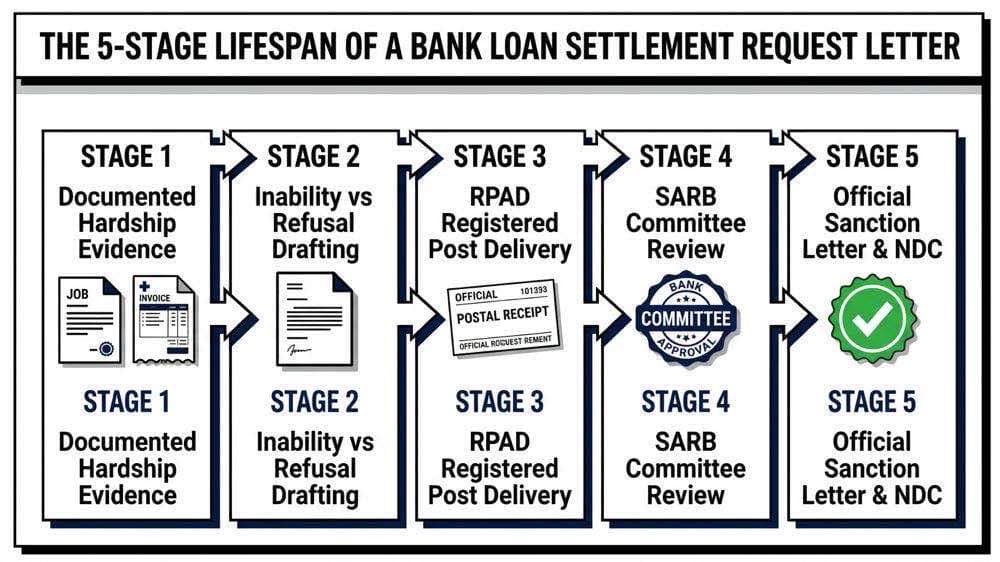
Figure 1: Complete 5-Stage Lifespan of a Bank Loan Settlement Request Letter
One-Time Settlement (OTS) Request Letter Generator
Customize your official hardship representation letter in English or Hindi. Generates court-tested wording proving legal inability under Section 63 of the Indian Contract Act.
- 1. Self-attested copy of PAN Card and Aadhaar Card
- 2. Copy of formal Termination / Relieving Letter
- 3. Bank statement of the last 6 months showing zero salary credit
- 4. Copy of EPFO passbook reflecting employment cessation
All these RBI rules, regulatory guidelines, and police FIR provisions exist officially in the books. However, the ground reality is that the Indian judicial and police system moves very slowly. In most everyday cases, lodging a formal complaint or filing an FIR will not give you immediate relief from aggressive collection calls.
The honest fact is: until all of your outstanding loans are either officially settled (via One-Time Settlement) or fully closed, the probability of getting complete peace of mind from recovery agencies is very low.
1. Change Your Mobile Number: Switch to a fresh SIM card for daily use, sharing it strictly with close family. Keep your old loan-registered SIM on silent in a spare phone to check SMS once weekly for official bank notices. This instantly cuts off the non-stop daily barrage of abusive phone calls.
2. Shift Your Residential Address: If recovery agents or local collection musclemen know your rented flat and keep showing up to humiliate you before neighbors, relocate to a different address if possible to protect your family from doorstep embarrassment.
3. Delete the Loan App & Revoke All Permissions: Immediately uninstall the lending app from your smartphone. Before deleting, open phone settings, revoke all permissions (contacts, storage, camera, location), and clear app data so trackers cannot continue harvesting your real-time data or accessing your contact list.
The Legal Difference: Inability to Pay vs Refusal to Pay
The most common drafting error is expressing anger instead of proving financial hardship.
Commercial default is a civil issue. Under RBI Master Directions on Wilful Defaulters (DOR.AML.REC.22/14.06.001/2024-25), refusing to pay despite having funds invites willful default classification and bureau blacklisting.
In Bijnor Urban Cooperative Bank v. Meenal Agarwal (2021), the Supreme Court ruled that an OTS is an internal commercial policy concession, not an automatic legal right. Courts cannot order banks to grant waivers.
Demanding an OTS leads to instant rejection. Frame your letter around involuntary financial inability, showing good faith while presenting an exit proposal.
The 4 Hardship Grounds That Bank Committees Legally Accept
Bank compromise committees face audit scrutiny. Officers cannot write off public funds without verified third-party proofs in the file.
Attach your official termination letter, 6 months of bank statements verifying zero salary credits, and an updated EPFO passbook.
Attach hospital discharge summaries, surgery invoices, and pharmacy receipts proving savings were exhausted on critical medical care.
Attach GST surrender receipts, audited balance sheets showing operating losses, or commercial lease termination notices.
Under Section 50 CPC, heirs are liable strictly up to inherited estate value. Attach the official death certificate and legal heir affidavit.
Whom to Address: Bypassing Branch Counter Clerks
Retail branch tellers have zero discretionary waiver authority. Handing letters to front counter clerks causes indefinite file delays.
Institutional Addressing Hierarchy:
Public Sector Banks (SBI, PNB, BOB, Canara): Address the Assistant General Manager (AGM) at the Stressed Assets Recovery Branch (SARB). For SBI, cite the Rinn Samadhan scheme.
Private Banks (HDFC, ICICI, Axis, Kotak): Address the Head of Collections at the Stressed Assets Management Branch (SAMB) and email the Principal Nodal Officer (PNO).
NBFCs & Fintechs (Bajaj Finance, Tata Capital, Navi): Address the Head of Grievance Redressal and Compromise Desk at corporate headquarters.
The 6 Mandatory Clauses of a Legally Enforceable OTS Letter
You can generate your personalized, print-ready letter using our interactive generator above. When drafting, ensure your document contains these six structural clauses:
State your 16-digit loan account number, sanction branch, and your track record of regular EMI repayments before hardship occurred.
Cite the exact date and nature of the crisis (such as layoff date or hospitalization date). State clearly that your current liabilities exceed your liquid assets.
Under RBI Circular DOR.STR.REC.20/21.04.048/2023-24, request the bank to freeze and waive all accumulated penal interest and late fees.
Specify your proposed settlement sum in both figures and words. Mention that funds are arranged from relatives specifically for final settlement.
Demand that payment constitutes complete accord and satisfaction under Section 63 of the Indian Contract Act, barring residual claims.
Mandate that upon clearance, the bank must report the account as Settled to CIBIL, Equifax, Experian, and CRIF within 30 days and issue an official NDC.
Safe Delivery & Postal Acknowledgment Rules
Never send your settlement proposal through WhatsApp or informal text messages to third-party recovery telecallers. A legal settlement requires verifiable institutional delivery.
Dispatch the physical letter via India Post Speed Post or RPAD to the Zonal Stressed Assets desk. Retain your postal receipt and download the digital delivery tracking confirmation from indiapost.gov.in. This constitutes conclusive legal proof of service under Indian Evidence law.
If delivering by hand, carry two identical hard copies. Request the branch officer to place an official branch rubber stamp on your duplicate receiving copy, noting their employee code, signature, and date.
A branch rubber stamp on your application proves delivery; it does NOT mean your settlement has been approved. Never deposit a single rupee until you hold an official Settlement Sanction Letter on bank letterhead. Once you receive an approval, verify its safety checkpoints against our manual on verifying a genuine settlement letter or download sample sanction specimens at our bank settlement letter format guide.
Frequently Asked Questions (FAQ)
Can a bank reject my loan settlement request letter?▼
Yes. In Bijnor Urban Cooperative Bank v. Meenal Agarwal (2021), the Supreme Court ruled that OTS is a commercial policy concession, not a legal right. Banks can reject proposals that lack verifiable hardship documentation.
How much settlement discount should I ask for in my first letter?▼
Propose paying 35% to 50% of the principal outstanding. Unrealistic 10% offers trigger instant rejection, while 35% to 50% demonstrates serious intent and leaves room for counter-negotiation.
What is the difference between an OTS request letter and a sanction letter?▼
An OTS request letter is your application sent to the bank. A sanction letter is the bank official approval on corporate letterhead. Never deposit funds until you hold the signed sanction letter.
Can I submit my loan settlement request letter in Hindi?▼
Yes. All public sector banks accept Hindi applications under official language rules. Private banks and NBFCs also accept Hindi hardship letters submitted to branch managers or recovery desks.
Should I submit my settlement letter by hand or by postal mail?▼
Send it via India Post Speed Post or Registered Post with Acknowledgment Due (RPAD) for legal tracking proof. If delivering by hand, obtain a dated branch rubber stamp on your duplicate copy.
What documents must I attach to my loan settlement letter?▼
Attach self-attested copies of your PAN and Aadhaar cards, plus third-party hardship proofs such as a job termination letter, bank statements showing zero salary credits, or hospital bills.
Can a bank file a criminal police case if I write a settlement letter?▼
No. Loan default is strictly a civil dispute under Indian law. Writing an honest hardship letter expressing inability to pay is recognized legal evidence of good faith.
Community Discussion & Case Notes
0 CommentsNo comments posted yet. Be the first to share your experience below!
Join the Discussion & Share Your Experience
Have you dealt with this situation or received a notice? Share your questions or experience with other borrowers.
Find this content helpful?
If this guide has helped you navigate your settlement journey, consider showing some support to keep this platform running.