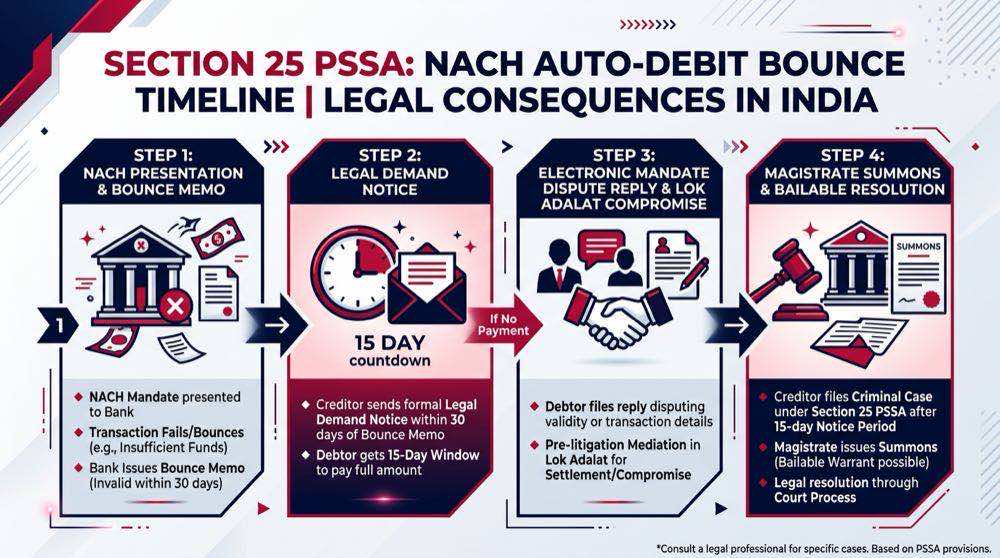
01. The 15-Day Clock: What A Section 25 PSSA Notice Actually Means
Receiving a Section 25 notice is an urgent event. It is not an arrest warrant. Section 25 is a statutory rule to enforce digital payments. A borrower does not become an accused person when the letter arrives. The cause of action arises only after 15 calendar days expire without payment. This clock starts from the exact date of physical delivery.
The date of delivery is the critical starting point. Keep the postal envelope or Speed Post tracking slip. You can also save a delivery screenshot showing the timestamp. Under Indian law, the 15-day payment window begins on the day after physical receipt. It does not start on the date printed at the top of the advocate letter. For example, suppose the bank sent the letter on May 1st. If you received it on May 8th, your 15-day reply window runs until May 23rd.
Ignoring a Section 25 notice is a serious error. Do not stay silent. The court may presume the claimed debt is undisputed. Sending a factual reply within 15 days puts your defense on the official record. This protects you before the lender files any complaint in court.
02. Electronic Mandates vs Cheques: How Section 25 PSSA Works
Section 138 deals strictly with physical paper cheques. In contrast, Section 25 of the PSSA governs electronic funds transfers. This includes NACH mandates, ECS debits, and standing bank instructions.
When an electronic debit bounces, Section 25 creates a quasi-criminal framework. However, under Section 25(5) of the Act, all rules of Chapter XVII of the Negotiable Instruments Act apply. This means that procedural protections and statutory notice windows apply equally to NACH bounces.
Courts have affirmed that Section 25 PSSA and Section 138 are companion rules. The lender must prove an existing debt. The lender must send a demand notice within 30 days of the bounce memo. The lender must also grant the full 15-day cure period before filing a case.
03. The Part-Payment Shield: Applying Dashrathbhai Patel to NACH
The part-payment rule under Section 56 of the NI Act is a vital defense for borrowers. In Dashrathbhai Trikambhai Patel v. Hitesh Mahendrabhai Patel (2022), the Supreme Court delivered a landmark ruling. The court held that presenting an instrument without crediting prior payments invalidates prosecution.
Under Section 25(5) of the PSSA, this rule applies directly to NACH debits. Suppose you took a loan of Rs. 6,00,000 and paid 18 monthly EMIs. If default occurs later, your debt is lower. The bank cannot present a mandate for the full loan sum.
Presenting an unadjusted mandate for an inflated sum violates statutory rules. The mandate must match the exact legally enforceable debt on that date. Raising this defect in your 15-day reply destroys the technical validity of the complaint.
04. Mandate Revocation & Cancellation Rights Under RBI Rules
Borrowers often assume a signed mandate gives banks permanent debit rights. This is legally untrue. Under the RBI e-mandate framework, every customer holds a right to stop, pause, or revoke an electronic mandate.
You can submit a mandate cancellation request at your bank branch. You can also cancel it through net banking. When you inform the bank that you are revoking the mandate due to hardship, the bank must stop presenting debits.
If the lender presents the debit after receiving notice of revocation, no criminal intent exists under Section 25. Highlighting your prior mandate revocation in your dispute reply provides a solid defense against criminal liability.
05. Decoding NPCI NACH Return Codes: 04, 06, 08 & Technical Errors
When a NACH auto-debit fails, NPCI issues an electronic return memo. This memo contains a specific two-digit reason code. Checking this code is vital for your defense:
If the failure was due to technical clearing errors or NPCI timeouts, no criminal case can stand under Section 25.
06. Predatory Multiple Debits: RBI Fair Lending Regulations 2023
Predatory lenders often present the same NACH mandate multiple times in a week. Each attempt triggers heavy bounce fees at both banks.
In August 2023, the RBI issued clear rules on fair lending practices. The RBI directed that penal charges must not be used for revenue growth. Lenders cannot compound penal fees. Lenders cannot levy multiple punitive debit charges.
When a lender piles up unfair bounce fees and demands them in a legal notice, they violate RBI rules. Demanding a full ledger audit and asking for fee reversals is a key defense in your reply.
07. Step-by-Step Defense Protocol Upon Receiving A Notice
When you receive a Section 25 PSSA notice for an auto-debit bounce, take these six structured steps:
- Preserve Delivery Proof: Keep the original Speed Post envelope showing the tracking barcode. Download the official delivery report from
indiapost.gov.into fix your 15-day timeline. - Check UMRN and Mandate Form: Review your initial loan agreement to find your Unique Mandate Reference Number (UMRN). Verify if the bank debited the agreed EMI amount.
- Audit Bank Statements: Download your bank statement covering the date of the alleged bounce. Check the exact NPCI return reason code and note any unfair bounce fees debited.
- Draft Your Administrative Dispute: Use the interactive generator above to draft a factual dispute response. State your financial hardship and invoke statutory defenses under Section 25(5) PSSA.
- Send via Speed Post and Email: Dispatch the signed reply by Speed Post or Registered Post. Send an electronic copy to the bank Principal Nodal Officer email.
- Propose Lok Adalat Compounding: Express your willingness to resolve the loan through an amicable One-Time Settlement (OTS) at the upcoming National Lok Adalat.
08. Civil Default vs Criminal Offense: Why Arrest Is Not Immediate
Third-party collection agents often use intimidation. They claim that the police will arrest the borrower within 24 hours of an auto-debit bounce. These claims are false and illegal.
Loan default due to genuine financial distress is fundamentally a civil breach of contract. Section 25 PSSA is a statutory remedy requiring a formal private complaint before a Judicial Magistrate. The police have no legal power to register an FIR or make an arrest for an auto-debit bounce.
Before any judicial action occurs, the magistrate must examine the complainant on oath. The magistrate verifies all statutory ingredients. If process is issued, the court first issues a summons by post. The offense under Section 25 is bailable. When you appear through counsel, bail is granted as a matter of right upon furnishing a personal bond.
09. The BNS 2024 Harassment Shield: Stopping Recovery Abuse
Lenders often intensify recovery collection calls after issuing a legal notice. Agents contact employers, message relatives on WhatsApp, or make abusive phone calls. Under the RBI Master Directions on Recovery Agents, lenders are strictly prohibited from contacting third parties or calling outside the window of 8:00 AM to 7:00 PM.
Under the new criminal statutes of 2024, abusive collection tactics are criminal offenses. Threatening reputation or physical safety constitutes criminal intimidation under Section 351 of the Bharatiya Nyaya Sanhita (BNS), 2024. Entering private property without permission constitutes criminal trespass under Section 329 BNS.
Always maintain call recordings and screenshot threatening WhatsApp messages. Document these violations in your reply to the bank Nodal Officer. File a formal grievance on the RBI CMS portal (cms.rbi.org.in). Banks face severe supervisory penalties from the RBI for agent harassment.
10. National Lok Adalat: Compounding Electronic Mandate Cases
National Lok Adalats are held quarterly across India under the aegis of the National Legal Services Authority (NALSA). They represent the most reliable and affordable forum to settle Section 25 disputes.
Under Section 147 of the Negotiable Instruments Act read with Section 25(5) of the PSSA, all offenses arising from mandate dishonour are compoundable at any stage. In Lok Adalat sessions, senior bank managers have pre-approved authority to offer One-Time Settlements (OTS), waiving 40% to 70% of accumulated interest, penal charges, and bounce fees.
An award passed by a Lok Adalat has the legal status of a final civil court decree. It cannot be appealed in any higher court. Once the agreed settlement sum is paid, the Section 25 matter is completely closed, and the bank is obligated to issue a formal No Dues Certificate.
11. Forensic Settlement Verification: 7 Critical Checkpoints
Never pay settlement money based on informal verbal promises or WhatsApp messages from collection agents. Before releasing any funds, verify your settlement against these seven checkpoints:
- Official Bank Letterhead: The settlement sanction letter must be issued on official bank letterhead with an official dispatch number.
- Accurate Account Identifiers: The letter must clearly state your name, loan account number, UMRN number, and the exact settlement amount.
- Full and Final Settlement Clause: The agreement must confirm that payment of the settlement amount discharges all claims completely.
- Court Case Withdrawal Commitment: The bank must formally commit in writing to withdraw any pending Section 25 complaints.
- Clear Payment Schedule: The letter must state precise installment due dates with realistic payment windows.
- No Dues Certificate Timeline: The bank must guarantee issuance of a No Dues Certificate within 15 to 30 days of final payment.
- Official Channel Payment: Always pay directly into your verified loan account through net banking, NEFT, or RTGS. Never transfer funds to private accounts or UPI handles.
12. Statutory Sources, Regulatory Circulars & Emergency Portals
Every statutory defense in this guide is grounded in verified legislation, court precedents, and regulatory portals:
Lodge complaints regarding predatory NACH debits and recovery agent misconduct.
cms.rbi.org.inAccess National Lok Adalat calendars and free legal aid services.
nalsa.gov.inAccess Dashrathbhai Patel and Sunil Todi rulings on debt crystallization.
sci.gov.inReport illegal recovery threats and extortion on national helpline 1930.
cybercrime.gov.in | Helpline 1930Section 25 PSSA NACH Bounce: Answers to Top 10 Borrower Inquiries
What is the statutory time limit to reply to a Section 25 PSSA notice?▼
You have exactly 15 calendar days from the date of physical receipt of the demand notice to reply or make payment. The 15-day window begins on the day after the notice is delivered to your address, not the date printed on the advocate's letter.
Can police arrest me immediately after a NACH auto-debit bounces?▼
No. Police cannot arrest you for an auto-debit bounce. Section 25 PSSA requires the lender to file a private complaint before a Judicial Magistrate. The court first issues a summons. The offense is bailable upon appearance.
What happens if I ignore a Section 25 PSSA demand notice?▼
If you do not reply or clear the demand within 15 days, the lender can file a criminal complaint in court within the next 30 days. Ignoring summonses from the court may lead to bailable or non-bailable warrants to compel your appearance.
Can a lender file a Section 25 case if I revoked the NACH mandate?▼
Under RBI e-mandate regulations, borrowers have a legal right to stop or revoke recurring auto-debit mandates at their bank. If a lender presents a revoked mandate, you can raise this as a valid defense against criminal intent under Section 25.
Does the Dashrathbhai Patel ruling on partial payments apply to Section 25 PSSA?▼
Yes. Section 25(5) of the PSSA expressly applies Chapter XVII of the Negotiable Instruments Act. Under the Supreme Court ruling in Dashrathbhai Patel (2022), presenting a mandate for the full loan sum without endorsing prior EMI payments invalidates statutory prosecution.
What should I do if a bank presents multiple NACH debits in a single month?▼
Repeatedly presenting auto-debits to trigger multiple bounce charges violates RBI Fair Lending Regulations of August 2023. You should record all bounce fees, file a dispute with the bank's Nodal Officer, and demand reversal of unfair levies.
Can a Section 25 PSSA case be settled out of court?▼
Yes. Offenses under Section 25 are compoundable under Section 147 of the Negotiable Instruments Act read with Section 25(5) PSSA. You can settle the dispute through an amicable One-Time Settlement (OTS) at National Lok Adalats.
What is the difference between Section 138 NI Act and Section 25 PSSA?▼
Section 138 NI Act applies strictly to physical paper cheques. Section 25 of the PSSA applies to electronic funds transfers including NACH, ECS, and e-mandates. Both share identical 15-day notice rules and compoundable settlement mechanisms.
Can recovery agents visit my workplace if a Section 25 notice is issued?▼
No. RBI recovery directives strictly prohibit agents from visiting your workplace, harassing relatives, or calling outside 8:00 AM to 7:00 PM. Threatening behavior is punishable under Section 351 of the Bharatiya Nyaya Sanhita (BNS).
What documents should I preserve after receiving a Section 25 notice?▼
Preserve the postal envelope showing the Speed Post tracking barcode, the delivery date report from the India Post website, your bank passbook showing all debited EMIs and bounce memos, and the original NACH mandate agreement.