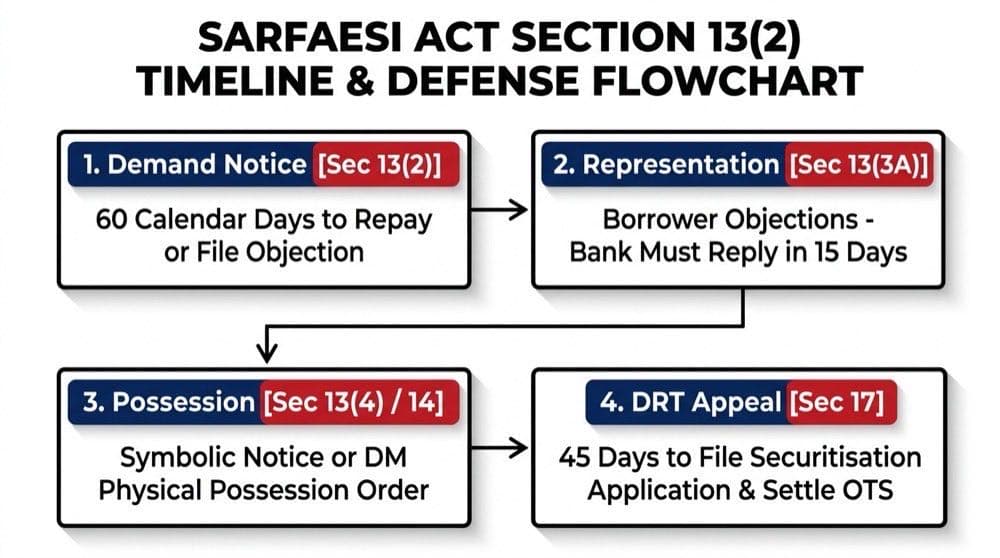
01. The 60-Day Clock: What A SARFAESI Section 13(2) Notice Means
Receiving a notice under Section 13(2) is an urgent matter. It is a formal warning from your bank. It is not an immediate eviction order. A bank cannot take or sell your property on the day the letter arrives.
The law grants a full 60-day window. This clock starts on the day you receive the postal delivery. It does not start on the letter date. If you get the letter on August 10, your window runs until October 9.
Do not ignore this notice. Staying silent allows the bank to assume you accept the claim. Once 60 days pass without a reply, the bank can issue a possession notice under Section 13(4). Sending a written reply protects your legal rights.
02. Statutory Right of Representation: Section 13(3A) & 15-Day Rule
Section 13(3A) is your main legal shield. Parliament added this rule after the Supreme Court ruling in Mardia Chemicals. The court held that borrowers have a right to object before a bank takes their property.
You have the right to file a written objection within 60 days. You can challenge wrong amounts, unfair interest, or errors in property records. The bank must review your reply with an open mind.
If the bank rejects your reply, it must send reasons in writing within 15 days. Courts hold that taking property without answering your reply is illegal. This rule gives borrowers strong leverage to settle.
03. Section 31 Absolute Exemptions: Agricultural Land & 20% Debt
The SARFAESI Act does not apply to all loans or properties. Section 31 lists clear exemptions that stop bank action:
Banks cannot seize farm land. The Supreme Court in the Blue Coast case ruled that active farm land cannot be sold under this Act.
The Act does not apply if your total debt due is under Rs. 1,00,000. Banks cannot seize homes for small amounts.
If you paid over 80 percent of your loan and owe less than 20 percent of principal and interest, the bank cannot auction your home.
If your loan fits any Section 31 rule, the bank notice is void. Citing this defense stops bank recovery.
04. Wrongful NPA Classification: Challenging the 90-Day Overdue Date
A bank can issue a Section 13(2) notice only after a loan becomes an NPA. Under RBI rules, an account becomes an NPA only when payments stay unpaid for over 90 days.
Banks often make system mistakes. In many cases, bank staff mark accounts as NPA early while borrowers pay interest or seek loan restructuring. Marking an account as NPA before 90 days violates RBI rules.
In your reply, ask for the exact date the system marked the account as NPA. An invalid NPA date makes the notice void and shields the borrower.
05. Illegal Penal Charges & Compounding: RBI Fair Lending 2023
Lenders often inflate claims with high penal interest, extra fees, and compound charges.
In August 2023, the RBI set clear rules on fair lending practices. The central bank ruled that penal charges must not be used to boost bank profits. Lenders cannot add penal charges to the loan principal. They cannot compound penal interest.
When a bank adds compound penal fees in a notice, it violates RBI rules. You can demand a full account audit and removal of unfair fees in your reply.
06. Defective Notice Grounds: Misdescription & Unauthorized Officers
A Section 13(2) notice must follow strict legal rules. Common defects that make a notice invalid include:
- No Breakup of Dues: Section 13(3) requires the bank to list principal, interest, and costs separately. A single lump sum without details is invalid.
- Wrong Property Details: If the notice has wrong survey numbers, incorrect flat numbers, or wrong boundaries, it cannot support property attachment.
- Unauthorized Officer: The notice must be signed by an Authorized Officer of Scale IV rank or above. Notices from recovery agents lack legal weight.
- Missing Co-Borrowers: If two or more people own the home, the bank must serve notice on all owners and guarantors. Leaving out a co-owner is a legal flaw.
07. Step-by-Step 6-Point Defense Protocol Upon Receiving A Notice
When a Section 13(2) notice arrives, take these six steps:
- Save Postal Proof: Keep the postal envelope with the barcode. Download the delivery proof from
indiapost.gov.into fix your 60-day window. - Check Loan Records: Download your bank statements. Calculate total principal paid, interest charged, and all past payments.
- Review Section 31 Rules: Check if your land is farm land or if your unpaid balance is under 20 percent of the total debt.
- Draft Your Reply: Use our interactive tool above to draft your formal written objection under Section 13(3A).
- Send by Speed Post and Email: Mail your signed letter by Speed Post with proof of delivery. Email a copy to the bank Nodal Officer.
- Propose a Settlement: State your intent to resolve the debt through a fair settlement before the bank acts under Section 13(4).
08. The Threat of Section 13(4) Possession & Section 14 DM Orders
If 60 days pass without payment or a reply, the bank can move to Section 13(4). The bank starts with symbolic possession. Staff paste a notice on the wall and publish it in two newspapers.
To take actual physical control, the bank cannot use private bouncers. The lender must file an application under Section 14 before the Chief Metropolitan Magistrate or District Magistrate.
The Magistrate checks whether the bank followed proper steps. The Magistrate then directs the local police to take physical possession. Borrowers facing this order should seek prompt relief from the Debts Recovery Tribunal.
09. DRT Securitisation Application (SA) Under Section 17 (45-Day Rule)
Any person aggrieved by bank actions under Section 13(4) can challenge them before the Debts Recovery Tribunal under Section 17.
You must file your application within 45 days from the date the bank takes action, such as the date of the possession notice.
Borrowers do not need to pay an upfront cash deposit to file under Section 17 in the DRT. The Supreme Court struck down pre-deposits at the DRT level. Pre-deposits apply only if you appeal from the DRT to the Appellate Tribunal under Section 18.
10. Negotiating a One-Time Settlement (OTS) & Loan Restructuring
Filing a reply under Section 13(3A) creates strong leverage to settle. Banks know that property disputes take time and cost money.
Most banks have One-Time Settlement policies for bad loans. Under an OTS, the bank waives penal interest, cuts unapplied interest, and closes the loan for an agreed lump sum.
Always get a formal OTS approval letter signed by bank officials before making payments. Once paid, collect your No Dues Certificate and retrieve your original property papers.
11. Common Misconceptions Regarding SARFAESI Proceedings
False rumors regarding home loan defaults cause panic. Here are the real legal facts:
Fact: The bank must grant 60 full days. For physical possession, the bank must obtain a Magistrate order under Section 14.
Fact: SARFAESI is a civil asset recovery law. Defaulting on a home loan is not a crime, and police cannot arrest you for unpaid debt.
Fact: Under Section 27 of the General Clauses Act, a letter sent to your address is legally served. Refusal only costs you your 60-day reply right.
Fact: Submitting an objection to the bank or filing a case in the DRT costs zero pre-deposit.
12. Statutory Sources, Regulatory Circulars & Emergency Portals
All legal defenses in this guide rely on official laws and government portals:
Check cause lists and case status for Section 17 appeals.
drt.gov.inFile complaints against recovery abuse and rule violations.
cms.rbi.org.inRead the landmark Mardia Chemicals and Blue Coast rulings.
sci.gov.inCheck National Lok Adalat dates and free legal aid.
nalsa.gov.inSARFAESI Section 13(2) Notice: Answers to Top 10 Borrower Inquiries
What is a Section 13(2) demand notice under the SARFAESI Act?▼
A Section 13(2) notice is a statutory 60-day demand letter issued by a bank or secured creditor after a loan account is classified as a Non-Performing Asset. It requires the borrower to pay the total outstanding dues within 60 calendar days from the date of physical receipt. It is not an immediate court eviction order.
How many days do I have to reply to a SARFAESI 13(2) notice?▼
You have 60 calendar days from the date you physically receive the notice to submit your written representation or objection under Section 13(3A). The calculation begins on the day after physical postal delivery, not the date printed on the letterhead.
Is the bank legally required to respond to my Section 13(3A) objection?▼
Yes. Under Section 13(3A) and the Supreme Court ruling in Mardia Chemicals, the secured creditor must consider your objections. If the bank rejects your representation, it must communicate its reasoned response in writing within 15 days of receipt before taking possession under Section 13(4).
Can agricultural land be seized or auctioned under the SARFAESI Act?▼
No. Under Section 31(i) of the SARFAESI Act, 2002, the provisions of the Act do not apply to any security interest created in agricultural land. If the mortgaged parcel is active agricultural land, the bank lacks jurisdiction to issue a 13(2) demand notice or take physical possession.
What is the minimum loan debt required for SARFAESI enforcement?▼
Under Section 31(h), the SARFAESI Act does not apply if the remaining debt due is less than Rs. 1,00,000. Additionally, under Section 31(j), SARFAESI cannot be enforced if the remaining unpaid balance is less than 20 percent of the original principal amount and interest.
Can the bank compound penal interest on my defaulted home loan?▼
No. Under RBI Master Directions on Fair Lending Practices issued in August 2023, banks and NBFCs cannot capitalize or compound penal charges. Penal fees must be charged only as simple penalty levies and cannot be added to the principal balance to inflate interest.
What happens if I ignore a Section 13(2) demand notice?▼
If you remain silent and the 60-day statutory window expires without a response, the bank earns the right to invoke Section 13(4). The lender can take symbolic possession, publish public notices in newspapers, and apply to the District Magistrate under Section 14 for physical eviction.
What is the difference between symbolic possession and physical possession?▼
Symbolic possession under Section 13(4) involves affixing a notice on the property outer wall and publishing notices in two local newspapers. Physical possession requires the bank to obtain an administrative order from the Chief Metropolitan Magistrate or District Magistrate under Section 14 to take physical keys with police aid.
Can I challenge the bank in the Debts Recovery Tribunal (DRT)?▼
Yes. Once the bank takes measures under Section 13(4), you have strictly 45 calendar days to file a Securitisation Application under Section 17 before the Debts Recovery Tribunal. No upfront cash deposit is required to file a Section 17 application before the DRT.
Can a home loan under SARFAESI be resolved through a One-Time Settlement?▼
Yes. Most public and private banks operate compromise settlement policies for stressed secured assets. Submitting a factual Section 13(3A) objection pointing out accounting discrepancies or Section 31 exemptions creates strong leverage to negotiate an amicable One-Time Settlement with fee waivers.