01. What is an Order 37 Summary Suit? Fast-Track Debt Recovery Rules
An Order 37 suit is a fast civil case under Order 37 of the CPC, 1908. In a normal civil case, you have an automatic right to defend. Normal civil trials take 5 to 10 years. An Order 37 summary suit removes this automatic defense right. Banks use it to speed up debt collection.
Lenders file Order 37 suits to avoid court delays. You must act fast. If you miss strict 10-day deadlines, the court presumes the bank claims are true. The court then passes an immediate money decree without a full trial.
02. The Two-Tiered Summons Trap: Form 4 Appearance vs Form 4A Judgment
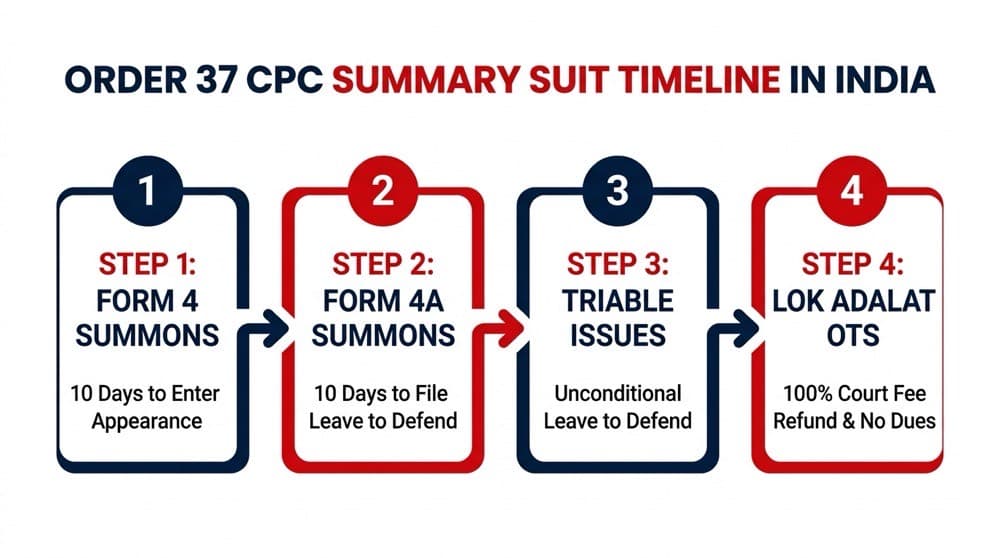
Banks rely on borrower confusion in Order 37 suits. This case does not work like a normal court summon. It runs on two fast stages with strict 10-day deadlines:
This summons arrives with a copy of the plaint. You have exactly 10 days from delivery to file a Memo of Appearance in the court registry. Do not file your main defense here. You only submit your address for court service. You must also send a copy to the bank lawyer. If you miss this 10-day window, the bank wins an immediate court decree.
After you file appearance, the bank serves Form 4A. This is a Summons for Judgment backed by an affidavit. You now have strictly 10 days to apply for Leave to Defend. You must file a sworn affidavit showing your triable legal defenses.
Under Order 37 Rule 3(7) CPC, court registries cannot excuse delay on their own. Any delay in filing appearance or leave to defend requires an application showing sufficient cause, such as non-service or medical emergency.
03. Leave to Defend Framework: Supreme Court Rules in IDBI and B.L. Kashyap
Your defense depends on your Leave to Defend application. In IDBI Trusteeship (2017), the Supreme Court set clear rules. In B.L. Kashyap (2022), the Court reaffirmed three main outcomes:
Granted if you show a real defense or raise genuine triable issues. The court moves the case to a full civil trial with oral proof.
Granted when your defense seems plausible but doubtful. The court may ask for a cash deposit in court. But conditions must not be harsh.
Refused only when the defense is fake or baseless. In this rare case, the court grants an immediate decree to the bank.
In B.L. Kashyap (2022), the Supreme Court ruled that granting leave is the normal rule. Refusal is the rare exception. Courts grant leave when you show supporting papers.
04. Top 6 Borrower Defenses: Formulating Bona Fide Triable Issues
To win leave to defend, you must show real triable issues. The top six borrower defenses in bank loan suits include:
Credit cards and overdrafts run on open, mutual ledgers. In GE Capital and Citibank, the Delhi High Court ruled that running accounts require ledger proof under Section 34 of the Evidence Act. They do not qualify as fixed debts under Order 37. This entitles you to unconditional leave to defend.
Banks often make borrowers sign blank promissory notes. Under Section 35 of the Indian Stamp Act, 1899, an unstamped promissory note cannot be used as evidence in court. An Order 37 claim based on an unstamped note must fail.
If a commercial court case claims Rs 3 Lakhs or more, Section 12A of the Commercial Courts Act makes mediation mandatory. In Patil Automation (2022), the Supreme Court ruled that skipping mediation requires the court to reject the bank plaint under Order 7 Rule 11 CPC.
Lenders often add heavy penal charges and extra fees contrary to RBI rules. Under Section 74 of the Contract Act, banks cannot charge penalties without proving real loss. Disputed interest math creates a triable issue for trial.
Under the Limitation Act, 1963, a bank has 3 years to file a debt suit. This runs from the default date or last payment. If the bank files after 3 years without a signed balance confirmation, the suit is barred by law.
Banks often take blank security cheques during loan sign-up. Filling them years later with high amounts is material alteration under Section 87 of the NI Act. This defeats summary recovery.
05. Setting Aside Ex-Parte Decrees: Special Circumstances Under Order 37 Rule 4
Many borrowers learn of an Order 37 decree after their bank account freezes. You can seek relief under Order 37 Rule 4 CPC.
In a normal civil suit, you only need to show sufficient cause under Order 9 Rule 13. But under Order 37 Rule 4, you must prove special circumstances.
In Rajni Kumar v. Suresh Kumar Malhotra, the Supreme Court set two clear rules to reopen a decree:
- Special Reason for Absence: Proof of severe events like non-service of summons, wrong address, or hospital stay.
- Merits of Defense: Proof of a real triable defense that would have won leave to defend.
When you prove both parts, the court stays the decree and reopens your defense.
06. Execution of Decrees: Salary Attachment Under Section 60 CPC
When a bank wins a money decree, it files for execution under Order 21 CPC. Lenders often try to seize the borrower salary. But Section 60(1)(i) of the CPC protects your income:
The first Rs 1,000 of monthly salary is 100% exempt from attachment.
Two-thirds (66.67%) of the remaining balance is fully protected by law.
Only the remaining one-third can be attached by the court.
07. Summary Suit vs Ordinary Civil Suit vs DRT Recovery Comparison
Comparing Order 37 to other debt forums helps you know your rights:
08. Lok Adalat & One-Time Settlement (OTS) Negotiation Leverage
An Order 37 suit is often the best time to negotiate a One-Time Settlement (OTS). Filing a strong Leave to Defend with real issues gives you high leverage.
Once the court grants leave to defend, the bank loses its fast track. The suit becomes a slow civil trial lasting 5 to 7 years. Lenders prefer a fast settlement over high lawyer bills.
When a bank files a suit, it pays high court fees (often 5% to 8% of the claim). Under Section 16 of the Court Fees Act, 1870 and Section 21 of the Legal Services Authorities Act, 1987, settling in Lok Adalat gives the bank a 100% court fee refund.
- This saves the bank money and helps you win 40% to 70% waivers.
- The court records the deal as a consent decree under Order 23 Rule 3 CPC.
- The bank then issues a full No Dues Certificate.
09. Day 1 to Day 10 Action Plan: Procedural Survival Protocol
Time is your most critical asset in an Order 37 suit. Follow this day-by-day action plan:
Look at the summons header. See if it is Form 4 (Appearance) or Form 4A (Judgment). Note the exact delivery date on the India Post envelope.
Write your Memo of Appearance with your court address for service, or hire a local civil lawyer.
Submit the appearance in the court registry. Post a copy to the bank lawyer by Registered Post AD. Keep postal receipts safe.
Gather bank statements, hardship proofs, and fee errors. Draft your sworn counter-affidavit with triable issues and file before day 10.
10. Civil Prison Protections: The Jolly George Varghese Shield & BNS 2024
Recovery agents often threaten borrowers with police arrest and civil jail. These threats are illegal. They violate Section 351 of the Bharatiya Nyaya Sanhita (BNS), 2024 for criminal intimidation.
In Jolly George Varghese v. Bank of Cochin (1980), the Supreme Court ruled:
"To cast a person into civil prison merely because of his poverty and inability to pay a contractual debt violates Article 21 of the Constitution and human rights."
Under Section 51 CPC, a court cannot send you to civil jail for simple lack of funds. Jail applies only if the court proves you have money right now and hide assets in bad faith. An honest borrower facing financial hardship cannot be jailed.
11. Essential Document Checklist for Court Defense & Counter-Affidavit
When filing your Leave to Defend, attach certified copies of these vital papers:
- Original India Post Envelope: Shows post barcode proving the exact delivery date. Defeats false service claims.
- Bank Account Statements: Proves all EMI payments made, loan disbursed, and missing credit entries.
- Hardship Proof: Job loss letter, medical discharge bills, or business loss records proving real distress.
- Loan Sanction Letters: Checks if promissory notes lack proper stamp duty under Section 35 of the Stamp Act.
- Past Settlement Emails: Emails sent to bank nodal officers showing ongoing good-faith effort to resolve dues.
12. Statutory Framework, Official Precedents & Emergency Escalation Portals
All rights in this guide rest on verified Indian laws, Supreme Court rulings, and official portals:
Track case status, cause lists, and orders online at ecourts.gov.in.
ecourts.gov.inCheck Lok Adalat dates and free legal aid at nalsa.gov.in.
nalsa.gov.inRead IDBI Trusteeship, B.L. Kashyap, and Jolly George rulings at sci.gov.in.
sci.gov.inReport unfair recovery and illegal fees at cms.rbi.org.in.
cms.rbi.org.inReport extortion threats on helpline 1930 or at cybercrime.gov.in.
cybercrime.gov.in | Helpline 1930Order 37 CPC Summary Suit: Answers to Top 10 Inquiries
What is an Order 37 CPC summary suit for bank loans?▼
An Order 37 summary suit is a fast-track civil lawsuit under the Code of Civil Procedure, 1908. Banks file it to recover fixed debts arising from written contracts, promissory notes, or guarantees. Unlike an ordinary suit, the borrower does not have an automatic right to defend and must obtain leave to defend from the court.
What is the 10-day rule in an Order 37 summary suit?▼
The 10-day rule refers to two strict statutory windows. First, you must enter an appearance in court within 10 days of receiving the initial summons in Form 4. Second, once the bank serves a summons for judgment in Form 4A, you have exactly 10 days to apply for leave to defend.
Can a bank file an Order 37 summary suit for credit card debt?▼
While banks often attempt to file Order 37 suits for credit cards, courts including the Delhi High Court have held that open, fluctuating credit card accounts requiring ledger proof under Section 34 of the Evidence Act are not liquidated debts under Order 37. This provides a strong basis for unconditional leave to defend.
What happens if I miss the 10-day deadline for filing appearance?▼
If you fail to enter an appearance within 10 days of receiving the summons, the court presumes that all allegations in the bank's plaint are admitted. The plaintiff bank becomes entitled to an immediate ex-parte money decree without a full trial.
What are the grounds for obtaining unconditional leave to defend?▼
Under Supreme Court precedents in IDBI Trusteeship and B.L. Kashyap, unconditional leave to defend is granted when the borrower shows a substantial defense or raises genuine triable issues, such as an unstamped loan note, disputed interest calculations, or non-maintainability of running accounts.
Can the court order me to deposit money to defend an Order 37 suit?▼
Yes. If the court finds your defense plausible but improbable, or doubts your good faith, it may grant conditional leave to defend requiring you to deposit a portion of the claimed amount into court. However, the Supreme Court has ruled that conditions must not be unduly severe.
Can I be arrested or sent to civil prison if an Order 37 decree is passed?▼
No. Under the landmark Supreme Court judgment in Jolly George Varghese v. Bank of Cochin, mere inability to pay a civil debt due to poverty or financial distress cannot lead to arrest or civil imprisonment. Arrest is strictly limited to debtors who dishonestly conceal assets.
How much of my salary can a bank attach under an Order 37 execution?▼
Under Section 60(1)(i) of the CPC, the first 1,000 Rupees and two-thirds of the remaining salary are completely exempt from attachment. Only the remaining one-third of the balance can be attached, and such attachment can last for a maximum of 24 months for the same decree.
How can I get an ex-parte Order 37 summary decree set aside?▼
Under Order 37 Rule 4 CPC, an ex-parte decree can be set aside only under special circumstances. As ruled in Rajni Kumar, you must prove both an extraordinary reason for not appearing and a substantial, triable defense on merits that warrants reopening the case.
Can an Order 37 summary suit be settled through a One-Time Settlement (OTS)?▼
Yes. Order 37 suits are frequently settled through an out-of-court One-Time Settlement recorded under Order 23 Rule 3 CPC. Furthermore, settling the matter in Lok Adalat or via Section 89 ADR entitles the bank to a 100% refund of court fees under Section 16 of the Court Fees Act, creating huge negotiation leverage.