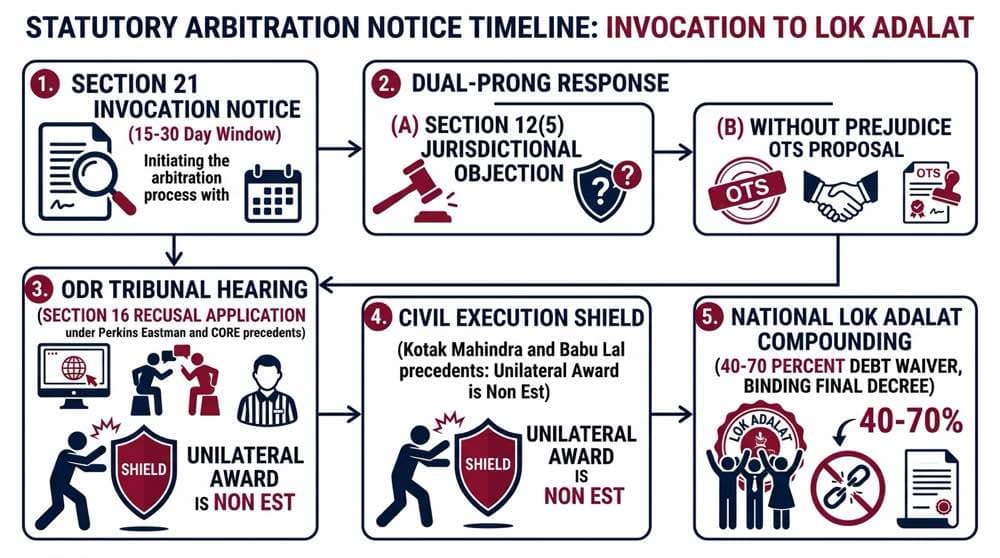
01. The Section 21 Notice: Understanding Arbitration Invocation in Loan Defaults
Receiving an arbitration notice is an urgent event. It is not an arrest warrant. It is not a police summons. Under Section 21 of the Arbitration Act, proceedings begin only when you receive the invocation notice.
The statutory response clock runs for 15 to 30 days. This clock starts from the date of physical delivery. It does not start on the date printed on the advocate letter. Save your Speed Post envelope. Keep the delivery tracking slip from the post office website.
Never ignore an arbitration notice. Staying silent allows the lender to seek an ex-parte award. Sending a timely written dispute puts your facts on record. It protects your rights and opens the path to a fair One-Time Settlement (OTS).
02. The Unilateral Appointment Bar: Supreme Court Precedents from TRF to Perkins Eastman
For years, lenders inserted one-sided arbitration clauses into loan forms. These clauses gave the bank sole power to appoint its own lawyer as arbitrator. The Supreme Court of India has struck down this practice.
In TRF Ltd. v. Energo Engineering (2017), the Supreme Court set a clear rule. A person with an economic interest in the dispute cannot act as an arbitrator. They also cannot appoint an arbitrator.
This rule was reinforced in Perkins Eastman Architects v. HSCC (2019). The Court held that an interested party cannot unilaterally appoint a sole arbitrator. A bank or NBFC cannot appoint an arbitrator without your written consent. Any unilateral appointment is void from the start.
03. Section 12(5) & Seventh Schedule: Statutory Disqualification of Lender-Appointed Arbitrators
Section 12(5) of the Arbitration Act creates a strict bar against biased appointments. Any person listed in the Seventh Schedule cannot serve as an arbitrator.
Most bank arbitrators have ongoing business ties with the lender. They receive repeat briefs from the same recovery team. This creates reasonable doubts about their neutrality.
The Supreme Court ruled on this in Bharat Broadband Network v. United Telecoms (2019). The Court held that Section 12(5) ineligibility cannot be waived by silence or participation. It can only be waived by an express written agreement signed after the dispute arises. Standard loan agreements signed before default do not waive this right.
04. The 2024 Constitution Bench Ruling: Complete Extinction of Curated Arbitrator Panels
To work around the Perkins Eastman ruling, some lenders formed narrow panels. They picked a small group of lawyers and forced borrowers to choose from it.
On November 8, 2024, a five-judge Constitution Bench of the Supreme Court ended this practice. In the CORE case, the Court overruled its 2020 judgment. It held that unilateral curated panels violate Article 14 of the Constitution. They also violate equal treatment under Section 18 of the Act.
The Supreme Court ruled that equal treatment applies at all stages. A lender cannot curate a closed list. Both parties must pick the arbitrator by mutual consent. If they cannot agree, they must apply to the High Court under Section 11.
05. Digital ODR Platforms (Presolv360, Sama, CADRE): Convenience vs Jurisdictional Defects
Many digital lenders and NBFCs now use Online Dispute Resolution (ODR) portals. Platforms like Presolv360, Sama, and CADRE send notices by email and run video hearings.
Institutional ODR can be fast and fair when both parties agree. But banks often use ODR tools for mass debt collection. In Radiance Galore v. Yes Bank (July 2025), the Bombay High Court checked this practice. The Court held that an arbitral award from an ODR platform initiated solely by a bank is invalid.
The Bombay High Court stated that algorithms cannot hide unilateral appointments. If you did not agree to the ODR platform after the default, the process is flawed. You have a legal right to challenge the forum.
06. Section 16 Jurisdictional Challenge: Raising Kompetenz-Kompetenz at the Earliest Stage
Your first step upon getting an arbitration notice is filing a Section 16 plea. Under the rule of Kompetenz-Kompetenz, the arbitral tribunal must first rule on its own jurisdiction.
In your Section 16 plea, you state that the appointment violates Section 12(5) and Perkins Eastman. You state on record that you did not consent to the arbitrator. You call upon the arbitrator to close the proceedings.
Filing this objection early stops any claim of implied consent. If the arbitrator rejects your plea and passes an award, you can easily challenge the award in court under Section 34.
07. The Strategic Without Prejudice Loan Settlement Reply: Forcing an Amicable OTS
A legal objection halts unfair hearings, but it does not erase the loan debt. This is why a dual-prong reply works best. You combine your Section 12(5) objection with a Without Prejudice One-Time Settlement (OTS) offer.
Under Section 23 of the Evidence Act, offers marked Without Prejudice cannot be used against you in court. Your reply letter achieves two goals:
- Jurisdictional Denial: You deny the lender's inflated claims and dispute the illegal arbitrator.
- Bona Fide Settlement Offer: You show good faith by explaining your financial hardship. You propose an affordable OTS payment, usually 30% to 50% of the principal loan sum.
Banks know that defending illegal appointments in High Court takes time and money. When they see a strong legal objection alongside a real cash offer, they often transfer the file to their compromise committee.
08. Section 34 Setting Aside Route: Timelines, Patent Illegality & Challenging Bad Awards
If an arbitrator ignores your Section 16 plea and passes an adverse award, you can challenge it. You file a petition in court under Section 34 of the Arbitration Act.
You have 3 months from receiving the signed award to file under Section 34. The court can grant 30 extra days for valid reasons. But no delay beyond 120 days is allowed.
Under Section 34(2A), the court can set aside an award for patent illegality. An award passed by an ineligible arbitrator suffers from patent illegality. It violates the public policy of India and cannot stand.
09. The Section 36 Execution Shield: Why Unilateral Awards Are Non Est in Civil Courts
Borrowers often fear that an arbitrator will seize their salary or home. This fear is misplaced. An arbitrator has no power to enforce awards. To collect money, the bank must file an execution case in civil court under Section 36 of the Act.
Indian courts have ruled that awards from unilateral appointments cannot be enforced. In Kotak Mahindra Bank v. Narendra Kumar Prajapat (2023), the Delhi High Court held that such awards are a nullity and non est in law. The civil court must reject enforcement.
The Supreme Court dismissed the bank's appeal in December 2023. In Babu Lal v. Cholamandalam (2023), the Delhi High Court also quashed unilateral loan awards as void from the start.
10. Consumer Protection Remedies & Criminal Shield: BNS 2024 Against Harassment
Banks often mix arbitration notices with threats from debt collection agents. Indian law gives borrowers strong shields under consumer and criminal rules.
In Emaar MGF Land v. Aftab Singh (2019), the Supreme Court ruled that arbitration clauses do not block consumer complaints. If a bank adds hidden fees or inflates interest, you can file a case in the Consumer Forum.
Also, the Bharatiya Nyaya Sanhita (BNS) 2024 makes abusive recovery a crime:
- Section 351: Punishes criminal intimidation, threatening calls, and abusive language.
- Section 79: Punishes acts that insult the modesty of women during home visits.
- Section 308: Punishes extortion and threats of unlawful property seizure.
Under RBI rules, agents cannot call before 8 AM or after 7 PM. They cannot visit your workplace or shame you in public.
11. National Lok Adalat Compounding: Converting Arbitration Disputes into Final Decrees
National Lok Adalats offer the safest way to settle loan disputes. They are held four times a year by the National Legal Services Authority (NALSA).
Under civil compounding rules, loan disputes can move to Lok Adalat at any time. Bank officers at Lok Adalats have pre-set power to waive 40% to 70% of penal interest and fees.
A Lok Adalat award is equal to a final civil court decree. It cannot be appealed in any court. Once you pay the agreed settlement sum, the loan is closed for good. The bank must give you a formal No Dues Certificate.
12. Statutory Framework, Official Precedents & Emergency Escalation Portals
Every right in this guide is based on verified laws, court rulings, and official portals:
Report recovery abuse and unfair lending at cms.rbi.org.in.
cms.rbi.org.inCheck Lok Adalat dates and legal aid at nalsa.gov.in.
nalsa.gov.inRead TRF, Perkins Eastman, and CORE rulings at sci.gov.in.
sci.gov.inReport extortionate loan threats on helpline 1930 or at cybercrime.gov.in.
cybercrime.gov.in | Helpline 1930Arbitration Notice Loan Settlement: Answers to Top 10 Inquiries
How do I reply to an arbitration notice for a loan settlement?▼
Send a formal written reply within 15 to 30 days of receipt. Mark the letter Without Prejudice, raise your Section 12(5) jurisdictional objection against unilateral arbitrator appointment, dispute any predatory penal interest, and present a structured One-Time Settlement (OTS) offer based on your verified repayment capacity.
Can I propose a One-Time Settlement (OTS) in my arbitration notice reply?▼
Yes. Under Section 23 of the Indian Evidence Act, settlement offers marked Without Prejudice cannot be used as admissions of debt in court. Proposing an OTS alongside jurisdictional objections often encourages the lender to freeze arbitration and refer the matter to their Compromise Settlement Committee.
Can a bank or NBFC unilaterally appoint a sole arbitrator without my consent?▼
No. Under Supreme Court landmark rulings in TRF Ltd., Perkins Eastman, and the 2024 CORE Constitution Bench judgment, a lender cannot unilaterally appoint a sole arbitrator or impose a curated panel. Such appointments are void ab initio and lack jurisdiction.
Does replying to an arbitration notice mean I accept the arbitrator's jurisdiction?▼
No, provided your reply explicitly objects to the arbitrator's jurisdiction under Section 16 of the Arbitration Act. In your reply, state clearly that you do not consent to the appointment and that your participation is strictly for objecting to the tribunal's constitution.
How does the Supreme Court Perkins Eastman ruling protect me in loan arbitration?▼
In Perkins Eastman (2019), the Supreme Court established that any entity with an economic interest in the dispute outcome is disqualified from unilaterally appointing a sole arbitrator. This disqualification invalidates standard bank loan arbitration clauses that grant the lender exclusive appointment powers.
What should I do if I receive an arbitration notice from an ODR platform like Presolv360?▼
Send a formal written objection challenging the platform's jurisdiction if you did not mutually agree to the specific ODR institution after the dispute arose. In Radiance Galore v. Yes Bank (2025), the Bombay High Court ruled that algorithmic ODR processes cannot camouflage unilateral appointments.
Can an arbitrator issue an arrest warrant or send police for loan default?▼
No. An arbitral tribunal is a private civil forum with zero criminal jurisdiction. An arbitrator cannot issue arrest warrants, non-bailable warrants, or direct police intervention. Any collection agent threatening arrest under an arbitration notice is committing criminal intimidation under Section 351 BNS.
Can a bank execute a unilaterally passed arbitral award against my salary or account?▼
Under the Delhi High Court Division Bench ruling in Kotak Mahindra Bank v. Narendra Kumar Prajapat (2023), awards rendered by unilaterally appointed arbitrators are null and void (non est) and cannot be executed by civil courts under Section 36 of the Arbitration Act.
How much time do I have to challenge an adverse arbitral award in court under Section 34?▼
You have exactly 3 months from the date of physical receipt of the signed arbitral award to file a Section 34 setting aside petition in the Principal Civil Court. The court may grant an additional 30 days upon showing sufficient cause, but no extension is permissible beyond 120 days.
How can I settle an ongoing loan arbitration case at a National Lok Adalat?▼
Submit an application to the lender or District Legal Services Authority (DLSA) requesting referral of your loan account to the upcoming National Lok Adalat. In Lok Adalat sittings, lenders routinely compound debt with 40% to 70% waivers, resulting in a binding, final civil decree.