What is Arbitration in India: Meaning, Process & Legal Rights
Arbitration Process, Bank Notices, ODR & Borrower Rights
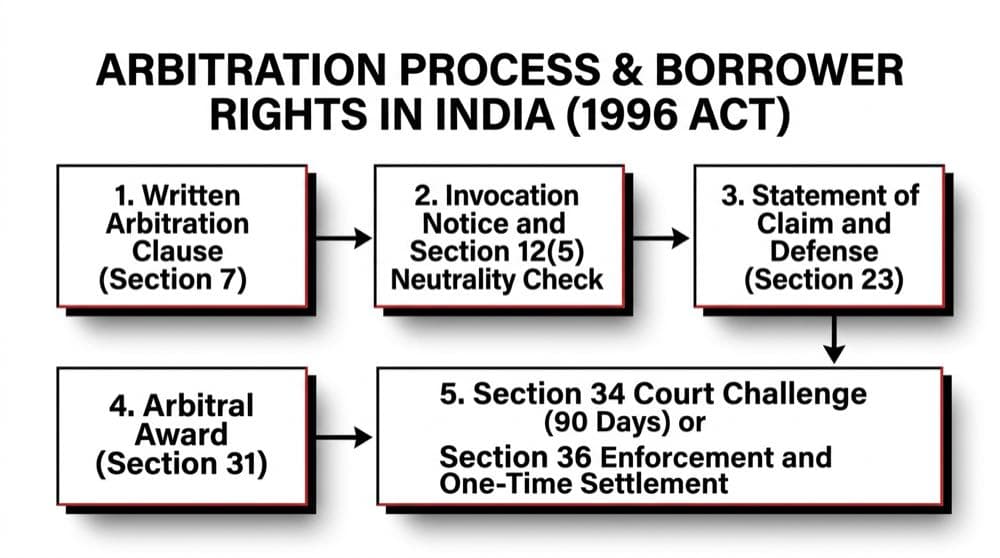
Flowchart: Five core statutory stages of arbitration and defense mechanisms under the Arbitration and Conciliation Act, 1996.
01. Quick Summary: What is Arbitration?
Arbitration is a private way to resolve legal and financial disputes outside regular civil courts. It is governed by the Arbitration and Conciliation Act, 1996. The two disputing parties choose a neutral third party called an arbitrator. The arbitrator examines evidence, hears arguments, and issues a final written decision called an arbitral award.
An arbitral award carries the exact same legal power as a civil court decree. Under Section 36 of the Act, the winning side can file a court petition to enforce it. The civil court can then execute the award against assets or income.
Banks in India routinely insert an arbitration clause into personal loan and credit card agreements. When a borrower misses payments, the lender starts arbitration to recover money quickly. However, lenders cannot pick their own private arbitrator. The Supreme Court of India has ruled that one-sided arbitrator appointments are void from the start.
02. How Arbitration Works Under the 1996 Act
The Arbitration and Conciliation Act, 1996 governs all domestic arbitrations in India. The law operates across five key statutory pillars:
- 1. Written Agreement (Section 7): Arbitration requires a signed written agreement. In loan contracts, this is found under the Dispute Resolution clause.
- 2. Civil Court Referral (Section 8): When a valid agreement exists, civil courts must refer the dispute to arbitration upon request.
- 3. Interim Orders (Section 9 & 17): Parties can seek urgent court or tribunal orders to protect assets during the dispute.
- 4. Strict Impartiality (Section 12): Arbitrators must be neutral. Any business connection or personal conflict disqualifies the arbitrator by law.
- 5. Final Award (Section 35 & 36): The arbitral award is final and binding. It can only be challenged on narrow procedural grounds under Section 34.
03. Arbitration vs Court vs Lok Adalat vs Mediation
Citizens often confuse arbitration with other legal forums. Here is how each dispute resolution channel compares in speed, cost, and legal power:
Decided by private arbitrator. Produces a binding arbitral award. Narrow appeal grounds under Section 34.
Formal public trial before a judge. High legal costs and long delays across multiple appeal courts.
Voluntary settlement bench. Awards carry civil decree power under Section 21. Zero court fees with 30% to 60% OTS discounts.
Direct negotiation under Section 63 of Contract Act. Bank issues official settlement letter and grants a formal NDC.
1. Did the bank or NBFC appoint the sole arbitrator on their own without your written consent?
2. Did you receive a formal 30-day Invocation Notice before the arbitrator was appointed?
3. Is the named arbitrator an empaneled advocate or regular consultant for this lender?
4. Is this an online digital arbitration proceeding (e.g. Sama, Presolv360, CADRE link)?
05. The 5-Stage Arbitration Process in India
The arbitration procedure moves through five distinct statutory steps:
The dispute begins when you receive a formal written notice. The lender states their intent to refer the dispute to arbitration.
Both parties must agree on the arbitrator. If parties disagree, the court appoints an independent arbitrator under Section 11.
The lender submits loan statements. You receive 30 days to file your written defense and challenge wrongful penal interest.
The arbitrator holds hearings in person or online. Both parties present documents and oral arguments.
The arbitrator passes a reasoned written award. A signed copy is delivered to both parties for enforcement or challenge.
06. Bank & NBFC Loan Arbitration: The Ground Reality
When borrowers default on credit cards or personal loans, banks send letters labeled Arbitration Notice. Many lenders use Online Dispute Resolution (ODR) portals like Sama or Presolv360 to conduct hearings over video links.
Digital arbitration is legal in India. However, recovery agencies often misuse the word arbitration to threaten borrowers. They send fake messages claiming police warrants will be issued. This is completely false. An arbitrator is a civil judge, not a police officer. They cannot arrest anyone or seize property directly.
All these RBI rules, regulatory guidelines, and police FIR provisions exist officially in the books. However, the ground reality is that the Indian judicial and police system moves very slowly. In most everyday cases, lodging a formal complaint or filing an FIR will not give you immediate relief from aggressive collection calls.
The honest fact is: until all of your outstanding loans are either officially settled (via One-Time Settlement) or fully closed, the probability of getting complete peace of mind from recovery agencies is very low.
1. Change Your Mobile Number: Switch to a fresh SIM card for daily use, sharing it strictly with close family. Keep your old loan-registered SIM on silent in a spare phone to check SMS once weekly for official bank notices. This instantly cuts off the non-stop daily barrage of abusive phone calls.
2. Shift Your Residential Address: If recovery agents or local collection musclemen know your rented flat and keep showing up to humiliate you before neighbors, relocate to a different address if possible to protect your family from doorstep embarrassment.
3. Delete the Loan App & Revoke All Permissions: Immediately uninstall the lending app from your smartphone. Before deleting, open phone settings, revoke all permissions (contacts, storage, camera, location), and clear app data so trackers cannot continue harvesting your real-time data or accessing your contact list.
07. Unilateral Arbitrator Appointments: Supreme Court Shield
The strongest borrower defense is the ban on unilateral arbitrator appointments. In loan agreements, banks write clauses giving themselves the sole power to pick an arbitrator.
The Supreme Court of India has struck down these clauses across landmark verdicts:
- 1. TRF Limited (2017): The Supreme Court ruled that an interested party cannot act as an arbitrator or nominate someone else.
- 2. Perkins Eastman (2019): The Supreme Court held that anyone with an interest in the dispute outcome cannot unilaterally appoint a sole arbitrator.
- 3. Bharat Broadband (2019): Attending hearings does not waive your right to challenge a biased appointment without written consent.
- 4. CORE (2024 Constitution Bench): Forcing a borrower to choose from a bank-curated arbitrator panel violates Article 14 equality.
08. Challenging an Arbitral Award Under Section 34
If an unfair arbitral award is passed against you, you can challenge it in court under Section 34 of the Arbitration Act.
- No Notice: You never received proper notice of the hearing dates or arbitrator appointment.
- Biased Arbitrator: The arbitrator was appointed unilaterally without mutual consent under Section 12(5).
- Beyond Agreement: The award covers matters outside the signed loan contract.
- Public Policy Breach: The proceedings violated basic natural justice or Indian law.
Time Limit: You must file your Section 34 petition within 90 days (three months) of receiving the award. The court can grant 30 extra days for valid delays. No challenge is allowed after 120 days.
Filing a Stay: Filing Section 34 does not stop the award automatically. You must file a stay application under Section 36(2). Courts can grant an unconditional stay if the appointment was illegal.
09. Section 36 Enforcement & Section 60 Wage Shield
If an award is not challenged within 90 days, the lender files an Execution Petition in District Court under Section 36.
Courts cannot attach your entire salary. Section 60 of the Code of Civil Procedure (CPC) provides strong legal shields:
The first 1,000 rupees of your monthly salary is 100% exempt. Two-thirds (66.6%) of the remaining balance is also exempt. Only one-third (33.3%) can ever be attached.
Protected Assets: Essential cooking items, clothes, bedding, and tools of artisans cannot be attached by any civil court in India.
10. Settle Loan Before or After Award (OTS Exit)
You can negotiate an out-of-court One-Time Settlement (OTS) with the lender at any time, even after an award is passed.
Executing an award in civil court takes 2 to 4 years and costs heavy legal fees. When borrowers prove financial hardship, banks routinely agree to settle for a 30% to 50% discount with 100% penal fee waiver.
- Written OTS Proposal: Submit a settlement letter explaining your hardship.
- Consent Award: Record a Consent Award under Section 30 or ensure the bank closes proceedings in writing.
- Verify Bank Sanction: Pay directly to your loan account, never to recovery agency accounts.
- No Dues Certificate: Obtain your formal NDC within 30 days and verify CIBIL updates.
Official Statutory Resources & Regulatory Portals
RBI & GOVT VERIFIEDAccess official government portals, regulatory ombudsman channels, and statutory dispute resolution bodies governing Indian banking and borrower rights:
- RBI Integrated Ombudsman Scheme (CMS)↗
File complaints against bank recovery abuse and fair practice violations
- RBI Sachet Portal (Illegal Recovery & Harassment)↗
Report unauthorized lending apps and aggressive recovery agency violations
- NALSA National Lok Adalat Schedules↗
Statutory alternative dispute resolution for mutually agreed OTS settlements
- National Consumer Helpline (NCH)↗
Government grievance redressal under Department of Consumer Affairs
- National Cyber Crime Reporting Portal (1930)↗
Official reporting for recovery blackmail, cyber threats, and extortion
- The Arbitration and Conciliation Act, 1996 (India Code)↗
Official statutory text of the central legislation governing domestic arbitration in India
- Supreme Court Ruling: Perkins Eastman Architects v. HSCC (2019)↗
Supreme Court judgment banning unilateral sole arbitrator appointments by interested parties
- Delhi High Court: Kotak Mahindra Bank v. Narendra Kumar Prajapat (2023)↗
Landmark ruling confirming that unilateral arbitration awards are void ab initio and unexecutable
- NITI Aayog ODR Policy Plan & Framework for India↗
Official policy framework for Online Dispute Resolution and digital dispute processing in India
Frequently Asked Questions
What is the basic difference between arbitration and a court case?+
Arbitration is a private dispute resolution process. A neutral arbitrator decides the case outside civil courts. A court case is conducted in public by a judge. Arbitration is faster. However, an arbitral award has the exact same legal power as a civil court decree.
Can an arbitrator send me to jail or issue an arrest warrant for an unpaid loan?+
No. An arbitrator is a civil judge, not a police officer or magistrate. They cannot arrest anyone, issue warrants, or seize property. Loan default is strictly a civil dispute in India.
Can a bank appoint its own in-house lawyer as the sole arbitrator?+
No. The Supreme Court of India banned unilateral arbitrator appointments in TRF Ltd and Perkins Eastman. Lenders cannot pick their own sole arbitrator without your written consent.
What should I do if I receive an online arbitration notice from Sama or Presolv360?+
Do not ignore the notice. Check if the arbitrator was appointed fairly. Send a written reply within 30 days. State your financial hardship and dispute any wrongful interest or penalties.
What is the time limit to challenge an arbitral award in court?+
Under Section 34 of the Arbitration Act, you have three months (90 days) to file a challenge. The court can grant 30 extra days for valid delays. No challenge is allowed after 120 days.
Can a bank attach my entire salary to recover an arbitration award?+
No. Section 60 of the Civil Procedure Code protects your income. The first 1,000 rupees plus two-thirds of the remaining salary is 100% exempt. Only one-third of the balance can be attached.
Can I settle my loan after an arbitration award has been passed?+
Yes. Banks prefer quick settlements over years of court execution. You can negotiate a One-Time Settlement (OTS) for a discounted lump sum at any stage.
Is an arbitration clause mandatory to start arbitration in India?+
Yes. Under Section 7 of the Arbitration Act, arbitration requires a written agreement. Both parties must agree in writing to submit disputes to arbitration.
Community Discussion & Case Notes
0 CommentsNo comments posted yet. Be the first to share your experience below!
Join the Discussion & Share Your Experience
Have you dealt with this situation or received a notice? Share your questions or experience with other borrowers.
Find this content helpful?
If this guide has helped you navigate your settlement journey, consider showing some support to keep this platform running.