WARNING: THIS IS NOT LEGAL ADVICE. THIS IS SURVIVAL GUIDANCE BASED ON STATUTORY INDIAN LAW AND BORROWER EXPERIENCE.
UPDATED: SEPTEMBER 2026

Borrower Death: Legal Heir Loan Liability Rules & Asset Protection

Section 50 CPC Defense Against Unlawful Recovery Demands

When a borrower passes away, banks and third-party recovery agencies frequently target grieving family members with aggressive calls, demanding that sons, daughters, or widows pay off the debt. Under Section 50 of the Civil Procedure Code, Indian law strictly protects you from personal liability.

Quick Answer Summary: Are You Liable?

Under Section 50(2) of the Civil Procedure Code (CPC), legal heirs are never personally liable for a deceased family member debt. Creditors can only claim repayment from the exact assets left behind by the deceased. If you inherited zero assets, your legal liability is exactly zero rupees. Personal loans and credit cards are unsecured and must be written off upon submission of the death certificate.

Ground Reality NoteBook Rules vs Reality
The Harsh Reality: Why System Slowness Demands Direct Self-Protection

All these RBI rules, regulatory guidelines, and police FIR provisions exist officially in the books. However, the ground reality is that the Indian judicial and police system moves very slowly. In most everyday cases, lodging a formal complaint or filing an FIR will not give you immediate relief from aggressive collection calls.

The honest fact is: until all of your outstanding loans are either officially settled (via One-Time Settlement) or fully closed, the probability of getting complete peace of mind from recovery agencies is very low.

Pro Survival Tips for Immediate Peace:

1. Change Your Mobile Number: Switch to a fresh SIM card for daily use, sharing it strictly with close family. Keep your old loan-registered SIM on silent in a spare phone to check SMS once weekly for official bank notices. This instantly cuts off the non-stop daily barrage of abusive phone calls.

2. Shift Your Residential Address: If recovery agents or local collection musclemen know your rented flat and keep showing up to humiliate you before neighbors, relocate to a different address if possible to protect your family from doorstep embarrassment.

3. Delete the Loan App & Revoke All Permissions: Immediately uninstall the lending app from your smartphone. Before deleting, open phone settings, revoke all permissions (contacts, storage, camera, location), and clear app data so trackers cannot continue harvesting your real-time data or accessing your contact list.

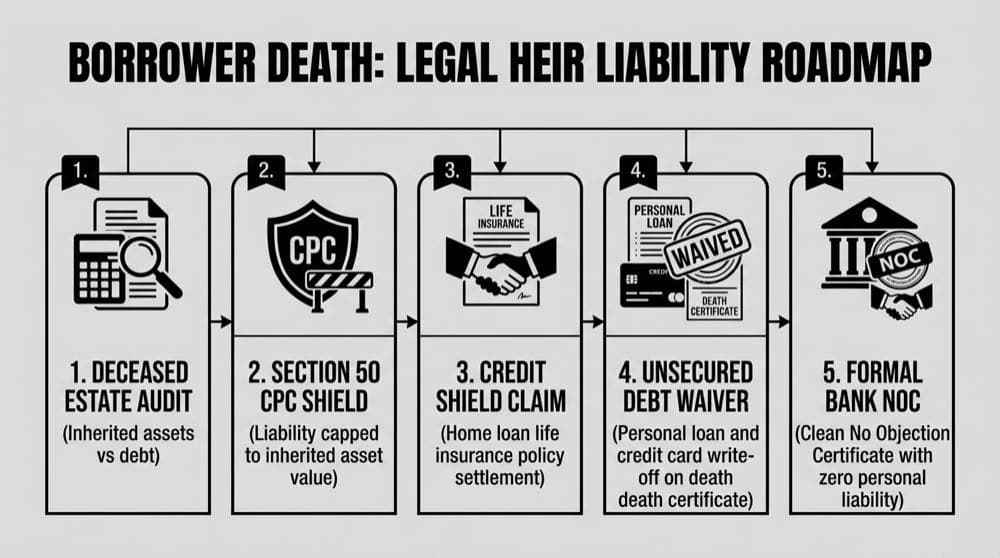
Borrower Death Legal Heir Loan Liability Roadmap and Section 50 CPC Rights

Visual Blueprint: 5-stage legal defense roadmap for legal heirs dealing with deceased borrower debts.

01. Section 50 CPC: The Core Legal Shield

Under Section 50 of the Code of Civil Procedure (CPC), 1908, a creditor can execute a court decree against the legal representatives of a deceased debtor only to the extent of the property of the deceased which has come to their hands. In plain English: you are only responsible up to the exact value of the assets you inherit.

This statutory protection is reinforced by Supreme Court rulings in Pannalal v. Mt. Naraini and State of Punjab v. Satnam Singh. The court affirmed that debt recovery cannot touch a legal heir self-acquired assets, salary, or personal savings.

Statutory Rule Breakdown:

If your late father owed ₹15,00,000 to a bank, but left behind an estate worth only ₹4,00,000 in bank deposits or land, the bank can recover at most ₹4,00,000. Once that inherited amount is surrendered, the remaining ₹11,00,000 is legally unrecoverable. The bank cannot demand a single extra rupee from your personal salary.

02. Zero Inheritance: What If No Assets Remain

Under Section 50(2) of the CPC, if the deceased borrower left zero property, the legal heirs have zero liability. Many families face severe financial hardship when a sole earning member passes away leaving behind only accumulated debt and unpaid medical bills.

Recovery telecallers often lie to family members, claiming that children must sign fresh promissory notes or pay off the balance under moral obligation. Under Indian contract law, you have no legal obligation to assume debt you never signed for.

The Zero-Liability Rule:

Zero inherited assets equal zero debt liability. Never sign any guarantee form, fresh loan application, or payment undertaking presented by recovery executives after a family member demise. Signing a new document creates a fresh personal liability that did not exist previously.

03. Unsecured Debt vs Secured Mortgages

Indian banking classifies debts into two fundamental categories upon a borrower death:

1. Unsecured Loans (Personal Loans & Credit Cards):

These loans have no asset pledged as security. Banks charge higher interest rates precisely to cover the risk of default or death. When the borrower dies, the lender cannot attach any family property. Upon receiving an attested death certificate, the lender internal credit committee writes off the outstanding principal and closes the file.

2. Secured Loans (Home Loans, Auto Loans, Gold Loans):

These loans are backed by a registered mortgage, hypothecation, or pledge. The bank holds a legal charge over the underlying asset. While heirs are still not personally liable, the property itself remains encumbered. Heirs must either settle the loan balance or allow the bank to recover dues through asset sale.

04. Home Loans & Credit Shield Insurance

Over 80% of institutional home loans sanctioned in India by lenders like SBI, HDFC, ICICI, and Axis Bank bundle a mandatory or optional group credit life insurance policy (such as SBI Life Rinn Raksha, HDFC Life Group Credit Protect, or ICICI Pru Loan Shield).

Under these policies, if the insured borrower passes away during the loan tenure, the insurance company is legally bound to pay the outstanding balance directly to the bank. The bank must accept this insurance payout and release the original title deeds to the legal heirs.

Essential Insurance Claim Steps:
  • Check the original loan sanction letter for insurance premium deductions.
  • Submit the insurer death claim form alongside the hospital medical cause of death certificate.
  • Demand that the branch manager put EMI collection on hold while the claim is under process.
  • Obtain the official claim settlement voucher and original property title deeds.

05. Co-Borrowers and Guarantors Liability

Section 50 CPC protection applies strictly to pure legal heirs who never signed the loan agreement. If a family member signed the original contract as a joint applicant or loan guarantor, the legal situation changes completely.

Under Section 128 of the Indian Contract Act, 1872, the liability of a guarantor or co-applicant is co-extensive with that of the principal debtor. The death of the primary applicant does not extinguish the contract for surviving signatories.

Surviving Signatory Rules:

If a husband and wife jointly took a home loan, the surviving spouse remains legally responsible for continuing the monthly installments. However, if the wife was merely listed as a nominee or legal heir without signing as a co-applicant, she has zero personal liability.

06. Vehicle and Gold Loan Repossession Rules

Vehicle loans are hypothecated under the Motor Vehicles Act, 1988, and gold loans are pledged under Section 176 of the Indian Contract Act. In both cases, the lender security interest attaches directly to the physical asset:

Vehicle Loans:

If EMIs stop after a car owner death, the finance company can repossess the vehicle, but strictly following Supreme Court guidelines in Manager, ICICI Bank Ltd. v. Prakash Kaur. Lenders cannot use musclemen or seize vehicles by force without giving advance written notice.

Gold Loans:

Lenders can auction the pledged gold to recover dues after issuing a 14-day notice. Under RBI rules, if the gold sells for more than the outstanding debt, the surplus cash must be returned to the legal heirs within 7 working days.

07. Stopping Illegal Collection Harassment

Recovery agencies frequently use illegal intimidation tactics against bereaved families, including sending abusive WhatsApp messages, calling distant relatives, or threatening to have the family arrested.

Under RBI Master Direction DOR.ORG.REC.65/21.04.158/2022-23, recovery agents are strictly prohibited from harassing family members or contacting non-borrowers. Threatening a bereaved family constitutes a cognizable criminal offense under Section 351 (Criminal Intimidation) and Section 308 (Extortion) of the Bharatiya Nyaya Sanhita (BNS).

Action Steps Against Aggressive Recovery Calls:
  • Record every telephone conversation and preserve WhatsApp chat screenshots.
  • Demand the caller full name, recovery agency registration, and bank authorization ID.
  • Send a formal cease-and-desist letter to the bank Principal Nodal Officer.
  • Dial 1930 to report cyber harassment or call 112 if recovery agents show up at your doorstep.

08. Step-by-Step Bank Intimation Protocol

To formally halt collection proceedings and protect your family, execute this 4-step bank intimation process:

Step 1: Draft Official Death Intimation Letter

Write a formal letter stating the borrower name, loan account numbers, date of demise, and list of legal heirs. Explicitly request an immediate freeze on automated NACH mandate debits and late penalty charges.

Step 2: Attach Statutory Documentation

Attach certified photocopies of the Municipal Death Certificate, the Legal Heir Certificate issued by the Revenue Authority or Tehsildar, and KYC documents of the claimant.

Step 3: Submit via Registered Post and Email

Deliver the packet to the home branch with an acknowledgment seal. Simultaneously email scanned copies to the bank Principal Nodal Officer to create an unalterable digital timestamp.

Step 4: Demand Written Closure Confirmation

For unsecured loans, obtain written confirmation that the account has been classified as deceased credit loss. For secured loans with insurance, monitor the claim settlement until a formal No Objection Certificate (NOC) is released.

09. Official Grievance Portals & RBI Contacts

If the lending institution ignores your death intimation letter or allows recovery agencies to continue harassment, escalate immediately through these statutory grievance redressal channels:

Statutory Authorities & Official Portals:

RBI CMS Portal: File an online grievance at cms.rbi.org.in or call toll-free helpline 14448.

National Cyber Crime Portal: Report abusive WhatsApp messages, morphed threats, and extortion at cybercrime.gov.in or dial 1930.

National Consumer Helpline (NCH): Register an unfair trade practice complaint at consumerhelpline.gov.in or dial 1915.

Police Emergency: Dial 112 immediately if recovery executives enter your residential premises without valid authorization.

10. Deceased Borrower & Legal Heir FAQs

Verified statutory answers regarding deceased borrower loan obligations, legal heir liability limits, and credit bureau rules in India.

Are children legally liable to pay their deceased father or mother loan in India?
No. Under Section 50 of the Civil Procedure Code (CPC), children and legal heirs are never personally liable for a deceased parent loan. You only have to pay if you inherited property from the deceased, and your liability is strictly capped up to the value of that inherited property. If you inherited zero assets, you owe zero rupees.
Can banks recover unpaid credit card debt or personal loans from legal heirs?
No. Credit cards and personal loans are unsecured debts. Since no property was pledged as collateral, the debt cannot be transferred to family members. Upon receiving the official death certificate, the bank must write off the unpaid unsecured balance as a credit loss.
Can a bank seize a deceased borrower home if there is an active home loan?
Yes, but with critical conditions. Home loans are secured debts backed by a mortgage on the property. If the loan had a Credit Shield or Loan Protection Life Insurance policy (such as SBI Rinn Raksha or HDFC Life Group Shield), the insurance company must clear the outstanding balance. If uninsured, the heirs must either clear the dues or the bank may initiate SARFAESI proceedings against the property.
What should family members do if recovery agents harass them for a deceased relative debt?
Demand the agent employee ID and written bank authorization letter, record all calls, and state clearly that you are not a co-borrower. File a written complaint with the bank Principal Nodal Officer citing RBI circular DOR.ORG.REC.65/21.04.158/2022-23. If threats persist, dial 1930 for cyber extortion or call 112 for criminal intimidation under Section 351 of Bharatiya Nyaya Sanhita (BNS).
Does a co-borrower or loan guarantor remain liable after the primary borrower dies?
Yes. If a family member signed the loan contract as a joint co-borrower or guarantor, their legal liability is independent and co-extensive under Section 128 of the Indian Contract Act. The bank has the legal right to demand payment directly from the surviving co-borrower.
Can banks attach a legal heir personal salary account or personal savings?
Never. Courts have repeatedly ruled that a legal heir personal income, private salary, and self-acquired assets cannot be attached for a deceased relative debt. The creditor can only proceed against property strictly left behind by the deceased borrower.
What documents must be submitted to the bank to report a borrower death?
You must submit a formal intimation letter along with an attested copy of the Municipal Death Certificate, the Legal Heir Certificate or Family Succession Card, and the relevant loan account statements. Request an immediate freeze on interest accumulation and demand an official No Dues Certificate for unsecured loans.
Can recovery agents visit our home at night or call relatives after a borrower death?
No. RBI regulations strictly restrict all recovery calls and visits to between 8:00 AM and 7:00 PM. Contacting friends, distant relatives, or neighbors to discuss a deceased person debt is a direct violation of RBI Fair Practices Code and carries regulatory penalties.
What happens if inherited assets are worth less than the deceased total debt?
Under Section 50(2) of the CPC, your liability is strictly limited to the exact market value of what you received. For example, if you inherited ₹3,00,000 in bank deposits but the deceased left ₹10,00,000 in debt, you surrender only ₹3,00,000. The remaining ₹7,00,000 must be written off by the lender.
How does credit shield or loan protection insurance work after a borrower death?
When an insured borrower passes away, the nominee submits a death claim form with the death certificate and loan statement to the insurer. The insurance company pays the approved sum directly to the lending bank to settle the outstanding balance, after which the bank releases the original property title deeds.

Find this content helpful?

If this guide has helped you navigate your settlement journey, consider showing some support to keep this platform running.