WARNING: THIS IS BORROWER SURVIVAL GUIDANCE BASED ON REAL SETTLEMENT EXPERIENCE. NOT LEGAL ADVICE.
UPDATED: SEPTEMBER 2026
PayU Finance Loan Settlement: LazyPay & PaySense OTS Rules in India
LazyPay & PaySense Personal Loan Default & Recovery Rules
Defaulted on LazyPay PayLater, XpressLoan, or PaySense? Learn how PayU Finance India Private Limited evaluates One-Time Settlements (35% to 60% waivers), stop unlawful contact list harassment under RBI Digital Lending Guidelines, defend against Section 25 PSS Act notices, and rebuild your credit score.
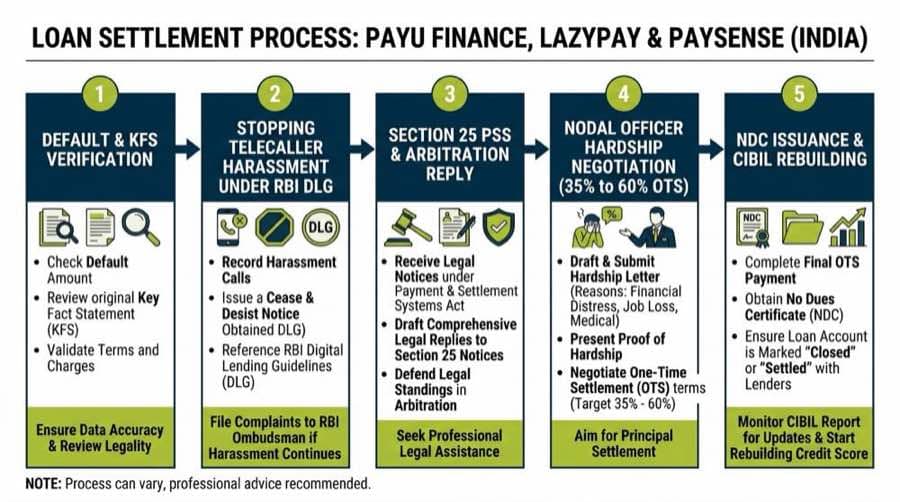
Figure 1: Official 5-stage settlement and regulatory defense roadmap for PayU Finance, LazyPay, and PaySense credit facilities.
Quick Answer Summary
PayU Finance India Private Limited regularly approves 35% to 60% One-Time Settlements (OTS) on delinquent LazyPay and PaySense loans once an account crosses 90 to 180 days past due (NPA). Under Section 171 of the Contract Act, PayU Finance cannot freeze your external bank savings accounts. Under RBI Digital Lending Guidelines, recovery agents are strictly prohibited from calling your phone contacts, relatives, or workplace colleagues. Section 25 PSS Act e-NACH bounce notices are bailable, compoundable, and permanently closed upon executing an official OTS.
Empirical Calculator40% - 60% OTS ELIGIBLE
PayU Finance & LazyPay Settlement Calculator
Understand realistic resolution possibilities based on PayU Finance India Private Limited provisioning metrics, NPA rules, and OTS compromise benchmarks.
₹1,50,000
Rs. 10,000Rs. 2,50,000Rs. 5,00,000
Target Compromise Range:₹60,000 - ₹82,500
Expected Haircut45% to 60%
Potential Savings₹67,500 - ₹90,000
Waiver Rules: 100% bounce charges and accrued penal interest waived upon formal sanction letter. Audit your Key Fact Statement (KFS). Escalate directly to PayU Finance Principal Nodal Officer for formal 40% to 60% OTS terms.
* Estimates based on empirical PayU Finance India Private Limited settlement data and RBI Prudential Framework. Actual approvals depend on individual financial hardship proof submitted to the Nodal Desk.
PayU Finance India Private Limited is a systemically important non-banking financial company (NBFC) registered with the Reserve Bank of India under Certificate of Registration No. N-13.01823. It functions as the primary lending balance sheet behind popular consumer credit brands including LazyPay (Buy Now Pay Later and XpressLoans) and PaySense (unsecured personal loans).
When you borrow money through the LazyPay mobile app or PaySense platform, your financial and legal liability is owed directly to PayU Finance India Private Limited (formerly known as Sidvik Leasing Private Limited), or one of its regulated co-lending partner institutions. Understanding this corporate structure is essential because collection telecallers often use trade brand names, whereas legal notices and settlement sanction letters must strictly originate from the licensed NBFC entity.
PayU Finance Entity Breakdown
Corporate Identity: PayU Finance India Private Limited (CIN: U65990MH1992PTC065624).
Consumer Facing Brands: LazyPay (BNPL, Revolving Credit Lines, XpressLoans) and PaySense (Personal Loans up to Rs. 5 Lakh).
Regulatory Oversight: Directly supervised under RBI Master Directions for Non-Banking Financial Companies and the Digital Lending Guidelines (DLG).
Settlement Authority: Loan compromise and waiver approvals are managed centrally by the PayU Finance Credit Committee in Mumbai, not by third-party calling agencies.
2. The Multi-Partner Digital Co-Lending Reality & Key Fact Statement (KFS)
LazyPay and PaySense operate a digital co-lending and loan origination architecture. While the majority of personal credit lines are funded directly by PayU Finance India Private Limited, certain loans are underwritten in partnership with third-party banks and NBFCs, including SBM Bank India (for LazyCard facilities), Northern Arc Capital, Fullerton India (SMFG India Credit), or Piramal Capital.
To identify your exact legal creditor, examine the Key Fact Statement (KFS) and loan agreement issued in your registered email at the time of loan disbursal. If the loan is co-funded or originated for a partner NBFC, any One-Time Settlement (OTS) proposal must be sanctioned by the specific institutional lender named on your sanction letter.
How to Verify Your Underlying Lender in 3 Steps
Check Your Sanction Email: Search your inbox for "Key Fact Statement" or "Loan Agreement" sent on the date of loan activation.
Inspect the Lender Name: Confirm whether the lender is listed as "PayU Finance India Pvt Ltd" or a partner NBFC.
Verify on Credit Bureau (CIBIL): Pull your official CIBIL report. The account will appear under "PAYU FINANCE" or the respective co-lending institution.
Recovery callers frequently threaten defaulted borrowers by claiming that PayU Finance will freeze their savings bank accounts, stop incoming salary credits, or attach fixed deposits held at other commercial banks. This claim is legally unfounded.
Under Section 171 of the Indian Contract Act, 1872, general banker's lien and right of set-off apply exclusively to banking institutions that hold customer deposit accounts under a single Customer Information File (CIF). PayU Finance India Private Limited is a non-deposit-taking NBFC. It does not hold your savings or current accounts.
Statutory Lien Rule: NBFCs Cannot Freeze External Bank AccountsPayU Finance and LazyPay have zero legal authority to freeze, debit, or attach funds held in outside banks (such as SBI, HDFC, ICICI, or Axis Bank) without obtaining an explicit attachment order from a competent civil court after a full trial. Any collection executive threatening an immediate account freeze is making a fraudulent misrepresentation.
4. Digital Lending Guidelines (DLG) & Borrower Privacy Shield
The Reserve Bank of India Digital Lending Guidelines (DLG), enforced across all regulated lending apps, strictly govern customer data privacy and collection ethics. Under these regulations, lending apps are prohibited from accessing borrower contact lists, location data, photos, or social media files.
Third-party recovery agencies acting on behalf of PayU Finance or LazyPay are legally barred from contacting your family members, friends, or workplace colleagues regarding your loan default. Your loan contract is strictly bilateral between you and the lender. Sharing your debt delinquency with third parties constitutes a direct regulatory violation punishable under RBI operational guidelines.
RBI Privacy Safeguards for Digital Borrowers
No Contact List Access: Lending apps may only access camera and microphone for one-time KYC onboarding. Continuous contact book scraping is strictly banned.
Calling Hours: Recovery agents may contact borrowers only between 8:00 AM and 7:00 PM. Calls at night or early morning are actionable offenses.
Physical Identification: Any agent visiting a borrower must carry an official photo identity card and a written authorization letter from PayU Finance.
Prohibition on Obscene Communications: Abusive language, threatening voice notes on WhatsApp, or fake legal summons sent via chat violate both RBI rules and the Information Technology Act.
5. Section 25 PSS Act Digital NACH e-Mandate Summons Defense
When monthly auto-debit payments bounce due to insufficient account balance, PayU Finance issues a statutory legal notice under Section 25 of the Payment and Settlement Systems (PSS) Act, 2007. This statutory provision treats the dishonour of an electronic funds transfer (e-NACH / e-Mandate) in a manner analogous to a bounced cheque under Section 138 of the Negotiable Instruments Act.
Receiving a Section 25 demand notice does not mean that an arrest warrant has been issued. The law mandates a 15-day cure window from the date of notice receipt. The offense under Section 25 is bailable, compoundable, and quasi-criminal in nature. It is designed to enforce financial obligations, not to incarcerate distressed borrowers who have suffered genuine economic hardship.
4-Point Statutory Protocol for Section 25 PSS Notices
Verify Demand Authenticity: Ensure the notice specifies your exact loan account number, bounced transaction reference, and the specific mandate date.
Reply Within 15 Days: Submit a formal written response citing your documented financial hardship (job loss, medical emergency, business downturn) and state your intent to seek an amicable OTS.
Never Ignore Court Summons: If a formal court complaint is filed before a Judicial Magistrate, appear through legal counsel to furnish bail and apply for compoundable settlement.
Close via Lok Adalat: Section 25 proceedings are routinely disposed of with zero criminal liability upon executing a structured One-Time Settlement.
6. Rebutting Unilateral Sole Arbitration (Perkins Eastman Rule)
Fintech lenders frequently issue notices intimating the commencement of digital or fast-track sole arbitration proceedings in distant locations such as Mumbai or New Delhi. Borrowers are threatened with ex-parte arbitral awards if they fail to attend virtual or physical hearings.
Under landmark Supreme Court of India judgments in TRF Ltd. v. Energo Engineering Projects Ltd. and Perkins Eastman Architects DPC v. HSCC (India) Ltd., any party that has an interest in the outcome of a dispute is legally disqualified from unilaterally appointing a sole arbitrator. Under Section 12(5) of the Arbitration and Conciliation Act, 1996, an arbitrator appointed without mutual written consent post-dispute lacks statutory jurisdiction.
Legal Jurisprudence: Unilateral Arbitrator IneligibilityAn arbitration clause inside a standard click-wrap digital loan agreement does not permit the lender to appoint its own panel advocate as the sole arbitrator without your express written concurrence after the dispute arises. You can submit a jurisdictional objection under Section 16 of the Arbitration Act rejecting unilateral proceedings.
7. LazyPay PayLater & Small-Ticket Credit Line Settlement Realities
LazyPay PayLater provides revolving credit limits typically ranging from Rs. 1,000 to Rs. 10,000 for daily merchant transactions. When a user defaults on a PayLater balance, late payment penalties and compounding monthly charges accumulate rapidly, frequently doubling the nominal balance within a few months.
For small-ticket PayLater balances, PayU Finance does not initiate formal civil litigation due to legal cost economics. Instead, collections are routed through automated robocall dialers and external collection agencies. If an account remains overdue beyond 90 to 180 days, PayU Finance routinely waives 100% of accumulated late charges and accepts a principal-only or discounted closure to write off the non-performing asset.
Small-Ticket Settlement Strategy (Under Rs. 25,000)Demand an itemized statement of accounts showing original principal usage versus accumulated late fees. Offer to clear the net principal amount in a single lump-sum payment upon receipt of a formal settlement confirmation from an official @payufin.com email address.
8. PaySense & XpressLoan Personal Loan Compromise Waivers (35% to 60%)
For high-ticket unsecured personal loans disbursed through PaySense or LazyPay XpressLoan (ranging from Rs. 50,000 to Rs. 5,00,000), default resolution follows structured credit provisioning rules. When an unsecured loan crosses 90 days past due (DPD), it is classified as a Non-Performing Asset (NPA).
Once an account enters the 180+ DPD bracket (Sub-Standard or Doubtful asset), PayU Finance's internal risk policy authorizes the credit settlement desk to negotiate One-Time Settlements. In genuine hardship cases involving loss of employment or medical crisis, borrowers can secure a 35% to 60% haircut on total outstanding ledger balances, alongside complete waivers on penal interest and bounce levies.
PayU Finance outsources delinquent accounts to third-party recovery agencies whose telecallers operate on commission structures. When dealing with high-pressure calls, remember that frontline calling staff possess zero legal power to execute asset attachments, police arrests, or credit score modifications.
If an agency telecaller uses abusive language, sends threatening messages on WhatsApp, or threatens to visit your residential premises outside permissible hours, document all evidence immediately. Record call audio, preserve chat screenshots with date and time stamps, and refuse to engage in verbal arguments. Demand that all future communication be conducted in writing via official email channels.
3 Rules for Handling Recovery Agency Calls
Demand Identity Proof: Insist that the caller state their full name, agency company name, and official employee identification number.
Refuse Cash or Personal Transfers: Never pay money via personal UPI handles or QR codes shared over WhatsApp. All payments must be remitted directly to PayU Finance.
Direct to Nodal Desk: Inform the caller that a formal hardship representation has been submitted to the Principal Nodal Officer at nodalofficer@payufin.com.
Under Indian criminal law, loan default is strictly a civil dispute arising from a breach of contract. Recovery agents who attempt to coerce payment through threats of physical violence, public defamation, or extortionate language commit cognizable offenses under the Bharatiya Nyaya Sanhita (BNS), 2024.
Under Section 351 BNS (Criminal Intimidation) and Section 308 BNS (Extortion), any individual who threatens another with injury to their person, reputation, or property to force a financial transaction is liable to criminal prosecution and imprisonment. If an agent threatens you or your family members, you have the legal right to lodge a formal complaint at your local police station or via the National Cyber Crime Portal (cybercrime.gov.in).
Statutory Crime Warning: Coercive Collection is IllegalLenders and recovery agencies have no statutory police powers. Threatening a borrower with immediate arrest or circulating delinquency notices to workplace colleagues constitutes a criminal offense under Section 351 BNS 2024. Report all such incidents to the police and the RBI Ombudsman immediately.
11. Resolving PayU Finance Debt via National Lok Adalat Benches
National Lok Adalats, organized quarterly by the National Legal Services Authority (NALSA) across all District and High Court complexes in India, provide the safest statutory forum for executing loan compromises with fintech lenders and NBFCs.
When a defaulted PayU Finance or LazyPay loan is referred to a Lok Adalat bench at the pre-litigation stage, authorized bank officers possess pre-delegated financial mandates to sanction 40% to 60% waivers. Under Section 21 of the Legal Services Authorities Act, 1987, a Lok Adalat award has the legal force of a civil court decree. It is final, binding, and non-appealable, permanently ending all Section 25 PSS Act or arbitration proceedings.
Advantages of Settling at National Lok Adalat
Zero Court Fees: Lok Adalat proceedings are completely free of charge for borrowers.
Binding Judicial Decree: The award operates as a formal decree of a civil court, preventing future litigation on the same debt.
Immediate Case Dismissal: Any pending Section 25 or Section 138 complaints are officially disposed of upon compliance with the award terms.
12. The 7-Point Settlement Letter Forensic Checklist
Never make any settlement payment based on oral promises, WhatsApp messages, or informal emails from collection executives. Fraudulent recovery agents frequently issue fabricated discount letters to collect cash or token sums without updating the lender's loan system.
Before remitting a single rupee, insist on receiving a formal One-Time Settlement (OTS) letter and verify it against these 7 non-negotiable forensic checkpoints:
7 Verification Checkpoints on Settlement Letters
Official Letterhead: Must be issued on the official letterhead of PayU Finance India Private Limited with corporate address and CIN.
Exact Borrower Demographics: Your full name, registered mobile number, and PAN must match your original loan records exactly.
Loan Account Number: The exact 16-digit or alpha-numeric loan account identifier must be explicitly stated.
Settlement Figure & Schedule: The exact compromised amount, installment breakdown (if applicable), and final payment due date must be listed.
Full Waiver Clause: Explicit statement that upon receipt of the agreed sum, all remaining principal, interest, and charges stand fully waived.
Authorized Signatory: The letter must bear the name, designation, and digital or physical signature of an authorized officer of PayU Finance.
Official Domain Dispatch: The letter must be delivered from an official @payufin.com email domain, never from Gmail, Yahoo, or personal accounts.
13. Securing the No Dues Certificate (NDC) & 30-Day RBI SLA
Following the successful remittance of the agreed settlement proceeds, PayU Finance is legally required to issue a formal No Dues Certificate (NDC) or Loan Closure Letter confirming that the debt obligation has been fully resolved.
Under RBI Circular RBI/2023-24/60 (Responsible Lending Conduct), all regulated entities, including NBFCs, must issue the NDC and release all customer documents within 30 calendar days of receiving full settlement payment. If the lender fails to deliver the NDC within 30 days without a valid statutory reason, it is mandated to pay compensation of Rs. 5,000 per day of delay to the borrower.
RBI 30-Day NDC Turnaround MandateAlways download your payment receipts immediately upon remittance. If PayU Finance does not issue your No Dues Certificate within 30 days, file an official compensation claim with the Principal Nodal Officer and escalate to the RBI Integrated Ombudsman under Circular RBI/2023-24/60.
When a loan is resolved through a One-Time Settlement for an amount less than the total outstanding balance, PayU Finance reports the account status to credit bureaus (TransUnion CIBIL, Experian, Equifax, and CRIF High Mark) as "Settled" rather than "Closed".
A "Settled" remark causes an initial drop of 70 to 120 points on your credit score and flags the account on future automated underwriting algorithms. However, this impact is not permanent. You can systematically rebuild your CIBIL score back above 750 within 18 to 24 months by following a disciplined credit rehabilitation strategy.
3-Step CIBIL Score Rehabilitation Plan
Secure an FD-Backed Credit Card: Open a small fixed deposit (Rs. 15,000 to Rs. 25,000) at a commercial bank (such as IDFC FIRST WOW or Kotak 811 DreamDifferent) and obtain a secured credit card.
Maintain Low Credit Utilization: Spend no more than 20% to 30% of the secured credit limit on routine monthly expenses and pay the total bill on or before the due date.
Audit Credit Bureau Records: Check your CIBIL report 45 days post-settlement to ensure the outstanding balance is updated to zero and the account status reflects "Settled" with no active overdue amounts.
15. PayU Finance, LazyPay & PaySense FAQs
Does PayU Finance offer loan settlement or One-Time Settlement (OTS)?▼
Yes. Unlike fintech apps with rigid zero-settlement mandates, PayU Finance India Private Limited does evaluate and sanction One-Time Settlements (OTS) once an account reaches Non-Performing Asset (NPA) status beyond 90 to 180 days past due. For borrowers facing documented hardship such as job loss or medical crises, PayU Finance regularly sanctions 35% to 60% compromise waivers on outstanding balances upon formal representation to its settlement desk.
Is LazyPay the actual lender or is PayU Finance the financial institution?▼
LazyPay is the digital consumer brand and technology platform. The regulated lending institution behind LazyPay credit lines and XpressLoans is PayU Finance India Private Limited, an RBI-registered Non-Banking Financial Company (NBFC). In certain co-branded products like LazyCard, underlying credit infrastructure is provided in partnership with SBM Bank India.
Can PayU Finance recovery agents freeze my bank savings account or salary?▼
No. Under Section 171 of the Indian Contract Act, general banker lien rights apply exclusively to banks holding customer deposit accounts. PayU Finance is an NBFC and holds no customer deposit accounts. It cannot freeze external bank accounts or stop salary credits without obtaining an attachment order from a civil court.
Can recovery telecallers legally contact my family members or colleagues?▼
No. Under RBI Digital Lending Guidelines and the Master Circular on Recovery Agents, PayU Finance and its outsourced collection agencies are strictly prohibited from contacting anyone who is not a co-borrower or guarantor. Contacting relatives, friends, or workplace employers is an actionable regulatory offense.
What should I do if I receive a Section 25 PSS Act notice from PayU Finance?▼
A Section 25 notice under the Payment and Settlement Systems Act covers dishonoured electronic NACH auto-debits. It is not an arrest warrant. Borrowers receive a 15-day statutory window to respond. The offense is bailable and compoundable, and proceedings are routinely disposed of upon executing a One-Time Settlement.
Are unilateral sole arbitration notices from PayU Finance legally valid?▼
No. Under Supreme Court rulings in TRF Ltd. and Perkins Eastman, a lender cannot unilaterally appoint a sole arbitrator without mutual written agreement after the dispute arises. Arbitrators appointed solely by the lender lack statutory jurisdiction under Section 12(5) of the Arbitration Act.
What percentage waiver is realistic on a defaulted PaySense personal loan?▼
On unsecured PaySense personal loans overdue beyond 180 days, negotiated settlements generally achieve 35% to 60% write-offs against total ledger balances, alongside complete 100% waivers on accumulated late payment charges and penal interest.
How can I settle my defaulted PayU Finance loan through National Lok Adalat?▼
When defaulted loans reach pre-litigation stage, they can be referred to quarterly National Lok Adalat drives held under NALSA. Settlements executed before a Lok Adalat bench have the statutory force of a civil court decree under Section 21 of the Legal Services Authorities Act, ensuring permanent legal closure.
How do I verify that a PayU Finance settlement letter is genuine?▼
Ensure the letter is issued on official PayU Finance India Private Limited letterhead with corporate address and CIN. Verify that your full name, PAN, and exact loan account number are specified, and confirm that the letter was dispatched from an official @payufin.com email domain.
Who is the Principal Nodal Officer for escalating PayU Finance grievances?▼
For unresolved collection disputes, write to Ms. Bhavana Bharat, Principal Nodal Officer of PayU Finance India Private Limited, at nodalofficer@payufin.com or call 022-69821177 (Mon-Fri, 10 AM to 7 PM). Her office is located at 2nd Floor, Wallace Towers, Crossing of Sahar Road, Vile Parle East, Mumbai - 400057.
Grievance Escalation Hierarchy
PayU Finance 4-Tier Regulatory Escalation Matrix
When automated chatbots and outsourced telecallers ignore your hardship or deploy unlawful pressure, escalate systematically through these statutory channels.
Tier 1: Customer Care (L1 Support)SLA: 7 Days
Contact PayU Finance & LazyPay frontline support desk for preliminary account statements and payment inquiries.
If PayU Finance rejects your grievance or fails to resolve collection harassment within 30 calendar days, lodge a formal regulatory complaint before the Reserve Bank of India Ombudsman.
Copy this statutory representation notice, fill in your details, and email it directly to nodalofficer@payufin.com and grievanceredressalofficer@payufin.com.
To,
The Principal Nodal Officer / Grievance Redressal Officer,
PayU Finance India Private Limited (LazyPay & PaySense),
2nd Floor, Wallace Towers, Crossing of Sahar Road, Vile Parle East, Mumbai, Maharashtra - 400057.
Email: nodalofficer@payufin.com / grievanceredressalofficer@payufin.com
Subject: FORMAL NOTICE TO CEASE UNLAWFUL RECOVERY HARASSMENT AND INITIATE REGULATORY COMPROMISE PROCEEDINGS
Loan Account Number: [YOUR_PAYU_OR_LAZYPAY_LOAN_ACCOUNT_NO]
Registered Mobile Number: [YOUR_REGISTERED_PHONE]
Borrower Legal Name: [YOUR_FULL_NAME]
Sir/Madam,
I am writing to formally register an urgent grievance against third-party recovery telecallers and collection executives representing PayU Finance India Private Limited (LazyPay / PaySense), in direct violation of the Reserve Bank of India Master Directions on Digital Lending (DLG) and Section 351 of the Bharatiya Nyaya Sanhita (BNS, 2024).
1. UNLAWFUL RECOVERY PRACTICES AND THIRD-PARTY HARASSMENT:
Recovery agents acting on your behalf have repeatedly violated RBI guidelines by placing calls outside permitted calling hours (before 8:00 AM / after 7:00 PM), deploying abusive language, threatening to contact individuals saved on my personal phone contact list, and sending fabricated legal and police notices over WhatsApp.
2. RBI DIGITAL LENDING GUIDELINES COMPLIANCE:
Under the RBI Digital Lending framework, lenders and their digital platforms are strictly prohibited from accessing borrower phone contacts or contacting third parties regarding debt defaults. Any attempt to contact my family, friends, or employer constitutes a direct regulatory infringement.
3. KFS CREDITOR AUDIT AND ONE-TIME SETTLEMENT (OTS) REQUEST:
Due to documented involuntary financial hardship ([BRIEFLY_STATE_REASON: JOB_LOSS / MEDICAL_CRISIS]), I am unable to service the original EMI schedule. I request a formal Key Fact Statement (KFS) audit confirming the statutory disbursing lender and demand that my account be placed before the Central Collections Committee for an authentic One-Time Settlement (OTS) with full penal interest waiver.
I request you to immediately intervene, instruct your collection agencies to halt all unauthorized communication, and provide an official response within the mandated regulatory timeframe.
Yours sincerely,
[YOUR_FULL_NAME]
[DATE]
Official Statutory Resources & Regulatory Portals
RBI & GOVT VERIFIED
Official Indian statutory frameworks, regulatory ombudsman channels, and dispute resolution portals governing PayU Finance (LazyPay & PaySense) and borrower rights: