WARNING: THIS IS NOT LEGAL ADVICE. THIS IS SURVIVAL ADVICE BASED ON REAL BORROWER EXPERIENCE.
UPDATED: SEPTEMBER 2026
Central Bank of India Loan Settlement Process & OTS Rules in India
How to Settle Central Bank Personal, MSME & Agri Debt
Founded in 1911 with over 4,500 branches, Central Bank of India offers structured settlements for personal, business, and farm loans. Learn how to negotiate an OTS discount, protect your money from Section 171 banker's lien, and get a binding court order at Lok Adalat.
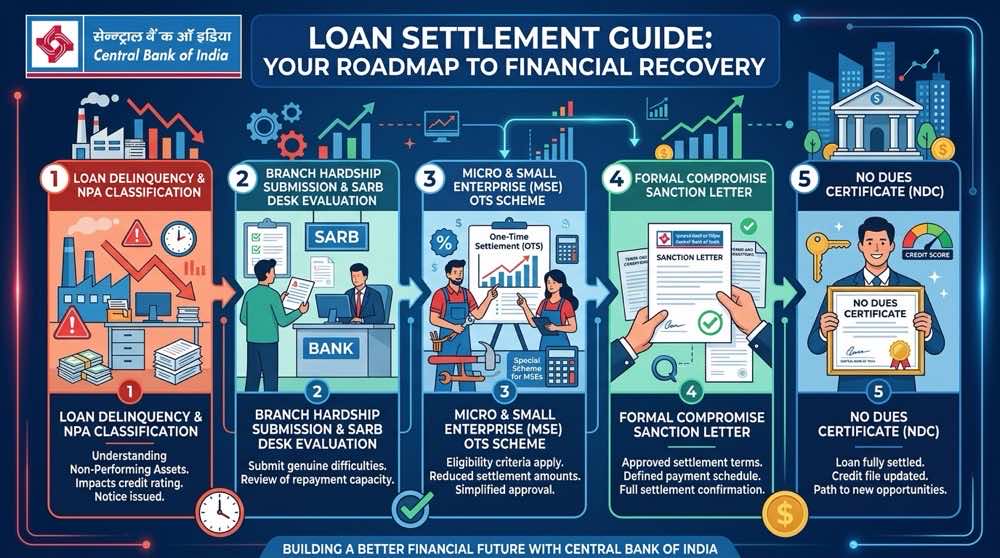
Figure 1: Official settlement hierarchy and Special OTS compromise procedure across Central Bank of India branches and recovery offices.
Quick Answer Summary
Central Bank of India settles bad personal loans, credit cards, and MSE debts under its compromise policy and Cent Samadhan drives. Borrowers in hardship can get 100% of late fees waived and a 40% to 60% discount on their principal loan balance. Beware of Section 171 banker's lien. The bank can freeze linked accounts, so move your family savings to a different bank before you default. Settle at National Lok Adalat to get a binding decree under Section 21 of the Legal Services Authorities Act. This ends all Section 138 cheque bounce and Section 25 NACH cases for good.
1. Central Bank Settlement Landscape & Historical Context
Sir Sorabji Pochkhanawala founded Central Bank of India in 1911. It was the first commercial bank fully owned and managed by Indians. With its head office at Chandermukhi in Nariman Point, Mumbai, the bank runs over 4,500 branches. It has a huge network across rural and semi-urban areas in Maharashtra, Madhya Pradesh, Uttar Pradesh, and Bihar.
Because it provides many retail loans, government-backed Mudra micro-loans, and farm credits, Central Bank manages many non-performing assets (NPAs).
Settling a bad loan with Central Bank requires patience. Branch managers must follow government manuals. But the bank has official compromise schemes to write off uncollectible loans and clean up its balance sheet.
2. Legal Framework: RBI & CVC Governance
Settlements at public sector banks follow strict legal rules:
RBI Master Direction on Compromise Settlements (2023)
Under RBI circular RBI/2023-24/40, Central Bank operates an approved compromise policy. This policy lets settlement committees waive late fees, unapplied interest, and part of the principal loan balance without going to court.
CVC Vigilance & Staff Accountability Audits
Because Central Bank is a public sector bank, loan write-offs face audits by the Central Vigilance Commission (CVC). Bank officers must check for staff lapses before approving a discount. You must submit genuine proof of financial hardship (such as medical bills, job loss, or business failure). This gives the officers a solid audit defense to sanction your OTS.
3. Internal Recovery Infrastructure: Branch to SARB
Central Bank delegates settlement powers across different levels based on loan size:
Branch Level (Up to ₹5 Lakh)
Branch managers handle personal loans and small rural debts. They can waive late fees or restructure loans, but have little authority to write off principal balances.
Regional Settlement Committees (₹5L - ₹50L)
Regional Offices evaluate settlement proposals across groups of branches. Led by Chief Managers and AGMs, these committees can grant substantial principal discounts.
Asset Recovery Branches (ARB) (₹50L - ₹1 Cr)
ARB branches in cities like Mumbai, Delhi, Kolkata, Bhopal, and Patna manage larger defaults and coordinate property auctions under the SARFAESI Act.
Stressed Asset Recovery Branches (SARB) (> ₹1 Cr)
Dedicated SARB offices report directly to Executive Directors and General Managers at the Central Office in Mumbai for high-value accounts.
4. Special OTS Schemes: MSE & Agri Drives
Central Bank regularly runs time-bound drives to speed up loan recovery:
Special OTS for Micro & Small Enterprises (MSE):
Help for Small Businesses: Gives small business owners facing financial trouble a quick way to settle their loans.
Clear Discount Formulas: Uses set formulas based on the market value of your collateral, waiving 100% of unapplied interest.
Cent Rin Mukti Drives: Nationwide recovery camps held in March and September offering on-the-spot settlements for retail and small farm credit.
5. Loan Products Breakdown & Realistic Haircuts
Settlement discounts depend on your loan type and collateral:
Loan Facility
Collateral Type
Interest / Penal Waiver
Expected Principal Haircut
Cent Personal Loan
Unsecured
100% Waiver
40% - 60%
Central Bank Credit Card
Unsecured Revolving
100% Finance Charges
45% - 65%
Cent MSE / Mudra Loan
Hypothecation / CGTMSE
100% Penal Interest
35% - 60%
Cent Kisan / Agri Allied
Crop / Cattle / Land
100% Penal Interest
40% - 65%
Cent Home Loan
Secured Real Estate
Penal Waiver Only
0% - 20% (Rare)
6. Section 171 Banker's General Lien Defenses
Under Section 171 of the Indian Contract Act, 1872, Central Bank has a general lien over all accounts sharing the same CIF number.
Protection Guidelines for Borrowers:
Statutory Pension Immunity: Under Section 60(1)(g) of the Code of Civil Procedure, Central Bank cannot freeze or deduct money from government pension accounts.
Third-Party and Trust Funds: Accounts you hold as an executor or trustee cannot be touched for your personal loan default.
Move Money Before Default: Before missing payments past 60 days, open a savings account in another bank to protect your family living expenses.
When settlement discussions take time, Central Bank may send legal notices:
1. SARFAESI Enforcement:
For home loans, the bank sends a 60-day demand notice under Section 13(2), followed by a possession notice under Section 13(4). You can file an objection under Section 13(3A), and the bank must answer within 15 days.
2. Cheque Bounce & NACH Defaults:
The bank may file criminal complaints under Section 138 of the Negotiable Instruments Act or Section 25 of the Payment and Settlement Systems Act in court.
3. Case Withdrawal on Settlement:
When you sign an OTS agreement and pay the agreed amount, Central Bank must withdraw all pending criminal complaints and court cases.
⚡ Empirical CalculatorUNSECURED NPA
Central Bank of India Settlement Estimator
Calculate realistic One-Time Settlement (OTS) compromise ranges based on Central Bank SARB & Special OTS circular guidelines.
Unsecured clean retail advance. Stressed accounts past 180 DPD qualify for 100% penal waiver and up to 55% principal reduction.
₹3,50,000
₹25,000₹25,00,000₹50,00,000
Target Settlement Offer:50%–65% Haircut
Realistic Settlement Range:₹1,22,500 – ₹1,75,000
Estimated Debt Forgiven:₹1,75,000 – ₹2,27,500
*100% penal interest and late bounce charges waived under Central Bank Special OTS.
⚠️
Central Bank SARB Caveat:Frontline branch staff have limited discretionary power due to CVC and CAG audit scrutiny. Route compromise proposals through Central SARB branches or Lok Adalat benches.
Follow these five steps to settle your loan with Central Bank of India:
Step 1: Ledger Statement Segregation
Get an official statement of account from your branch. Separate your original principal balance from unapplied interest and penal charges.
Step 2: Formal Hardship Dossier Submission
Write an OTS application to your Branch Manager and Regional Office. Include clear proof of financial trouble (such as hospital bills, job termination letters, or business loss records).
Step 3: Settlement Committee Evaluation
The committee checks your assets and real estate. If you have no other properties to clear the loan, they approve an OTS write-off.
Step 4: Formal Sanction Order on Bank Letterhead
Make sure your settlement letter is printed on official Central Bank of India letterhead with an official sanction number, approved settlement amount, payment schedule, and an AGM/DGM signature.
Step 5: Direct Remittance & NDC Issuance
Pay the settlement money directly into your loan account number. Collect your unconditional No Dues Certificate within 30 days.
10. Deconstructing Compromise Haircuts
When a Central Bank loan defaults, extra penalties and fees add up quickly. Over 18 to 36 months, your total balance can double on paper.
In a formal settlement:
Penal Interest & Processing Fines: 100% waiver is standard institutional practice across public sector bank settlement rules.
Unapplied Ledger Interest: Under RBI rules on bad loans, interest stops counting as bank income. Waiving this unapplied interest costs the bank zero cash.
Core Principal Sacrifice: For unsecured personal loans unpaid for over a year (Doubtful status), Central Bank usually agrees to settle at 45% to 60% of the core principal in a lump-sum payment.
11. National Lok Adalat Fast-Track Resolution
Settling your loan through the quarterly National Lok Adalat gives you maximum legal protection:
Power of a Civil Court Order: Under Section 21 of the Legal Services Authorities Act, 1987, a Lok Adalat award is equal to a civil court decree. Neither side can appeal against it.
Case Dismissal: The settlement order permanently dismisses and closes all Section 138 cheque bounce and Section 25 NACH court cases.
Fast Spot Approvals: Deputed Central Bank officers have on-the-spot powers to approve settlement discounts.
Tier 1
Branch Manager & Centralized Customer Care
SLA: 7 Working Days
Frontline Branch Operations
Initial hardship submission, statement of account reconciliation, and branch service grievances.
Submit this formal communication to the Principal Nodal Officer before filing a statutory complaint with the Banking Ombudsman:
Subject: URGENT: Coercive Recovery Harassment & Formal Compromise Settlement Application - Loan A/C [Your Account Number]

To:
The Principal Nodal Officer, Central Bank of India (gmoper@centralbank.co.in)
Copy: Chief Grievance Redressal Officer (complaints@centralbank.co.in)

Respected Sir/Madam,

I am writing regarding my Loan Account [Your Account Number] maintained at Central Bank of India [Branch Name]. Due to documented severe financial hardship [state reason: job loss / business closure / severe medical crisis], I have been unable to service regular monthly installments.

I have submitted an application for One-Time Settlement (OTS) under the bank's approved compromise settlement guidelines. Regrettably, collection agents claiming to represent Central Bank of India have engaged in repeated telephone intimidation and unannounced residential visits outside regulatory hours, in direct violation of the RBI Master Direction on Fair Practices Code.

I formally request your urgent intervention to:
1. Direct collection teams to halt coercive outreach immediately and communicate solely through registered postal or email channels.
2. Direct the Branch / Asset Recovery Branch to evaluate my OTS compromise offer on its merits.
3. Issue an itemized statement of dues separating core principal from penal interest and unapplied charges.

Sincerely,
[Your Full Name]
[Registered Contact Number]
[Registered Postal Address]
13. Securing the No Dues Certificate (NDC): Verification Rules
Your loan settlement is not legally complete until you receive your official No Dues Certificate (NDC) or No Objection Certificate (NOC).
Mandatory NDC Verification Points:
Check that your loan account number, full name, and PAN number are accurately printed.
Confirm that the certificate states the loan is fully closed with zero dues and waives all future claims.
Confirm the withdrawal of all court cases and the discharge of any guarantors.
30-Day Mandatory Release (RBI/2023-24/60): Under RBI directions on property documents, Central Bank must issue your No Dues Certificate and return all original documents within 30 days of full payment. If the bank delays beyond 30 days, they must pay you ₹5,000 for each day of delay.
14. Post-Settlement CIBIL Restoration Plan
After you settle your loan, Central Bank reports the account as 'Settled' or 'Post-Write-Off Settled' to credit bureaus. This stops recovery pressure, but lowers your credit score by 50 to 90 points temporarily.
You can rebuild your credit score above 750 within 18 to 24 months with these three steps:
1. Secured FD Card
Open a fixed deposit of ₹20,000 to ₹30,000 in another bank and take a secured credit card.
2. 20% Utilization
Spend under 20% of your card limit every month. Pay the entire statement bill on time before the due date.
3. Bureau Verification
Download your updated CIBIL report after 90 days to confirm that your Central Bank account balance shows ₹0.
15. Frequently Asked Questions: Central Bank Settlements
Does Central Bank of India offer a One-Time Settlement (OTS) scheme for personal loans?▼
Yes. Central Bank of India follows a clear settlement policy under RBI guidelines. If you face real financial hardship and your loan is unpaid for over 90 days, you can apply for an OTS. The bank usually waives 100% of late fees and gives a 40% to 55% discount on the core principal balance.
What is the Central Bank Special OTS Scheme for Micro and Small Enterprises (MSE)?▼
Central Bank regularly launches special OTS schemes for small businesses with loans up to ₹5 Crore. If your business loan is marked as Doubtful or Loss, these schemes offer pre-set discount formulas. You can settle bad debts quickly with deep interest waivers and principal discounts without going to court.
Why do Central Bank branch managers hesitate to approve compromise settlements?▼
As a public sector bank, Central Bank is watched closely by government auditors and the Central Vigilance Commission (CVC). Branch managers worry about vigilance inquiries if they write off money. To help them approve your settlement, you must provide solid proof of hardship, such as medical records, job loss papers, or business tax losses.
What percentage waiver can I secure on Central Bank credit card debt?▼
Central Bank credit card interest can reach 36% to 40% each year. In a compromise settlement with the Regional Credit Card Cell, the bank waives 100% of accumulated interest and late fees. You can also negotiate a 45% to 65% discount on your principal card spends.
Can Central Bank attach my savings or agricultural accounts under Section 171?▼
Under Section 171 of the Indian Contract Act, 1872, the bank has a right called a banker's lien. If you default, the bank can freeze funds in accounts linked to your CIF number. However, government pensions, crop relief subsidies, and trust funds are protected by law and cannot be seized.
How does National Lok Adalat assist in settling Central Bank of India loans?▼
National Lok Adalat is one of the safest places to settle bad debts. The judge passes an award under Section 21 of the Legal Services Authorities Act, 1987. This order has the power of a civil court decree. Neither side can appeal it, and it permanently closes all Section 138 cheque bounce and Section 25 NACH court cases.
Who sanctions high-value compromise settlements at Central Bank of India?▼
Settlement limits depend on your loan size. Branch Managers handle loans up to ₹5 Lakh. Regional Committees handle loans between ₹5 Lakh and ₹50 Lakh. Zonal Committees led by a General Manager review cases up to ₹1 Crore. Stressed Assets Recovery Branches (SARB) handle large multi-crore loans.
What should I do if recovery agents visit my home and create a public disturbance?▼
Record the interaction on video or audio. Ask to see the agent's official ID card and authorization letter from Central Bank. If agents shout, threaten, or harass you, file a police complaint under Section 351 of Bharatiya Nyaya Sanhita (BNS). Also email the bank's Grievance Redressal Officer at complaints@centralbank.co.in.
How many days does Central Bank have to issue the No Dues Certificate?▼
Under RBI circular RBI/2023-24/60, Central Bank must issue your No Dues Certificate within 30 days of full payment. They must also return all your original documents. If the bank delays past 30 days, they must pay you ₹5,000 for each day of delay.
How does a Central Bank compromise settlement impact my CIBIL credit score?▼
The bank reports your loan as 'Settled' to credit bureaus. This causes a temporary drop of 50 to 90 points in your CIBIL score. You can rebuild your score by taking a secured credit card against a small fixed deposit. Pay all monthly bills on time to bring your score above 750 within 18 to 24 months.
Find this content helpful?
If this guide has helped you navigate your settlement journey, consider showing some support to keep this platform running.