03. Why Vivifi Refuses Principal Waivers
Vivifi India Finance holds RBI license N-09.00447 as a fintech NBFC. The firm lends digital cash through FlexSalary and FlexPay. Big banks like HDFC and SBI take public savings. Vivifi takes zero public deposits. It has no cheap retail cash pool. Big banks can easily write off 50% to 70% of bad loans. Their huge deposit reserves cover bad debt hits.
Vivifi relies on external bank loans and venture capital. In 2024, Vivifi raised 75 million dollars in debt and equity funds. Writing off loan principal cuts right into its net worth of 286 crore rupees. Such write-offs break strict debt covenants with its wholesale lenders.
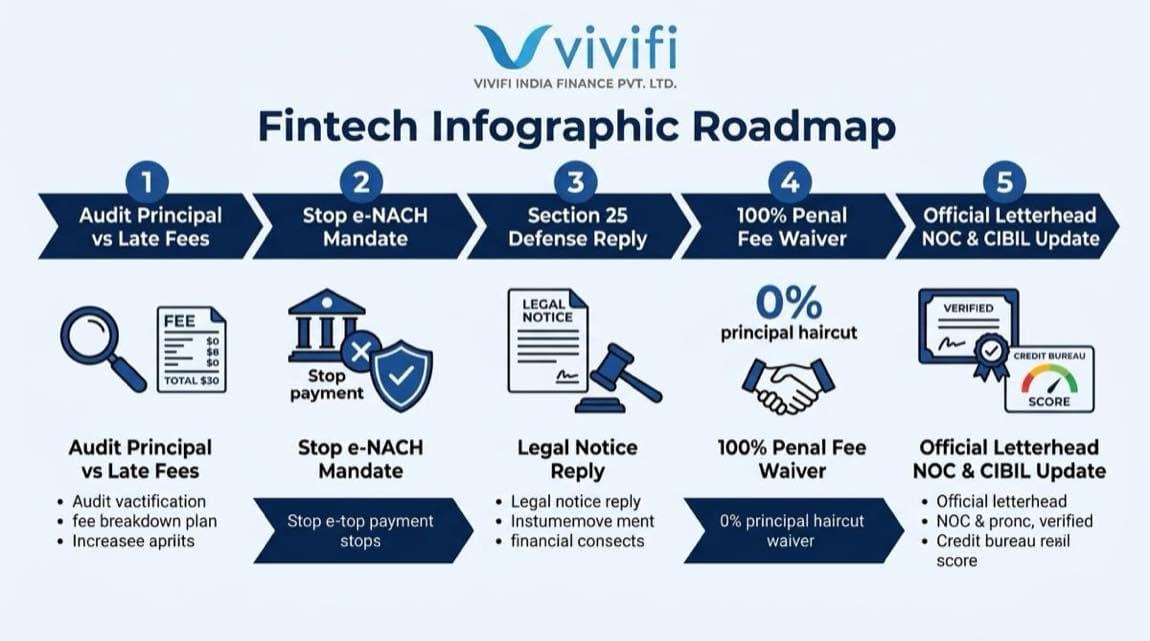
The Capital Reality Rule:Thus, Vivifi keeps a strict rule against principal cuts. In early default from 90 to 180 days, recovery heads will firmly deny debt discounts. Distressed borrowers must know this fact first. Pleading for big loan cuts will fail right away. Instead, focus your plan on getting rid of 100% of all late fees, bounce costs, and extra interest.
04. Compounding Penal Fees on FlexSalary
FlexSalary works as an open-ended credit line. Users withdraw cash up to a set credit limit and pay monthly dues. But default brings fast compounding charges. When you miss a due date, the app adds late fees right away. It also adds auto-debit bounce fees of 300 to 500 rupees for each failed try.
These extra fees get added to your core principal debt. This practice inflates your bill far above what you took out. A small loan of 40,000 rupees can grow to over 68,000 rupees in nine months. Borrowers think their small payments cut down the debt. In reality, interest and late fees eat all their money.
RBI Fair Lending Directive:Under RBI Fair Lending Rules, lenders cannot levy compounding penal interest. Regulated firms can only charge fair, non-capitalized late fees for default. When negotiating an overdue FlexSalary bill, get a full account statement. Split the true principal from extra penalty fees. You have the right to demand zero penalty fees before paying the core debt.
05. Stopping Automated e-NACH Mandates
FlexSalary users must set up an automated e-NACH bank mandate at sign-up. This lets Vivifi auto-debit monthly dues from your bank account. Once payments stop, automated systems present debit requests again and again. Each failed debit triggers a bounce fine from your own bank.
Bank bounce fees cost 295 to 590 rupees for each failed hit. Over several failed hits, your bank account can drop into deep negative balance. This loss takes away money needed for daily food and family care. Many borrowers think only Vivifi can stop this mandate. That view is false under Indian banking rules.
Mandate Revocation Protocol:Under RBI circular DPSS.CO.CHD.No./2019-20, you have the full legal right to cancel any debit mandate. You can tell your home bank to stop payments without asking the lender. Log in to your net banking app and open the e-mandate section. Find the Vivifi mandate and click cancel. You can also give a stop-payment letter at your home branch counter. Stopping auto-debits ends financial loss while you plan repayment.
06. Section 25 PSS Act Legal Defense
When an electronic auto-debit bounces, Vivifi legal teams often issue statutory legal notices. These notices cite Section 25 of the Payment and Settlement Systems Act, 2007. Section 25 works like Section 138 of the Negotiable Instruments Act for bounced paper cheques. It treats a failed electronic debit as a quasi-criminal statutory default.
Rogue recovery callers often use Section 25 notices to threaten defaulted borrowers with quick arrest. These threats are completely false. Section 25 cases are strictly bailable commercial issues. A magistrate does not issue arrest warrants when a case is filed. The court first issues a simple summons to appear. The lender must also meet strict legal rules before a court acts.
The lender must prove the debit was for a valid legal debt. They must also serve a demand notice within 30 days of the bounce. You have a full 15-day window from receipt to send your reply. Never ignore a real Section 25 notice. Have an advocate send a reply showing your financial hardship and disputing inflated fees. A timely reply shows good faith and moves your case toward an easy settlement.
07. Defeating Unilateral Digital Arbitration
Digital lenders often use online dispute websites to get quick recovery orders against borrowers. You may get emails or SMS texts from an unfamiliar digital dispute portal. The notice says an arbitrator has been named to hear Vivifi recovery claims. It warns that a final order will pass if you do not show up online.
Many borrowers panic and pay up out of fear. Under Indian arbitration law, one-sided arbitrator picks made by a lender are legally void. The Supreme Court of India set this rule in TRF Limited v. Energo Engineering. The Supreme Court backed it up in Perkins Eastman Architects v. HSCC India. An interested party cannot pick a sole arbitrator on its own.
Statutory Jurisdictional Objection:Vivifi chooses and pays the digital arbitration vendor. Thus, the named arbitrator lacks legal neutrality. If you get an arbitration notice, do not ignore it. Send a written objection to the arbitrator and Vivifi legal team. Cite the TRF Limited and Perkins Eastman court orders. State that you object to their jurisdiction due to one-sided appointment without mutual consent. This step strips the digital order of legal force in court.
08. Halting Telecaller Harassment (DLG)
Defaulted borrowers often face harsh calls from third-party recovery agents. These callers ring repeatedly, threaten home visits, and contact family members. Some callers access phone contacts and send rude messages to third parties. Every one of these acts breaks Reserve Bank of India rules.
The RBI Master Direction on Digital Lending strictly controls debt collection conduct. Recovery callers can only contact you between 8:00 AM and 7:00 PM. They cannot call your parents, relatives, or office bosses. They cannot make abusive or threatening statements. The Bharatiya Nyaya Sanhita 2024 provides criminal safeguards. Under Section 351 BNS, criminal intimidation by collectors is a punishable crime.
If callers abuse you, start saving electronic proof right away. Record all phone calls. Save screenshots of abusive WhatsApp messages. Note phone numbers, caller names, and call timings. Send a formal complaint to Vivifi Nodal Officer Prakash Rajan at pno@vivifin.com. State that ongoing abuse will be reported to the RBI Ombudsman and local police. Regulated lenders rein in rogue agencies quickly once proof is shown.
09. Negotiating 100% Late Fee Waivers
Vivifi maintains a firm stand on principal recovery. Successful debt closure requires sharp tactical focus. Never waste time begging for a 60% cut on core borrowed money. That plea will face quick refusal. Instead, put all your effort into wiping out late fees, bounce costs, and extra interest charges.
Over six to twelve months of default, extra penalty fees make up 30% to 50% of the gross balance. Vivifi credit managers hold power to waive these secondary fees. To secure this relief, audit your loan account carefully. Find the exact net principal paid to your bank minus your verified repayments.
Lump-Sum Proposal Protocol:Send an official settlement letter to Vivifi credit desk at support@vivifin.com and pno@vivifin.com. State your clear intent to pay 100% of your net principal in one single payment. Insist that payment depends on full written waiver of all penalty charges. Share proof of income loss, such as medical bills or job lay-off letters. Credit heads often take a clean principal closure to wipe an aging bad debt off their books.
10. Restructuring & EMI Extension Paths
Borrowers hit by job loss often cannot pay their total principal in a single payment. When lump-sum cash is unavailable, seeking a discount won't work. Vivifi will refuse a cut, and interest will keep mounting. In this spot, structured tenure extension is the best practical path.
Tenure restructuring turns your unpaid principal into a fixed term loan. The lender freezes new late fees and spreads dues over 6 to 12 fixed monthly EMIs. This halts monthly bank bounces and stops recovery calls. It gives your home budget immediate room to breathe.
To request a recast, reach out to Vivifi grievance desk before your account crosses 180 days past due. Submit proof of income cut, like pay slips or bank sheets. Ask for an EMI plan with frozen interest. Make sure the approved EMI schedule comes on official Vivifi letterhead. Confirm that no fresh bounce fines apply while you pay your monthly dues.
11. 360+ DPD Loss Assets & ARC Sales
When an unpaid loan passes 360 days, its classification shifts under RBI rules. Lenders must classify aged overdue debt as a loss asset. At this stage, Vivifi must make 100% provisioning on its balance sheet. Once fully provisioned, the loan counts as written-off debt rather than active capital.
To clean its books before fiscal year ends, Vivifi may bundle old bad debts. These bundles are sold to Asset Reconstruction Companies at steep discounts. ARCs buy bad debt bundles for 15 to 25 paise on the rupee. Once an ARC buys your debt, the deal changes completely.
ARC Negotiation Window:Because the ARC bought your debt for pennies, its officers have wide power to cut deals. An ARC can give 50% to 60% discounts and still make a solid profit. If your Vivifi loan is over a year old, find out who owns the debt. Check if Vivifi still holds it or if an ARC bought it. If an ARC owns it, you can negotiate a regular settlement discount.
12. National Lok Adalat Conciliation
National Lok Adalats offer a great legal forum to settle fintech loan disputes. Lok Adalats take place every three months across all Indian states under the Legal Services Authorities Act, 1987. Lok Adalat sittings are free of court fees and aim for mutual compromise.
Lenders like Lok Adalats because they give permanent legal closure. A Lok Adalat order has the full force of a civil court decree. It cannot be appealed in higher courts. When Vivifi attends Lok Adalat hearings, senior officers carry mandate books. They hold authority to compromise disputed claims right there.
You do not need to wait for the lender to call you to Lok Adalat. You can visit your local District Legal Services Authority office and file for pre-litigation conciliation. Give your Vivifi loan account ID and offer a fair principal settlement. The legal authority will issue a notice to Vivifi to appear. In a neutral court setting, recovery heads readily waive penalty fees and finalize a clean deal.
13. 7-Point Settlement Letter Checklist
Rogue recovery agents often make fake settlement letters to meet monthly targets. They share fake discount letters on WhatsApp and take money into personal accounts. Once money is sent, the borrower finds their loan is still active in Vivifi systems. To stay safe, check every settlement letter against this 7-point guide:
- Official Corporate Letterhead: The letter must show the full name Vivifi India Finance Private Limited, CIN U65923TG2016PTC110767, and registered Hyderabad office address.
- Specific Account Identifiers: The letter must list your full legal name, registered mobile number, PAN, and specific FlexSalary loan ID.
- Exact Settlement Breakdown: The document must state the net payment sum, the payment deadline, and the exact fees being waived.
- Full and Final Closure Clause: The text must say clearly that paying the agreed sum closes all claims in full.
- Waiver of Future Litigation: The letter must state that Vivifi will pull back all legal notices, including Section 25 PSS Act actions.
- No Dues Certificate Commitment: The document must give a clear timeline, usually 21 to 30 days, to deliver your No Dues Certificate.
- Authorized Manager Sign-off: The letter must bear an official signature with officer name, staff code, and come from an official @vivifin.com email ID.
14. Safe Repayment & Fraud Defense
Once an official deal is struck, paying safely is vital. Paying via wrong links can mean losing your money forever. Many borrowers fall for recovery agents who send personal UPI QR codes. They claim personal QR links offer extra discounts. These claims are total fraud.
Never send funds to a personal UPI ID, personal account, or digital wallet. Never give physical cash to any agent visiting your home. Vivifi does not collect cash through field agents. All real loan payments must go straight to Vivifi corporate bank accounts.
Verified Payment Channels:Use official channels only. Pay right through the FlexSalary app or official Vivifi site. If using NEFT or RTGS, send funds only to the designated corporate virtual account tied to your loan ID. Always keep payment transaction IDs and bank receipts. Email payment proof to pno@vivifin.com and support@vivifin.com right away to get quick credit.
15. Rebuilding CIBIL After Resolution
Borrowers must know how debt settlement affects their credit score. When you resolve an account through a fee waiver, lenders do not report it as clean "Closed". Vivifi reports the account to CIBIL and Experian as "Settled" or "Post-Write-off Settled". This remark tells future banks that the lender took a loss.
A "Settled" tag can cut your score by 50 to 120 points. It stays on your credit report for up to seven years. Big banks may hesitate to grant fresh unsecured credit with this tag on file. But settling is far better than leaving an active "Written-Off" default open.
Once you get your official No Dues Certificate, wait 30 to 45 days for bureau updates. Pull fresh credit reports from CIBIL and Experian. Make sure your outstanding balance reads zero. To rebuild your credit score, get a secured credit card backed by a fixed deposit. Pay all bills on time and use less than 30% of your limit. Steady payments will lift your score past 750 in 18 to 24 months.
16. Step-by-Step Escalation Ladder
If you face recovery abuse, lost payments, or refusal to issue a No Dues Certificate, use the formal escalation ladder. Never waste time arguing on WhatsApp with recovery callers. Follow this 4-step regulatory path:
Level 1: Customer Care Desk:Send a formal written complaint to support@flexsalary.com and support@vivifin.com. State your loan ID and facts clearly. Customer support must give you a complaint ticket ID within 48 hours.
Level 2: Grievance Redressal Officer (GRO):If customer support fails to solve your issue in 7 days, take it to Nodal Officer Prakash Rajan. Email him at pno@vivifin.com or call +91-91211-96333. Give your Level 1 ticket ID and evidence.
Level 3: Executive Director Review:If your dispute remains unsolved after 15 days, write to Whole-time Director Srinath Kompella at srinath@vivifin.com. Report the failure of lower desks to fix your issue.
Level 4: Reserve Bank of India Ombudsman:If Vivifi fails to resolve your grievance within 30 days, escalate to the RBI. File an online complaint at cms.rbi.org.in. Attach all emails and proof. The RBI Ombudsman can penalize non-compliant lenders and order relief.