NBFC-ICC (EPIMONEY)ZERO OTS RECOVERY POLICYUPDATED: SEPTEMBER 2026
Epic Money Loan Default: Zero OTS Reality & Borrower Defense
Epic Money & Epimoney NBFC Borrower Defense Guide
Policy Notice:Zero Settlement Scheme
Epic Money operates through Epimoney Private Limited and currently does not offer loan settlements or debt waivers. The company demands 100% principal recovery across all MSME loan accounts. Beware of third-party recovery agents offering fake verbal discounts.
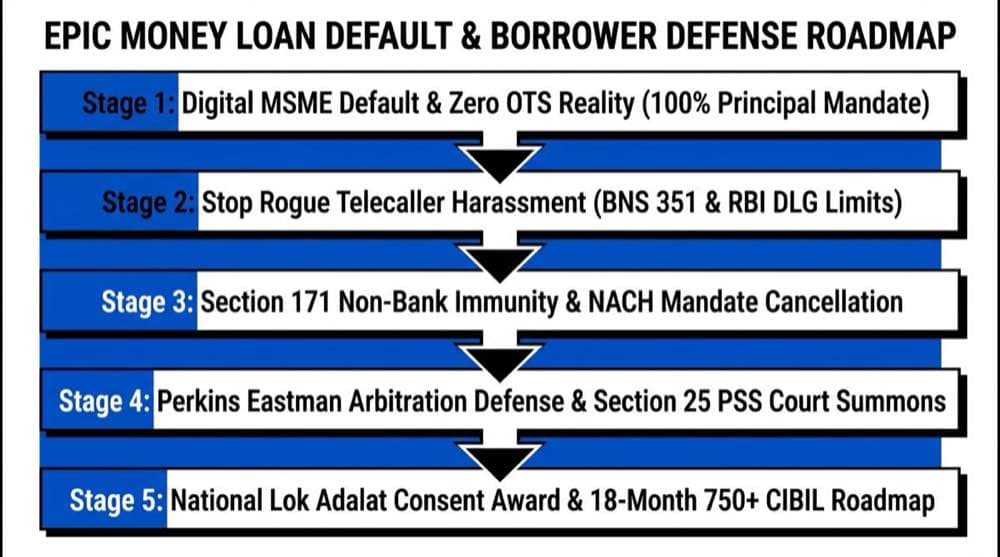
Epic Money Borrower Defense Roadmap: 5-stage guide for zero settlement reality, NACH rights, and legal defense.
Quick Answer: Does Epic Money Offer Loan Settlement?
No. Epic Money operates through Epimoney Private Limited and denies all loan waivers. The lender takes debt lines from bank partners. These terms require full principal recovery. Third-party callers offering verbal cuts are running scams. Borrowers can seek tenure relief or resolve files at Lok Adalat.
Epic Money gives loans through Epimoney Private Limited. The firm is an RBI-listed NBFC based in Lower Parel, Mumbai. Its company code is U71309TN1995PTC030536. It runs under the FlexiLoans brand. It is an NBFC Middle Layer lender under RBI rules.
Public banks often hold yearly write-off funds. Epimoney borrows its money from bank partners instead. It raises debt from large banks and credit funds. These debt lines carry ratings from CRISIL and Acuite. The contracts require full loan recovery. The board demands full repayment of all loans.
Borrowers who ask for a write-off face a flat refusal. Branch staff and call agents reject all such requests. Epimoney has no debt cut scheme on any active account. Knowing this fact stops business owners from paying fake agents.
Epimoney Zero-Settlement Policy:Epimoney Private Limited does not cut or settle loans. The company demands full repayment. Never pay outside agents who promise phone deals.
02. Digital MSME Underwriting: Algorithm Scoring, GST Data & Default Triggers
Traditional bank branches require property papers to approve small business loans. Epimoney uses automated software to evaluate cash flows instead. The platform checks borrower credit through GST filing logs. It also reviews bank statements and card swipe volumes.
Digital credit scoring lets merchants get fast cash without pledging property. But yearly interest rates range from 18% to 32%. Lenders also add upfront processing fees. When daily sales stay healthy, automated debits run smoothly.
When retail sales drop, rigid debit schedules cause heavy financial strain. Missing an installment triggers instant computer penalties. These charges include bounce fees and late interest. Over a few months, added fees inflate the total bill.
GST Algorithm & Working Capital Shock Protocol:Algorithmic digital loans add automated bounce fees and late penalties immediately upon a missed debit. If business revenue drops, gather sales invoices and file for formal tenure restructuring.
For retail store owners, Epimoney offers merchant cash advances. These loans link to card swipe machines. The lender takes a set share of daily card transactions. Funds get captured right at the payment gateway before reaching the shopkeeper.
During slow sales weeks, daily deductions drain vital cash. As sales drop, daily sweeps leave no money for shop rent or new stock. The business owner faces cash shortages as automated software takes revenue.
Borrowers stuck in daily deduction loops can request relief. If daily sweeps harm your business, write to the nodal cell in Mumbai. Send your current GST reports. You can ask to change daily sweeps into set monthly payments.
POS Merchant Auto-Sweep Protection Shield:Daily automated POS swipe deductions cannot legally strip an enterprise of operating capital needed for basic inventory. If daily sweeps prevent payroll or inventory purchase, submit a formal restructuring petition to Central Operations.
Epimoney NBFC Policy Analysis100% PRINCIPAL MANDATE
Epic Money Policy & Recovery Reality Check
Understand why Epimoney currently denies OTS discounts and evaluate realistic resolution paths.
₹3,00,000
₹50,000₹12,50,000₹25,00,000
Institutional OTS Status:0% Principal Haircut (100% Recovery Demanded)
Zero Settlement Policy Warning:
Epimoney central policy prohibits settlement haircuts on active loans. Demands for 30% to 50% cash discounts from telecallers are unverified.
Recommended Action:
Submit audited sales drop records to Central Operations in Mumbai to request tenure extension and late fee freeze.
Lok Adalat Outlook:
Referral to National Lok Adalat benches allows waiver of penal compounding under Section 21 consent awards.
Statutory Guard: Epimoney is an NBFC with zero legal authority under Section 171 to freeze external bank accounts or attach salaries.
Epimoney uses a partner co-lending model. It works with lenders like Vivriti Capital and Northern Arc Capital. Partner banks put up a large share of each loan. Epimoney finds the borrower and runs daily collections.
These partner deals have strict debt rules. When a borrower stops paying, Epimoney must tell the partner credit teams. The company cannot cut debt on its own. It needs a written go-ahead from every lending partner first.
Getting partner approval is very hard, so staff follow strict recovery rules. Field agents have no power to cut loan balances. Knowing this partner setup stops borrowers from trusting phone discount offers.
Co-Lender Recovery Policy Guard:Epimoney co-lends with debt funds that ban one-sided loan cuts. Call agents and field staff have zero power to grant any debt reduction.
When loans stay unpaid, collection callers often threaten to freeze borrower bank accounts. They claim powers under Section 171 of the Indian Contract Act. Stressed borrowers must realize that these threats are legally false.
Section 171 gives banker lien rights only to licensed banking companies. Epimoney Private Limited is an NBFC. It is not a bank under the Banking Regulation Act. High courts have ruled that NBFCs hold zero banker lien powers.
Epimoney cannot freeze your savings at banks like SBI, HDFC, or ICICI. The company can only pull money through your active NACH mandate. Under RBI rules, you have the right to ask your bank branch to stop that auto-debit mandate.
Statutory Non-Bank Immunity Shield:Section 171 banker lien applies exclusively to licensed banks. Epimoney is an NBFC with zero legal authority to freeze savings accounts or attach funds in outside commercial banks.
06. Electronic NACH Bounces Under Section 25 & Section 138 Bail Protocol
When a scheduled auto-debit fails, Epimoney tries electronic re-presentments. If debits bounce for insufficient funds, the lender issues a demand notice. This notice arrives under Section 25 of the Payment and Settlement Systems Act, 2007.
Collection callers often call these notices immediate police arrest warrants. That claim is completely untrue. Section 25 and Section 138 cases are commercial disputes. The law grants a fifteen-day cure period to pay the bounced sum.
If Epimoney files a case in court, the Magistrate issues a bailable summons. Never ignore court summons. Appear in court to get same-day bail on simple personal surety. Judges routinely refer commercial files to Lok Adalat for an agreed settlement.
Section 25 NACH Bail & Lok Adalat Defense:NACH bounce notices under Section 25 PSS Act are bailable commercial offenses. Attend the court hearing to secure instant bail, prevent non-bailable warrants, and route the file to Lok Adalat.
07. Perkins Eastman Sole Arbitration Defense: Halting Unilateral Arbitrator Notices
Digital loan contracts standardly contain an arbitration clause naming Mumbai or Chennai. After long payment delays, borrowers receive letters from law firms. These notices claim that Epimoney has appointed a sole arbitrator to pass an order.
Appointing an arbitrator by itself breaches Section 12(5) of the Arbitration Act. In landmark cases like TRF Ltd and Perkins Eastman, the Supreme Court ruled firmly. A party with an interest in a dispute cannot pick an arbitrator alone.
When you get a one-sided arbitration notice, send a written objection at once. State that you reject the arbitrator under Section 12(5). Any one-sided award made without consent is invalid and can be challenged under Section 34.
Perkins Eastman Arbitration Ineligibility Shield:Lenders cannot unilaterally appoint a sole arbitrator without mutual written consent. One-sided awards violate Section 12(5) of the Arbitration Act and cannot be enforced against your assets.
08. Stopping Recovery Harassment Under BNS 351 & RBI Digital Lending Guidelines
Delinquent borrowers often face rude treatment from third-party recovery teams. Callers make threats to contact business clients or relatives. They also call early in the morning or late at night. These coercive actions break RBI Digital Lending rules.
Under RBI rules, recovery agents cannot contact borrowers before 8:00 AM or after 7:00 PM. Accessing phone contacts or messaging family members is strictly forbidden. Threatening commercial reputation constitutes Criminal Intimidation under Section 351 of the BNS 2024 code.
Keep call logs and recordings of abusive calls. Do not argue on the phone. Send a formal written grievance to the Epimoney Nodal Officer in Mumbai. If harassment continues, file a complaint on the RBI Sachet portal and report to local police.
RBI Digital Lending Harassment Defense Shield:Collection agents cannot contact third parties, call outside 8:00 AM to 7:00 PM, or use abusive language. Report violations under BNS Section 351 and file on the RBI CMS portal.
The most common trap for defaulted borrowers is the unauthorized verbal discount deal. Outside collection agents work on recovery commissions. They contact borrowers promising a 40% discount to close the account quickly.
These callers ask you to send money via UPI or quick payment links. They claim an official closure letter will arrive later. But because Epimoney enforces a zero-settlement rule, the system credits funds toward late fees, leaving the loan active.
Never pay settlement money based on phone calls or WhatsApp messages. Real settlements require a formal corporate letter on Epimoney letterhead with a verified signature. If a caller cannot provide a genuine corporate letter, reject the offer.
Anti-Fraud Warning: Rogue Telecaller Detection:Never remit funds based on phone calls or WhatsApp promises. Epimoney demands 100% principal recovery. Verbal discounts are unauthorized traps designed to capture commission fees.
10. The Multi-Year Default Reality: When Can Epic Money Debts Actually Resolve?
Epimoney enforces a no-settlement rule during early default. But RBI rules require lenders to manage bad loans through set accounting steps. Unpaid debts move from Substandard to Doubtful, and reach Loss Asset status after 360 days.
When an account hits Loss Asset status, the lender writes it off against loss funds. At this point, the cost of calling exceeds the money they can get back. The lender goal shifts from full interest to saving the core amount before time runs out.
Borrowers whose debts stay unpaid for two or more years can find paths to close their file. These closures happen at legal benches, not through phone calls. Keeping clear records of business hardship is vital to get a binding closure.
Multi-Year Provisioning Reality:Accounts in default beyond 360 days move to Loss Asset status under RBI rules. This opens real paths for court-led debt closure through legal forums.
11. Resolving Epic Money MSME Debts via National Lok Adalat Benches
The safest way to close unpaid loans with digital NBFCs is the National Lok Adalat. Set up under the Legal Services Act of 1987, Lok Adalats meet each quarter in all Indian court buildings. Judges and legal aid staff run the hearings.
Lok Adalats skip rigid court rules to help both sides reach a fair deal. Benches often tell lenders to drop late fees and penal charges. Borrowers can get simple repayment terms based on the real unpaid loan amount.
Every deal made in a Lok Adalat creates a Consent Award under Section 21. This award has the full weight of a civil court order. It is final and binding on Epimoney. The lender must issue a No Dues Letter within thirty days.
Lok Adalat Consent Award Protocol:Lok Adalat awards carry the weight of a civil court order under Section 21. Benches routinely cut penal interest and set up enforceable, interest-free payment plans.
12. Restructuring Options: Formal Hardship Applications via Central Operations
Borrowers with short-term cash drops who want to repay can apply to restructure their loan. Field agents cannot change contract terms. You must send a formal request to Epimoney Central Credit in Mumbai.
A valid request must explain why your business is in hardship. Attach bank records showing lower sales or lost orders. Ask to pause penal fees and propose a longer loan term with smaller monthly payments.
Under the RBI Fair Practices Code, lenders must review genuine hardship cases fairly. Send your request by post and email to the Grievance Officer. Save postal receipts as proof of good faith in future legal steps.
Hardship Restructuring Protocol:Send your restructuring request to Mumbai Central Operations. Show revenue drop with GST data and ask for a longer term with a freeze on penal interest.
13. The 4-Tier Escalation Hierarchy: Reaching the Principal Nodal Officer
Borrowers facing unfair recovery calls or no reply to their letters must skip front-line agents. Use the four-tier complaint system set by the Reserve Bank of India to get a proper review.
Tier 1 is Customer Support at myaccount@flexiloans.com or by calling 022-68219595. Give them seven days to reply. If the issue stays open, move to Tier 2 by writing to the Grievance Officer at nodal.grievance@epimoney.com in Mumbai.
If the issue stays open after fifteen days, send a formal appeal to Tier 3, the Principal Nodal Officer. If Epimoney does not fix your complaint within thirty days, move to Tier 4 by filing with the RBI Ombudsman on cms.rbi.org.in.
Statutory Escalation Hierarchy:Follow the four-tier ladder: Customer Care, Nodal Grievance Officer, Principal Nodal Officer, and RBI Ombudsman. Never rely on oral promises made by outside recovery agents.
Statutory Grievance Hierarchy
Epic Money 4-Tier Escalation Matrix
Do not waste time arguing with recovery telecallers. Escalate your dispute directly through these statutory tiers.
Tier 1: Central Customer Care & Help DeskSLA: 7 Days
Register your initial grievance ticket and request formal hardship review on your loan file.
Email: myaccount@flexiloans.comPhone: 022-68219595Timing: Mon-Sat 10:00 AM - 7:00 PM
Tier 2: Grievance Redressal CellSLA: 15 Days
Escalate unresolved Level 1 complaints and report unauthorized telecaller harassment or illegal threats.
Final statutory recourse if Epimoney fails to resolve your grievance within 30 days or violates RBI Digital Lending Guidelines.
Portal: cms.rbi.org.inToll-Free: 14448
Address: CRPC, Reserve Bank of India, 4th Floor, Sector 17, Chandigarh 160017
1-Click Formal Notice Template
Use this verified formal notice to demand cessation of collection harassment, assert Section 171 non-bank immunity, and request tenure restructuring or Lok Adalat referral.
To,
The Principal Nodal Officer & Grievance Redressal Cell,
Epimoney Private Limited (Trade Name: FlexiLoans / Epic Money),
7th Floor, South Annexe, Tower 2, One World Centre, 841, Senapati Bapat Marg,
Lower Parel, Mumbai, Maharashtra 400013.
Email: nodal.grievance@epimoney.com
CC: myaccount@flexiloans.com, compliance@epimoney.com

Subject: FORMAL GRIEVANCE NOTICE - UNLAWFUL COLLECTION HARASSMENT, SECTION 171 INAPPLICABILITY & REQUEST FOR RESTRUCTURING / LOK ADALAT REFERRAL
Loan Account Number: [YOUR_EPIC_MONEY_ACCOUNT_NO]
Product: Digital MSME Working Capital Loan / POS Swipe Advance / Vendor Credit

Dear Sir or Madam,

I write this formal grievance notice regarding my credit account with Epimoney Private Limited. Empanelled recovery contractors and collection telecallers have engaged in coercive collection practices in direct violation of the RBI Master Directions on Digital Lending Guidelines (DLG), the NBFC Fair Practices Code, and Section 351 of the Bharatiya Nyaya Sanhita, 2024.

1. Third-Party Harassment Prohibition Under RBI DLG: Recovery personnel have issued unlawful threats to contact suppliers, business clients, and personal phone contacts. Under binding RBI Digital Lending Guidelines, lenders and their recovery agencies are strictly prohibited from contacting third parties or accessing borrower phone contact lists. Any communication of debt delinquency to outside parties constitutes Criminal Intimidation under Section 351 of the Bharatiya Nyaya Sanhita (BNS), 2024.
2. Section 171 Banker Lien Inapplicability: Recovery callers have issued false threats claiming Epimoney will invoke Section 171 of the Indian Contract Act, 1872 to freeze my business current account or personal savings. Epimoney Private Limited is an NBFC, not a licensed banking institution. Section 171 applies exclusively to banks. Epimoney has zero statutory authority to freeze outside bank accounts or attach funds without a final civil court decree.
3. Perkins Eastman Arbitration Defense: Unilateral notices threatening sole arbitration proceedings in Mumbai or Chennai violate Section 12(5) of the Arbitration and Conciliation Act, 1996, and Supreme Court rulings in TRF Ltd and Perkins Eastman. I do not consent to any unilaterally appointed sole arbitrator.
4. Severe Commercial Hardship: Due to verified business disruption and cash flow decline, I cannot service compounding late fees, penal interest, and recurring NACH bounce charges.
5. Formal Relief Request: Under the RBI Fair Practices Code, I request immediate cessation of third-party recovery harassment, waiver of accumulated penal interest, and conversion of my overdue principal into an extended term restructuring, or formal referral of this file to the upcoming National Lok Adalat for an agreed consent decree under Section 21 of the Legal Services Authorities Act, 1987.

Please acknowledge this statutory notice within 7 working days with a formal grievance tracking number. If unlawful harassment persists, I will escalate this matter directly to the Reserve Bank of India Integrated Ombudsman on the CMS portal (cms.rbi.org.in).

Sincerely,
[Your Full Legal Name]
[Your Registered Business / Mobile Number]
[Your City, State]
14. Post-Default Credit Rehabilitation: The 18-Month 750+ CIBIL Roadmap
Defaulting on a digital MSME loan harms your credit score. When an account stays overdue, Epimoney reports payment defaults to CIBIL, Experian, and CRIF High Mark. These negative records lower your credit rating by 150 to 250 points.
Once the debt is cleared or resolved through a Lok Adalat order, the lender must update credit bureaus within thirty days. Collect your formal No Dues Certificate from Epimoney. If bureaus fail to update records, file an online dispute with your certificate attached.
Rebuilding your credit score to 750 takes a steady 18-month plan. Start by opening a fixed-deposit secured credit card with a bank. Keep card usage below 30% of your deposit limit and clear the full bill on time every month. Steady repayments restore your credit standing.
Secured FD CIBIL Restoration Protocol:Rebuild your credit profile using a fixed-deposit secured credit card. Keep card utilization below 30% and pay on time monthly to restore a 750+ CIBIL rating within 18 months.
Verified regulatory answers regarding Epimoney default, zero OTS policies, recovery agency conduct, and credit bureau rehabilitation.
Does Epic Money offer loan settlement discounts or OTS waivers?▼
No. Epic Money operates through Epimoney Private Limited and denies all loan waivers. The lender takes funds from wholesale bank partners. These credit lines require full principal recovery. Branch staff hold no power to cut active debt.
Why do recovery telecallers offer 40% discounts on Epic Money loans?▼
Callers make fake phone offers to earn quick fees. Epimoney never approves verbal deals. Money sent without a formal letter goes to late fees. The full principal remains active and unpaid.
Can Epic Money freeze my bank account under Section 171 Banker Lien?▼
No. Section 171 of the Contract Act applies only to licensed banks. Epimoney is an NBFC. It holds no banker lien rights under Indian law. It cannot freeze your outside bank savings.
Can I cancel my automated NACH mandate for Epic Money?▼
Yes. Under Reserve Bank rules, borrowers have the legal right to stop NACH debits. You can submit a written stop request to your home bank. This halts recurring bounce charges.
What happens if a Section 25 PSS Act or Section 138 notice is issued?▼
Section 25 notices are formal demand letters for unpaid debits. You get fifteen days to respond. In court, it is a bailable commercial matter. You can get instant bail on personal surety.
Can Epic Money appoint a sole arbitrator in Mumbai without my consent?▼
No. Under Section 12(5) of the Arbitration Act, lenders cannot pick sole arbitrators alone. The Supreme Court confirmed this in Perkins Eastman. You must object in writing at once.
How can I stop recovery agents from calling my business contacts?▼
Under Reserve Bank digital lending rules, agents cannot call your contacts or vendors. Calling third parties is illegal. It constitutes intimidation under Section 351 of the BNS 2024 code.
How can I resolve my delinquent Epic Money loan through Lok Adalat?▼
You can request the legal services authority to list your file at Lok Adalat. Benches routinely wipe out late fees and penal charges. They pass binding consent awards under Section 21.
How do I contact the Grievance Redressal Officer at Epimoney?▼
Write to nodal.grievance@epimoney.com at Lower Parel, Mumbai. For basic customer care, call 022-68219595 or email myaccount@flexiloans.com.
What should I do if my complaint is not resolved within 30 days?▼
If Epimoney fails to resolve your written grievance in thirty days, escalate to the Reserve Bank. File an online complaint on cms.rbi.org.in or call 14448.
Official Epimoney Grievance Portals & Regulatory Authorities: