1. The Small NBFC Reality: Why Chinmay Fin Does Not Settle Debt
Chinmay Finlease Limited is an RBI registered non bank lender. Its registration number is B.01.00558. Large banks like ICICI or SBI have huge capital reserves. They can absorb large loan write offs. Chinmay Fin is very different. It is a small lender with only 2 Crore rupees in paid up capital.
This small capital base controls its recovery policy. Big banks keep thousands of crores for bad loans. Chinmay Fin does not have large reserve funds. It recycles everyday cash to run its business.
The Capital Reality (Zero OTS Mandate)Chinmay Fin does not give One Time Settlement discounts. It cannot waive loan principal. Forgiving 50 percent of debt would wipe out its net funds. For this reason, the lender insists on 100 percent principal recovery.
Never pay third party settlement agents. Any agent who promises a 50 percent waiver on Chinmay Fin is lying. You must focus on loan tenure extension and penalty fee waivers instead.
2. Digital Lending Architecture: Chinmay App vs Lenditt
Digital personal loans run through apps like Chinmay and partner platforms like Lenditt. The RBI Digital Lending Guidelines create a clear legal separation. There is a technology platform and a regulated lender.
The mobile app acts as a Lending Service Provider. It manages user login, KYC checks, and customer screens. However, your legal loan contract is only with Chinmay Finlease Limited.
Key Loan Document VerificationAlways check your Key Fact Statement and sanction letter. The document must state Chinmay Finlease Limited as the licensed lender. Third party app support staff cannot change your legal loan terms.
Send all formal dispute letters directly to Chinmay Finlease head office in Ahmedabad. Do not rely on app customer care chat agents.
3. NACH e-Mandate Bounces & Section 25 PSS Act Defense
When you borrow on the Chinmay app, you sign an electronic NACH debit mandate. If your payment bounces, the lender can use Section 25 of the Payment and Settlement Systems Act, 2007.
Section 25 works as the digital version of Section 138 cheque bounce laws. It treats the deliberate bounce of an electronic bank transfer as a legal offense.
Statutory 15-Day Demand Notice RuleA NACH bounce does not bring immediate police action or arrest. Under Section 25 of the PSS Act, the lender must send a written demand notice within 30 days of the bounce. You have 15 days from receiving this notice to pay the due amount.
Reply to this notice in writing with proof of your financial hardship. This formal response shows good faith and stops court action.
4. Instant Personal Loans: APR Compounding & Penal Charge Traps
Short term digital personal loans carry annual interest rates from 24 to 36 percent. When you miss payments, daily penalty charges and bank bounce fees add up fast.
Within 90 days, a 30,000 rupee loan can jump past 55,000 rupees due to extra fees. Defaulted borrowers panic when they see these inflated numbers.
Separating Legitimate Principal from Penal FeesUnder RBI Fair Practices rules, lenders cannot charge compound interest on penalties. Ask for a clean account statement. Separate the original loan amount from extra penalty fees before you negotiate.
Chinmay Fin credit officers can waive all extra fees if you agree to pay the real loan balance in installments.
5. Loans Against Mutual Funds: Margin Calls & Pledged Units
Chinmay Fin also offers Loans Against Mutual Funds. Under this plan, your mutual fund units are pledged with registrars like CAMS or KFintech.
If market prices drop, your loan to value ratio can break safe limits. The lender will issue a margin call. You must add cash or pledge more fund units.
Section 176 Contract Act SafeguardsUnder Section 176 of the Indian Contract Act, 1872, the lender cannot sell your units without fair written notice. The company must give you clear time to pay the gap before selling any funds.
Any extra money left after clearing the loan must be sent back to your bank account within 7 working days.
6. Third-Party Telecallers: RBI Calling Hours & Conduct Rules
Overdue loan accounts are often sent to outside recovery call centers. Borrowers often face heavy call pressure during the first two months of default.
The Reserve Bank of India sets strict rules for recovery agents. Every lender is responsible for the actions of its collection callers.
- Calling hours run strictly between 8:00 AM and 7:00 PM. Calls late at night or early morning break RBI rules.
- Agents cannot call your family, friends, or office bosses to share your debt details.
- Using threats, shouting, or abusive language is illegal under law.
- Agents who visit your home must show an official company ID card and an authorization letter.
Record every phone call and note down caller numbers. This evidence helps when you file regulatory complaints.
7. Criminal Intimidation Shield: Section 351 BNS Protection
Under the Bharatiya Nyaya Sanhita, 2024, borrowers have strong legal protection against harassment. Section 351 BNS deals with criminal intimidation.
Threatening injury to your health, home, or social reputation is a criminal act. It carries a jail term up to two years, a fine, or both.
Statutory Landmark: ICICI Bank v. Prakash Kaur (2007)In the landmark case ICICI Bank v. Prakash Kaur, 2007, the Supreme Court banned musclemen for debt collection. Lenders must follow civil court procedures to recover dues.
If recovery callers threaten you or your family, file a formal complaint with the Chinmay Fin Nodal Officer. You can also file a report on the National Cyber Crime portal.
8. Digital Arbitration Notices: Perkins Eastman & TRF Ltd Protection
Defaulted borrowers sometimes get emails titled Urgent Arbitration Notice. These notices ask you to appear before a private arbitrator chosen by the lender.
The Supreme Court ruled against one sided arbitrator picks in TRF Ltd and Perkins Eastman.
The Unilateral Appointment BarUnder Section 12(5) of the Arbitration Act, an interested party cannot name a sole arbitrator on its own. An award from an arbitrator chosen without your written consent is not valid in civil court.
If you receive a private arbitration notice, send a polite written objection citing Perkins Eastman. Ask to move the dispute to your local District Legal Services Authority.
9. The Restructuring Route: Loan Tenure Extension & EMI Re-spacing
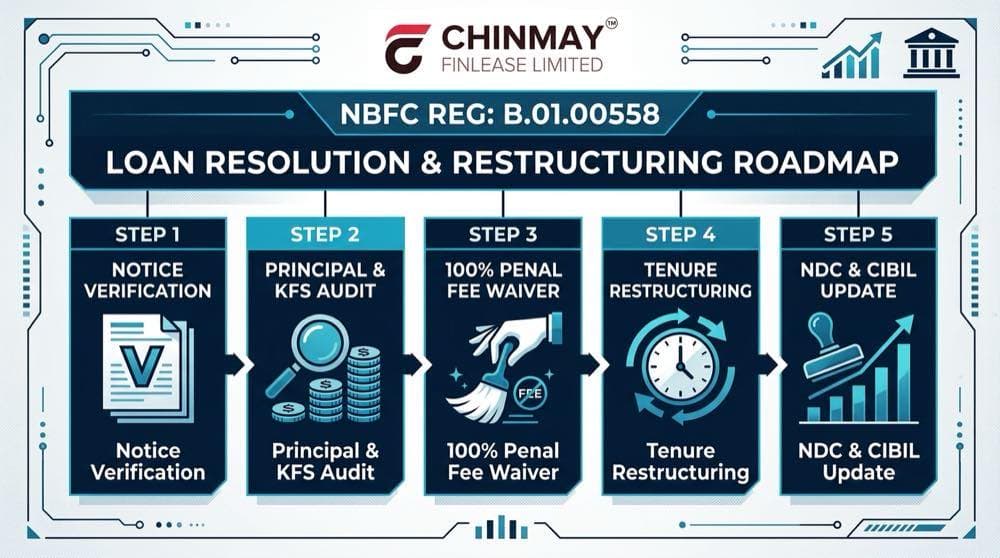
Chinmay Fin cannot offer loan haircuts. Therefore, loan restructuring is your best path to clear default. Restructuring changes your payment plan to match your current income.
You can ask to extend your loan tenure from 6 months to 12 or 18 months. This cuts your monthly EMI in half. It helps you pay steadily without new default marks.
Three Steps to Request Loan Restructuring- Write a formal letter explaining your hardship, such as medical bills or job loss.
- Suggest a practical monthly payment that you can afford on time.
- Email your request to the Grievance Officer at grievance@chinmayfinlease.com.
A formal restructuring agreement stops new penalty charges and prevents legal escalation.
10. Penal Interest & Late Fee Waivers: The Realistic Concession
Chinmay Fin will not reduce the loan principal. However, credit managers have full power to waive 100 percent of penal interest and bounce charges.
On loans overdue by 120 days, penalty fees often make up 30 percent of the total bill. Removing these extra fees gives huge financial relief.
Negotiation Strategy for Charge WaiversTell the credit manager you are ready to pay the real principal in a single payment or two installments. Ask for a complete waiver of all late fees and bounce penalties in return.
Always get this fee waiver confirmed on official company letterhead before you make any payment.
11. National Lok Adalat Conciliation for Small Loans
National Lok Adalats run every quarter across India under the Legal Services Authorities Act, 1987. They provide a calm, court guided place to solve loan disputes peacefully.
A sitting judge leads the Lok Adalat session. Lender officers have legal power to settle loans and waive extra fees on the spot.
Finality of a Lok Adalat AwardA Lok Adalat award acts as a final civil court decree under Section 21 of the Act. No one can appeal against it. Once you finish the agreed payments, the lender cannot file new claims against you.
You can visit your local District Legal Services Authority office to list your Chinmay Fin loan for the next Lok Adalat session.
12. Fraud Prevention & Safe Repayment Rules
Borrowers under stress face a high risk of payment scams. Fake recovery callers often demand payment to personal UPI numbers, promising fast account closure.
Follow three strict payment rules to keep your money safe.
- Never send money to an individual UPI address or private bank account. All payments must go to Chinmay Finlease Limited.
- Use only the official payment link inside the Chinmay mobile app or website.
- Always download an official receipt showing your loan account number and transaction ID.
Money paid to private accounts will not clear your loan. It leaves you open to more debt demands.
13. Closing the Account: No Dues Certificate (NDC) SLA
Making your final payment does not finish the loan process. Under RBI rules, lenders must give you a No Dues Certificate within 30 days of full payment.
For mutual fund loans, the lender must also remove all lien marks with the mutual fund registrar.
Mandatory Checkpoints on Your NDC LetterYour closure letter must show Chinmay Finlease Limited letterhead, corporate CIN, and authorized officer signatures. It must confirm zero dues left on the loan.
If the company does not send your certificate within 30 days, file a complaint with the RBI Banking Ombudsman for compensation.
14. Credit Bureau Restoration: Removing Default Marks Post-Closure
Defaulting on a personal loan lowers your credit score by 80 to 140 points. Credit bureaus like CIBIL and Experian record missed payments under Days Past Due columns.
When you pay the full principal under a restructured plan, your account is marked as CLOSED. It is not marked as SETTLED.
Why "Closed" Status Outperforms "Settled"A SETTLED mark shows that you did not pay the full loan. It stays on your credit report for up to seven years. It blocks you from getting new credit cards or home loans. A CLOSED mark shows full payment.
After you get your No Dues Certificate, check your credit report for 45 days. If an active default still shows, file an online dispute with your certificate attached.