Aye Finance MSME Loan Default: Zero OTS Stance & Borrower Defense
Aye Finance MSME & Hypothecation Borrower Defense Guide
Aye Finance follows a strict zero compromise rule. The firm demands full payment of all dues. Borrowers must reject fake telephone offers made by callers.
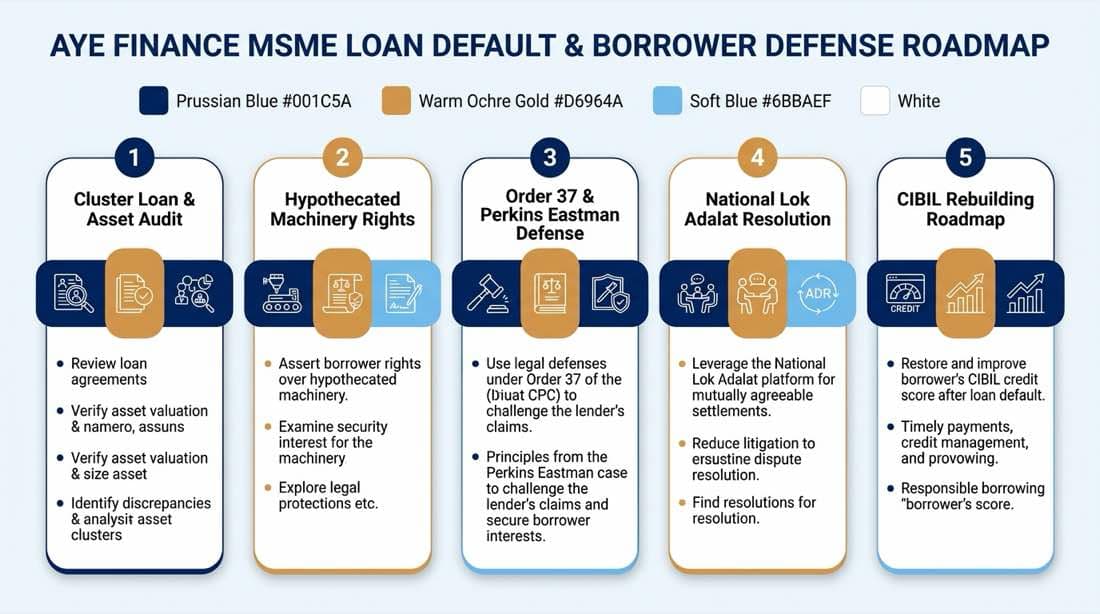
01. Aye Finance Operating Scale: Middle-Layer NBFC Architecture & Zero Waiver Mandate
Aye Finance is an NBFC based in Gurugram, Haryana. Its corporate identity code is L65921DL1993PLC283660. The firm is an RBI Middle-Layer lender. It manages over four thousand crore rupees in active loans. It runs four hundred field offices across eighteen states.
The firm raises capital from global equity funds. It also takes debt lines from domestic banks. These funding partners set rigid asset targets. Due to these debt terms, top managers ban loan cuts. Field staff must recover all principal dues in full.
State banks often grant seasonal loan discounts. Aye Finance sets aside no funds for debt relief on active files. Branch staff will turn down all compromise pleas. Knowing this policy shields shop owners from paying fraudulent middlemen.
02. Cluster Underwriting Mechanics: Why Micro-Manufacturers Struggle With High APR Debt
Commercial banks often reject informal production units. They demand tax records that small units lack. Aye Finance uses an on-site cluster lending system instead. Field staff inspect local hubs. They evaluate Agra shoe makers, Surat textile units, and brass artisans.
Agents check power bills to estimate monthly cash flow. They also review worker counts and raw stock. But these loans carry high yearly interest rates from 26% to 32%. During slow sales months, high monthly installments trigger sharp stress.
When a borrower misses a payment, software adds late fees. It also adds bounce costs. Over six months, these added fees inflate the total balance. Under Reserve Bank fair practice norms, stressed borrowers can request more time. They can write to the head office for fee relief.
Local branch agents cannot cut your loan balance. If your workshop faces cash drops, collect your electricity bills and sales records. Write to the Gurugram credit desk to ask for extended tenure.
Aye Finance Policy & Recovery Reality Check
Understand why Aye Finance currently denies OTS discounts and evaluate realistic resolution paths.
Submit business turnover records to the Gurugram Zonal Committee to request more time and a freeze on penal interest.
Referral to National Lok Adalat after long default allows waiver of penalty fees under Section 21 consent awards.
Supreme Court rulings in Prakash Kaur bar musclemen repossession. Taking workshop tools without written notice is unlawful.
03. Hypothecated Shop Assets: Legal Guardrails Halting Physical Equipment Seizure
Aye Finance business loans place a security claim on workshop tools. This charge covers industrial tools, sewing units, lathe cutters, and raw stock. This contract creates security rights under the Indian Contract Act of 1872.
When dues stay overdue past ninety days, recovery teams often threaten to take workshop tools. Some agents arrive with loading trucks. They threaten to cart machines away. Forcing entry without a court order breaches Indian law.
In landmark cases like Prakash Kaur (2007) and Shanti Devi (2008), the Supreme Court acted. Judges ruled that lenders cannot use brute force to take goods. Lawful asset recovery requires a written notice. Lenders must give borrowers fair time to pay. Any legal seizure also demands a signed inventory list.
04. Informal Property Collateral: Navigating Quasi-Mortgage Deeds & SARFAESI Ceilings
To grant larger loan sums, Aye Finance uses informal property papers. Small shop owners often hold ancestral land without registered deeds. They offer power of attorney papers or tax receipts instead.
The lender holds these unindexed property files during the loan term. When payments stop, callers often threaten prompt SARFAESI home auctions. In reality, these aggressive claims lack legal grounds.
Under central rules, NBFCs can only use SARFAESI Section 13 for debts of twenty lakh rupees or higher. Most Aye Finance loans stay below this mark. Also, SARFAESI action demands a registered mortgage on the CERSAI web portal. Informal papers cannot support swift property auctions without a civil court trial.
NBFC lenders cannot invoke SARFAESI on loans under twenty lakh rupees. Unregistered land papers cannot be auctioned without a full civil court hearing.
05. Bank Account Seizure Myths: Why NBFCs Possess Zero Section 171 Banker Lien Authority
Recovery callers often claim that Aye Finance will freeze your bank balance. They cite banker lien rules. These claims are false and have zero legal basis.
General banker lien provisions under Contract Act Section 171 apply solely to licensed banks. Aye Finance is an NBFC. It lacks a banking charter under the Banking Regulation Act of 1949. High court rulings confirm that NBFCs have no lien power over bank deposits.
Aye Finance cannot place debit holds on accounts at outside banks. It can only draw funds via your pre-authorized electronic mandate. Under central bank rules, you have the legal right to cancel active auto-debits directly with your home bank branch.
06. Delhi Order 37 Recovery Suits: Submitting Leave to Defend Against Summary Petitions
When accounts stay unpaid past one year, Aye Finance often starts legal action. The lender files summary suits under Order 37 in Delhi district courts. Cases often go to Tis Hazari, Saket, or Dwarka.
Order 37 is a fast civil court process for debt claims. When court summons arrive, you must act fast. If you fail to respond in time, the judge accepts the claim as true. The court enters an immediate decree against you.
Borrowers must file a Leave to Defend plea within ten days of notice. In your plea, explain your business troubles. Contest unfair late fees. Submit past payment receipts. When valid defenses exist, courts grant leave to defend. This opens the case to fair mediation.
Never ignore an Order 37 court notice from Delhi courts. Submit your Leave to Defend within ten days to fight inflated fees and prevent automatic court decrees.
07. Sole Arbitrator Challenges: Invoking Perkins Eastman Against Ex-Parte Proceedings
Aye Finance loan contracts often name Delhi or Gurugram as the arbitral venue. Following long payment gaps, the lender names a sole arbitrator alone. It acts without securing the borrower's consent.
Arbitral consent rules under Section 12(5) of the Arbitration Act make one-sided choices invalid. In Perkins Eastman and TRF Limited rulings, the Supreme Court spoke clearly. Judges held that an interested party cannot choose a sole arbitrator alone. An ineligible lender cannot pass that role to a nominee.
If you receive an unapproved arbitration notice, send a formal objection at once. Cite Section 12(5) and the Perkins Eastman verdict. Reject the chosen arbitrator. State that any one-sided award will be challenged in High Court under Section 34.
Aye Finance cannot pick an arbitrator without your consent. One-sided arbitration orders violate Section 12(5) and hold no legal validity in court.
08. Digital Mandate Dishonor: Handling Section 25 PSS Act & Cheque Bounce Summons
When electronic NACH transactions decline for want of cash, Aye Finance issues statutory notices. These notices fall under the PSS Act of 2007 (Section 25). For bounced paper cheques, the firm files complaints under the Negotiable Instruments Act (Section 138).
The company must obey strict legal time limits. A demand notice must be served within thirty days of the bank memo. The borrower then has fifteen days to pay. A court case can only begin if payment is not made within those fifteen days.
These cases are bailable financial matters focused on debt recovery, not jail time. When court summons arrive, attend the hearing with counsel to obtain immediate bail upon surrender. Because these statutory offenses are compoundable, judicial magistrates routinely recommend pre-trial conciliation.
09. Stemming Recovery Abuses: Criminal Intimidation Remedies Under Section 351 BNS
During active default cycles, third-party recovery teams sometimes resort to illegal harassment. Tactics include unannounced workshop visits and verbal abuse. Callers also place night phone calls and send fake court templates on chat apps.
Such harsh actions breach the RBI Fair Practices Code for NBFCs. Central bank rules limit calls to between 8:00 AM and 7:00 PM. Agents cannot use foul words. They cannot threaten family members or enter shops without identity cards.
Under the 2024 penal code (BNS), coercive recovery actions are statutory crimes. Section 351 of the BNS penalizes intimidating behavior. Issuing fake court notices violates Section 319 for Cheating. Trespassing on factory land violates Section 329. Retain audio recordings. Submit an FIR with local police. Log an official grievance on sachet.rbi.org.in.
10. Combating Telecaller Deception: Exposing Bogus 50% Verbal Concession Offers
Outsourced recovery callers face heavy monthly collection quotas. To extract fast money, agents often pitch unauthorized settlement deals on calls or text chats.
Callers offer a forty or fifty percent cut if you send cash right away via UPI. Borrowers who pay assume their debt is cleared. In truth, Aye Finance books these sums against late fees and bounce costs. The principal balance remains fully active.
Never transfer funds based on verbal claims or personal payment links. Aye Finance rejects informal deals. Any valid compromise requires a formal compromise letter on corporate stationery. The letter must have a verified number from the Gurugram office.
11. Portfolio Aging Dynamics: When Aye Finance Write-Offs Enable ARC or Legal Resets
Aye Finance maintains an unyielding non-settlement rule throughout the initial 180 days of non-payment. But balance sheet treatment shifts as overdue debts mature. Under central bank guidelines, debts unpaid for more than two years become loss assets.
Once old debts are fully written off on the books, collection costs yield low returns. At this later stage, the lender may assign bad loan files to Asset Reconstruction Companies. It may also refer files to Lok Adalat benches.
Small shop owners facing insolvency should avoid high-cost moneylenders to pay unmanageable dues. Keep your sales and tax records safe. Protect basic living funds. Resolve old debts when files move to judicial mediation or debt buyers.
Early default (0 to 180 DPD): Strict zero settlement rule requiring full principal dues. Late stage (720+ DPD loss asset): Debt write-offs open doors for ARC transfer or court mediation.
12. Statutory Lok Adalat Compromise: Securing Binding Decrees for Stressed Borrowers
The most reliable statutory forum for resolving overdue accounts with Aye Finance is the National Lok Adalat. Administered quarterly by NALSA across all judicial districts, these benches operate under the Legal Services Authorities Act of 1987.
Either the debtor or the lender can request the district panel to list a defaulted account before an upcoming session. Aye Finance sends authorized legal officers with power to sign agreements. The forum focuses on peaceful closure without court trials, often waiving penal fees in exchange for structured payment.
A signed settlement in Lok Adalat becomes an official Consent Award under Section 21 of the 1987 Act. This decree carries the full legal weight of a civil court decree. It is final and unappealable. It involves no judicial filing stamps. It permanently ends all pending court cases and machine seizure claims.
13. Hierarchical Grievance Escalation: Engaging Principal Nodal Officer Mithilesh Shukla
Borrowers facing agent harassment or seeking more loan tenure should not argue with branch staff. Aye Finance runs a four-step complaint system under RBI rules.
Start at Tier 1 with Customer Care by calling 1800-102-4040 or emailing customer.care@ayefin.com. The company must record your issue and reply within seven working days.
If unresolved after ten days, move to Tier 2: Grievance Cell at customer.complaint@ayefin.com. If still unresolved after fifteen days, escalate to Tier 3: Nodal Officer Mr. Mithilesh Shukla at Unitech Commercial Tower-2, Sector-45, Gurugram (email: nodalofficer@ayefin.com). If the firm fails to resolve your issue within thirty days, lodge a Tier 4 complaint with the RBI Ombudsman at cms.rbi.org.in or call 14448.
Tier 1: Customer Desk (1800-102-4040 | customer.care@ayefin.com) -> Tier 2: Grievance Cell (customer.complaint@ayefin.com) -> Tier 3: Nodal Officer Mithilesh Shukla (nodalofficer@ayefin.com) -> Tier 4: RBI Ombudsman (cms.rbi.org.in | 14448).
Aye Finance 4-Tier Escalation Matrix
Do not waste time arguing with recovery telecallers. Escalate your dispute directly through these statutory tiers.
Register your initial grievance ticket and request formal hardship review on your loan file.
Escalate unresolved Level 1 complaints and report illegal recovery harassment or machinery seizure threats.
Executive escalation desk for severe delinquency cases, illegal threats, and formal Zonal settlement representations.
Final statutory recourse if Aye Finance fails to resolve your grievance within 30 days or violates RBI Fair Practices.
Use this verified legal representation notice to demand cessation of agent harassment, assert Prakash Kaur repossession limits, and request restructuring or Lok Adalat referral.
To,
The Principal Nodal Officer & Grievance Redressal Cell,
Aye Finance Limited,
7th Floor, Unitech Commercial Tower-2, Sector-45, Arya Samaj Road,
Gurugram, Haryana 122003.
Email: nodalofficer@ayefin.com
CC: customer.care@ayefin.com, customer.complaint@ayefin.com

Subject: FORMAL GRIEVANCE NOTICE - UNLAWFUL COLLECTION HARASSMENT, SECTION 171 INAPPLICABILITY & REQUEST FOR RESTRUCTURING / LOK ADALAT REFERRAL
Loan Account Number: [YOUR_AYE_FINANCE_ACCOUNT_NO]
Product: Hypothecation Loan / Quasi-Mortgage / Micro-Enterprise Loan (MEL)

Dear Sir or Madam,

I write this formal grievance notice regarding my credit account with Aye Finance Limited. Empanelled recovery contractors and collection telecallers have engaged in coercive collection practices in violation of the RBI Master Direction on NBFC Fair Practices Code and Section 351 of the Bharatiya Nyaya Sanhita, 2024.

1. Machine & Asset Repossession Injunction Under Supreme Court Precedents: Recovery personnel have issued unlawful threats to forcibly seize factory machinery and workshop stock without due process. Under binding Supreme Court rulings in ICICI Bank v. Prakash Kaur (2007) and Shanti Devi Sharma (2008), lenders cannot use force or private musclemen to repossess assets. Any repossession without statutory pre-seizure notice, signed inventory certification, and post-seizure valuation memo violates the law.
2. Section 171 Banker Lien Inapplicability: Recovery callers have issued false threats claiming Aye Finance will invoke Section 171 of the Indian Contract Act, 1872 to freeze my commercial current account or personal savings. Aye Finance Limited is an NBFC, not a licensed banking company. Section 171 applies exclusively to banks. Aye Finance has zero statutory authority to freeze outside bank accounts or attach salary without a final civil court decree.
3. Perkins Eastman Arbitration Defense: Unilateral notices threatening sole arbitration proceedings in Delhi or Gurugram violate Section 12(5) of the Arbitration and Conciliation Act, 1996, and Supreme Court rulings in TRF Ltd and Perkins Eastman. I do not consent to any unilaterally appointed arbitrator.
4. Severe Commercial Hardship: Due to verified business disruption and cash flow distress, I cannot service compounding late fees, penal interest, and recurring NACH bounce charges.
5. Formal Relief Request: Under the RBI Fair Practices Code, I request immediate cessation of third-party recovery harassment, waiver of accumulated penal interest, and conversion of my overdue principal into an extended term restructuring, or formal referral of this file to the upcoming National Lok Adalat for an agreed consent decree under Section 21 of the Legal Services Authorities Act, 1987.

Please acknowledge this statutory notice within 7 working days with a formal grievance tracking number. If unlawful harassment persists, I will escalate this matter directly to the Reserve Bank of India Integrated Ombudsman on the CMS portal (cms.rbi.org.in).

Sincerely,
[Your Full Legal Name]
[Your Registered Business / Mobile Number]
[Your City, State]
14. Credit Bureau Rehabilitation: Repairing MSME Commercial Scores After Default
Missing payments on an Aye Finance facility damages your profile across credit information companies (CIC bureaus). The account is tagged as a defaulted asset. This mark lowers your commercial score and blocks fresh bank credit.
When an overdue account is cleared, whether by full payment or Lok Adalat order, get an official No Objection Certificate. The letter must confirm the debt is fully settled with zero balance left. Aye Finance must update credit bureaus within thirty days under RBI rules.
Rebuilding credit takes steady effort. Open a small credit card backed by a fixed deposit to build a fresh repayment track. Keep credit use under thirty percent. Check your bureau reports every three months to ensure closed loans show no balance.
15. Aye Finance Borrower Protection: Essential Answers on Settlement & Rights
Does Aye Finance approve loan settlements or principal waivers for defaulters?+
No. Aye Finance enforces a zero compromise rule. The firm requires full recovery of all principal sums. Branch officers hold zero power to approve balance cuts.
Why are external collection agents promising a 50% discount on my Aye Finance debt?+
Callers make fake phone deals to earn quick cash. Aye Finance never approves verbal pacts. Money sent without an official letter goes to penal costs.
Can Aye Finance representatives enter my factory and seize hypothecated machinery without a warrant?+
No. The Supreme Court in Prakash Kaur barred forced tool seizures. Lenders must issue formal notices. They must also take signed inventories first.
Can Aye Finance initiate SARFAESI property auctions for defaulted micro-loans?+
No. Central rules permit NBFCs to use SARFAESI only on debts over twenty lakh rupees. Smaller shop loans with informal papers cannot be sold off.
Is Aye Finance legally empowered to freeze my savings account at external commercial banks?+
No. Banker lien powers under Section 171 belong strictly to licensed banks. As an NBFC, Aye Finance cannot freeze your deposits at outside banks.
How should an MSME borrower respond to an Order 37 summary suit filed by Aye Finance in Delhi?+
Submit a Leave to Defend plea within ten days of summons. Detail your business stress. Contest arbitrary late charges to secure a full trial.
Can I challenge an arbitrator appointed unilaterally by Aye Finance in Gurugram?+
Yes. Under the Perkins Eastman rule, one-sided arbitrator choices are void under Section 12(5). Borrowers can send written objections to stop hearings.
Does a bounced NACH mandate lead to immediate arrest by the police?+
No. Mandate dishonor under Section 25 is a bailable financial matter. Defaulters can secure same-day bail before the judge and pursue conciliation.
What legal steps can I take against collection agents who intimidate my family or staff?+
Record every abusive call. Intimidation violates Section 351 of the BNS penal code. Lodge a police report. Submit an alert on the RBI Sachet portal.
At what stage can a distressed Aye Finance borrower reach an actual compromise?+
During early default, the lender demands full dues. After two years of non-payment, debts become loss assets. Accounts can then settle via Lok Adalat.
Facing Machine Seizure or Delhi Court Summons from Aye Finance?
Our legal team helps business owners stop illegal machinery seizures, file Leave to Defend in Order 37 suits, and resolve debts via National Lok Adalat.
Get Free MSME Debt Strategy ConsultationFind this content helpful?
If this guide has helped you navigate your settlement journey, consider showing some support to keep this platform running.